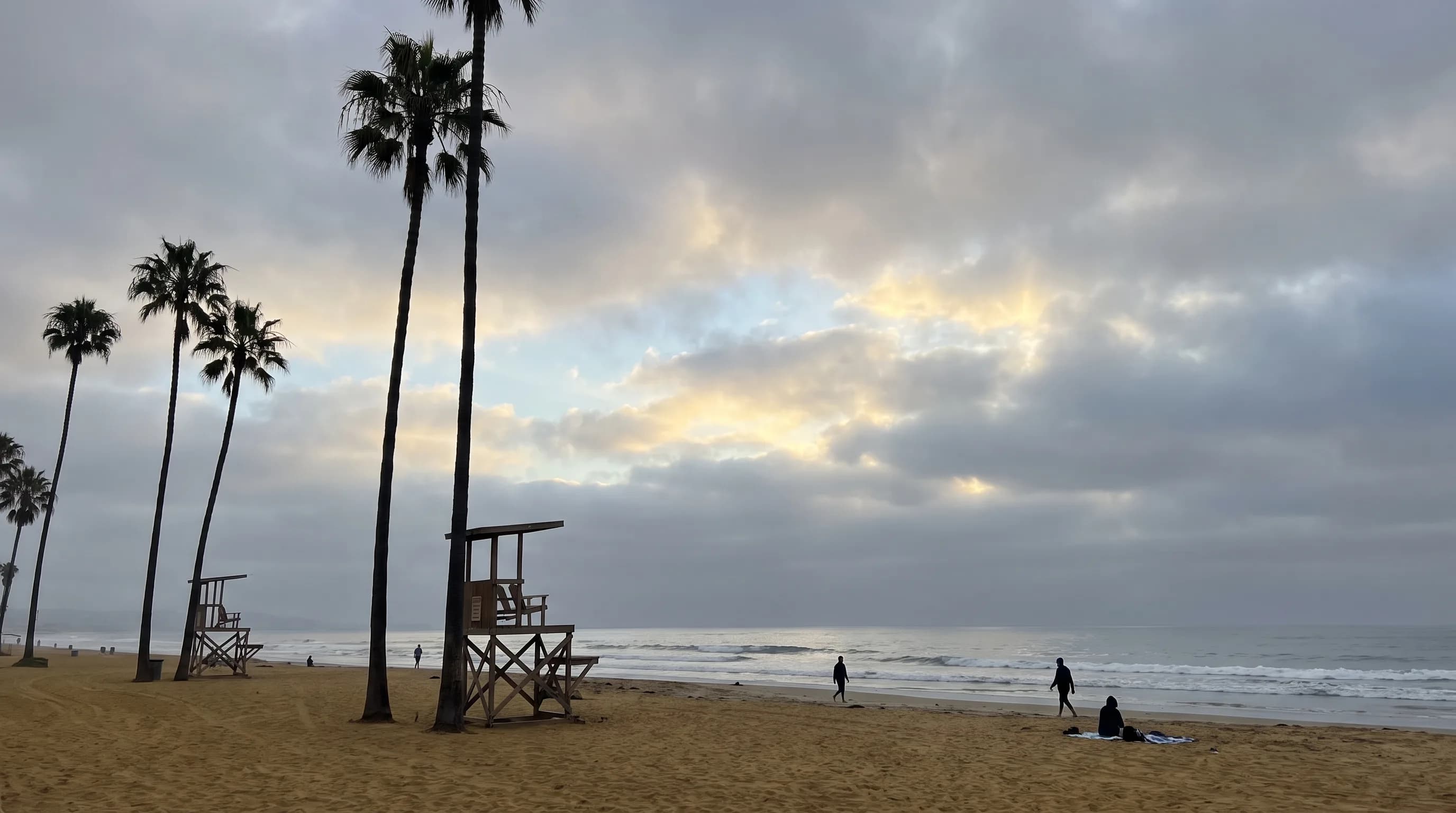
Santa Monica is mild all year. Average highs run from about 66°F in winter to 76°F to 77°F in August and September, and lows from about 48°F to 63°F. From May through July, mornings often start gray under the marine layer and usually clear by afternoon. The ocean is warmest, about 70°F, in August and September, and nearly all of the city's 13.45 inches of yearly rain falls from November to March.
Santa Monica's steady weather is appealing, but it can mislead visitors. At 9 a.m. on a typical June day, Santa Monica has about a 59% chance of a low gray ceiling overhead. By 3 p.m., that falls to about 15%. Most June days do become sunny beach days, but usually only after lunch.
What Is the Weather Like in Santa Monica Each Month?
Santa Monica's weather is cool, steady and bright for most of the year, with a gray stretch in early summer and a short rainy season in winter. The ocean keeps it that way. Santa Monica sits right on the water, so the sea breeze keeps summer afternoons cool and winter nights mild. Average highs vary by only about 11 degrees across the year, one of the narrowest in Los Angeles.
| Month | High / low (°F) | Rain (in) | Gray at 9 a.m. | Water (°F) |
|---|---|---|---|---|
| January | 66 / 49 | 3.28 | 15% | 59 |
| February | 66 / 49 | 3.34 | 14% | 59 |
| March | 66 / 51 | 2.09 | 20% | 60 |
| April | 68 / 53 | 0.56 | 32% | 60 |
| May | 69 / 57 | 0.26 | 55% | 63 |
| June | 71 / 60 | 0.08 | 59% | 66 |
| July | 75 / 63 | 0.04 | 51% | 69 |
| August | 77 / 63 | 0.01 | 38% | 70 |
| September | 76 / 62 | 0.14 | 38% | 69 |
| October | 74 / 58 | 0.55 | 32% | 67 |
| November | 70 / 52 | 0.76 | 18% | 63 |
| December | 66 / 48 | 2.34 | 17% | 60 |
Air: NOAA 1991-2020 normals, Santa Monica Airport. Gray: share of days with a ceiling below 3,000 ft at 9 a.m., 2019-2025. Water: NOAA Santa Monica Pier gauge, 2014-2025.
How Gray Is June Gloom in Santa Monica?
June Gloom leaves Santa Monica gray most mornings and clear most afternoons. From 2019 to 2025, a ceiling below 3,000 feet covered Santa Monica at 9 a.m. on 55% of May days, 59% of June days and 51% of July days. By 3 p.m., only 18%, 15% and 5% of those days were still gray. Most mornings clear between late morning and early afternoon as the sun warms the land and thins the cloud deck, though on some days in May and June it never clears at the beach at all.
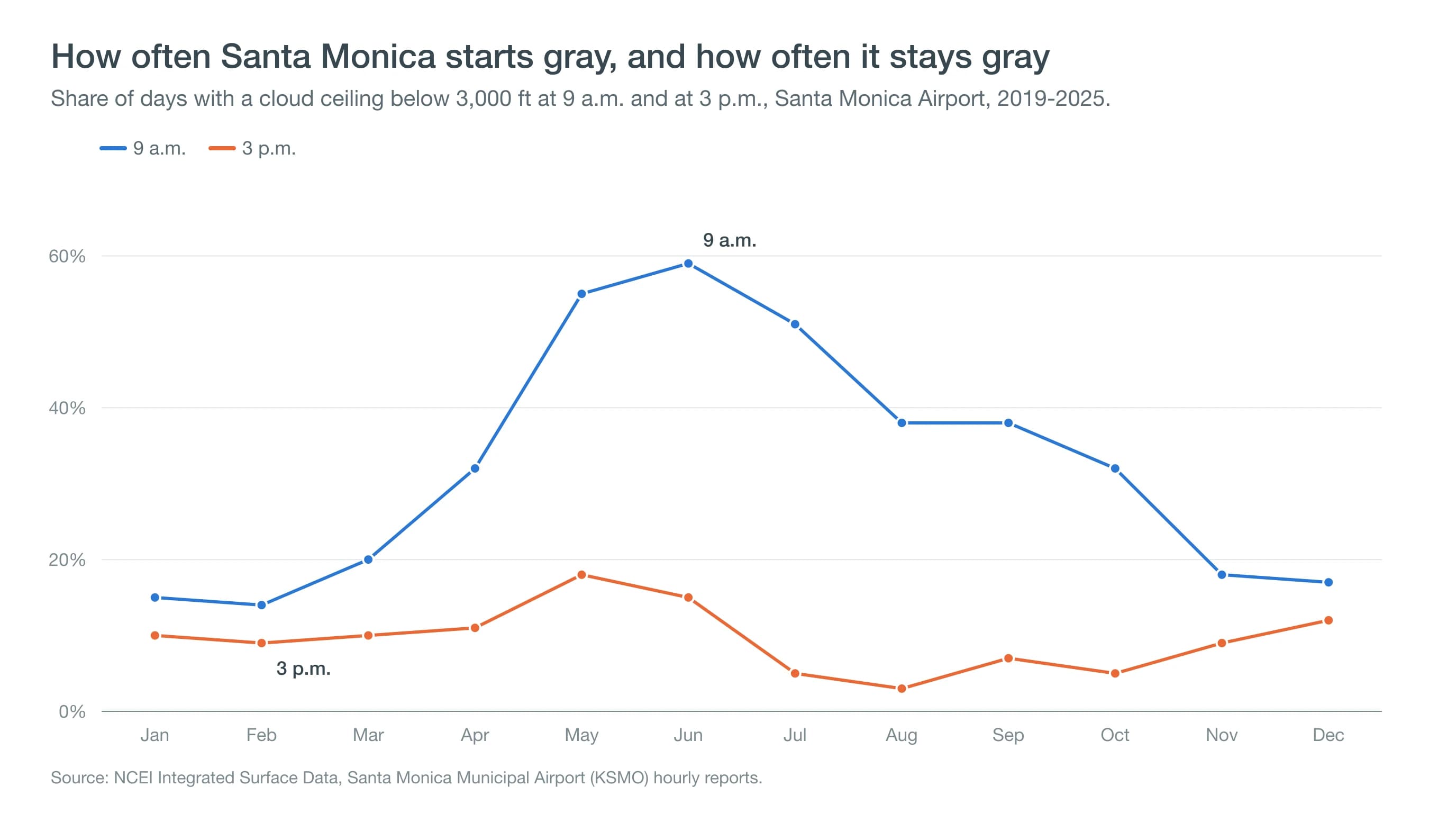
The gray is the marine layer, a sheet of cool, moist ocean air capped by warmer air above, and it is deepest and lasts longest in late spring. The science and the nicknames are explained in May Gray and June Gloom and LA's marine layer. Gray mornings return in fall, too, at 32% to 38% of 9 a.m. readings from August through October, but they clear faster: by 3 p.m. in August, only 3% of days are still overcast. Clear evenings over the open Pacific are also the best chance to see the green flash at sunset.
When Is the Best Time for a Beach Day in Santa Monica?
The best time for a beach day in Santa Monica is late July to early October. Afternoons are the sunniest of the year, and the Santa Monica Pier water gauge averages 69°F to 70°F in August and September, compared with about 66°F in June and 59°F in winter.
In May, June and early July, plan the beach for the afternoon. From August on, mornings work too. Monthly water temperatures are in LA ocean water temperatures. Some summers bring red tides that make breaking waves glow blue at night.
Choose your spot carefully. Heal the Bay's 2025-26 Beach Report Card put the water at Santa Monica Pier second on its statewide "Beach Bummer" list for the fifth year in a row. Swim well away from the pier and storm drains, and stay out of the ocean for at least 72 hours after rain. Bring sunscreen even on gray days; the UV index can run high under thin cloud.
How Cold Does Santa Monica Get at Night?
Santa Monica gets cool at night, but rarely cold. Lows average about 48°F in December and January and about 63°F in August. The breeze off the water makes evenings feel cooler than the number, especially on the pier after sunset, when cool air moves in off the ocean.
Carry a light jacket or sweater for dinner on Ocean Avenue or a walk down the Third Street Promenade in every month of the year. Full lists are in what to pack for Los Angeles by month.
Does Santa Monica Ever Get Hot?
Santa Monica occasionally gets hot, almost always in fall. Santa Monica averages about five days a year at 90°F or hotter, and from 1999 to 2025 September and October accounted for more than 60% of them.
The cause is offshore wind, often Santa Anas, which blocks the sea breeze and lets inland heat reach the coast. Fifteen of the 27 Octobers in that span had at least one 90°F day. The station's record is 103°F, set on September 27, 2010, the same day Downtown hit its all-time high.
Even then, Santa Monica is usually the coolest place around. On a typical August afternoon, the San Fernando Valley runs 15 to 20 degrees warmer or more, as the LA weather by neighborhood guide shows, which is why the beach fills up on hot inland days.
When Does It Rain in Santa Monica?
Santa Monica's rain falls from November to March. Those five months bring almost 12 of Santa Monica's 13.45 inches, with about six days of measurable rain a month from December through February. From May to September, rain is rare, though a deep marine layer can leave a little drizzle on some late-spring mornings. After a storm, stay out of the ocean for three days because of runoff.
Timing makes the difference in Santa Monica. Come in late summer or early fall for the warmest water and the sunniest afternoons, plan June beach time for after lunch, and bring a layer for the evening. Check the hourly forecast for Santa Monica and neighboring Venice Beach before you go.