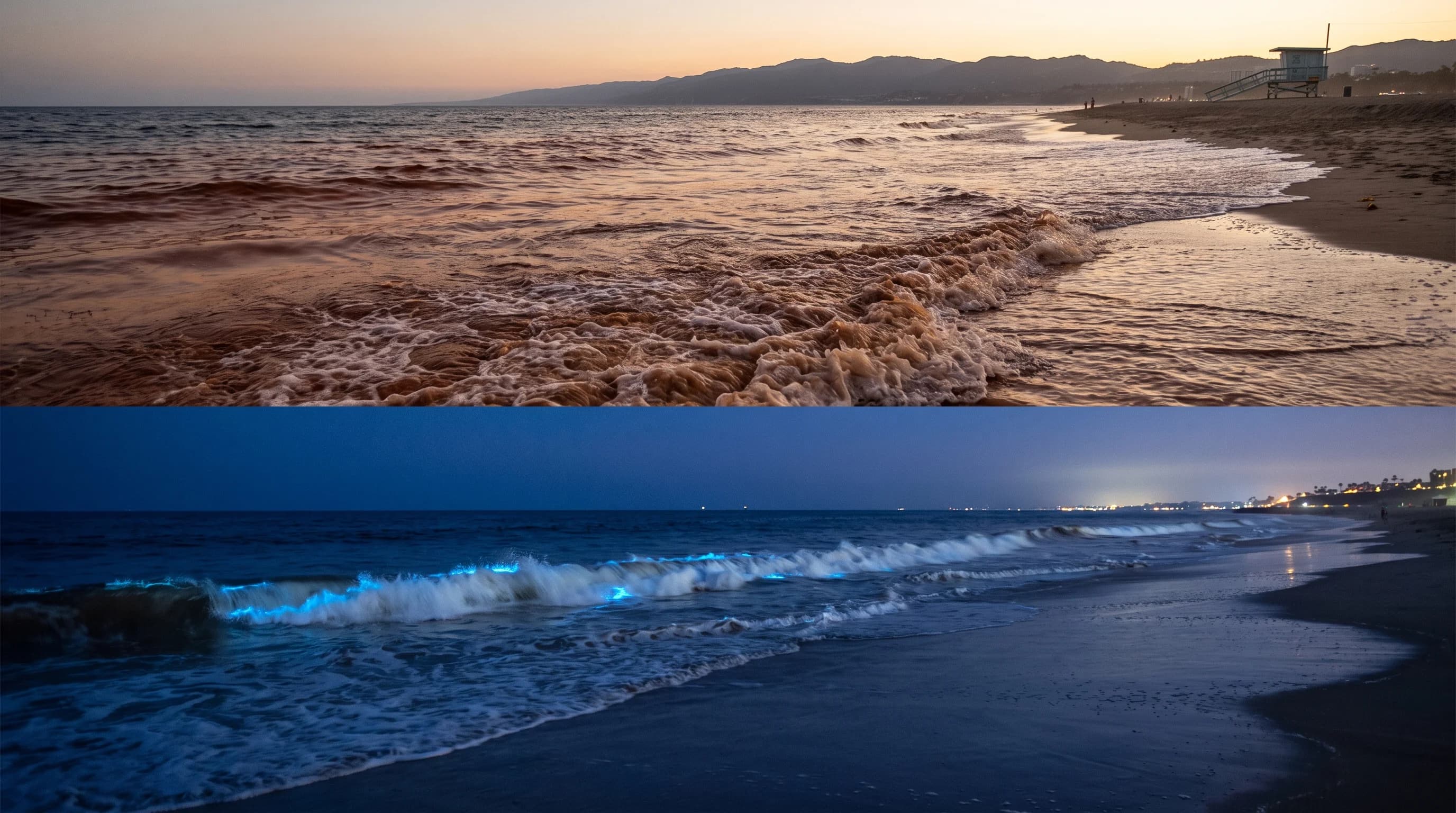
A red tide is a dense bloom of microscopic algae, usually single-celled organisms called dinoflagellates, that multiply fast enough to discolor coastal water. Off Southern California beaches like Santa Monica and Malibu, red tides usually tint the water reddish-brown by day. At night, if the bloom includes a bioluminescent species, breaking waves glow electric blue wherever the water is disturbed. The color and the glow are separate effects of the same organisms, and neither shows whether a bloom is producing harmful toxins.
What Is a Red Tide?
A red tide is the common name for a dense, visible algal bloom, a sudden concentration of phytoplankton in coastal water. The name comes from early reports of reddish-brown water, and it is informal, not scientific. Scientists at the NOAA Ocean Service prefer "harmful algal bloom," because many dense blooms are neither red nor harmful.
Bloom color depends on which organism is multiplying and how dense it gets. Off Southern California, the main bloom-forming dinoflagellates are usually Lingulodinium, Akashiwo and Ceratium. They can tint water rust red, deep brown or murky green, depending on cell density and light.
Some blooms barely change the water's color and show up only in water samples. Color is a clue, not a diagnosis: a red-brown tide is not automatically toxic, and an uncolored bloom is not automatically safe.
| Time of day | What you typically see | What it tells you about safety |
|---|---|---|
| Daylight | Reddish-brown, rust-colored, or murky green discoloration, often strongest in surf zones, harbors, and bays where the bloom concentrates | Color alone does not confirm toxicity; treat any visibly discolored water as a reason to check local advisories, not a confirmed hazard |
| Dusk / low light | Color fades from view as light drops; no glow yet since bioluminescence needs full darkness to be visible | A transition window; conditions are the same bloom as daytime, just harder to see |
| Full darkness | Blue-white glow along breaking wave crests, surfboard wakes, and footprints in wet sand, visible only where the water is mechanically disturbed | The glow itself is not a health signal in either direction; a bloom can glow and still be non-toxic, or lack visible bioluminescence and still carry a toxin-producing species |
| Any time | Dead fish, foam, or a sulfur-like smell near shore | A stronger signal of bloom-related oxygen depletion or die-off; check county water-quality postings before entering the water |
What Causes a Southern California Bloom?
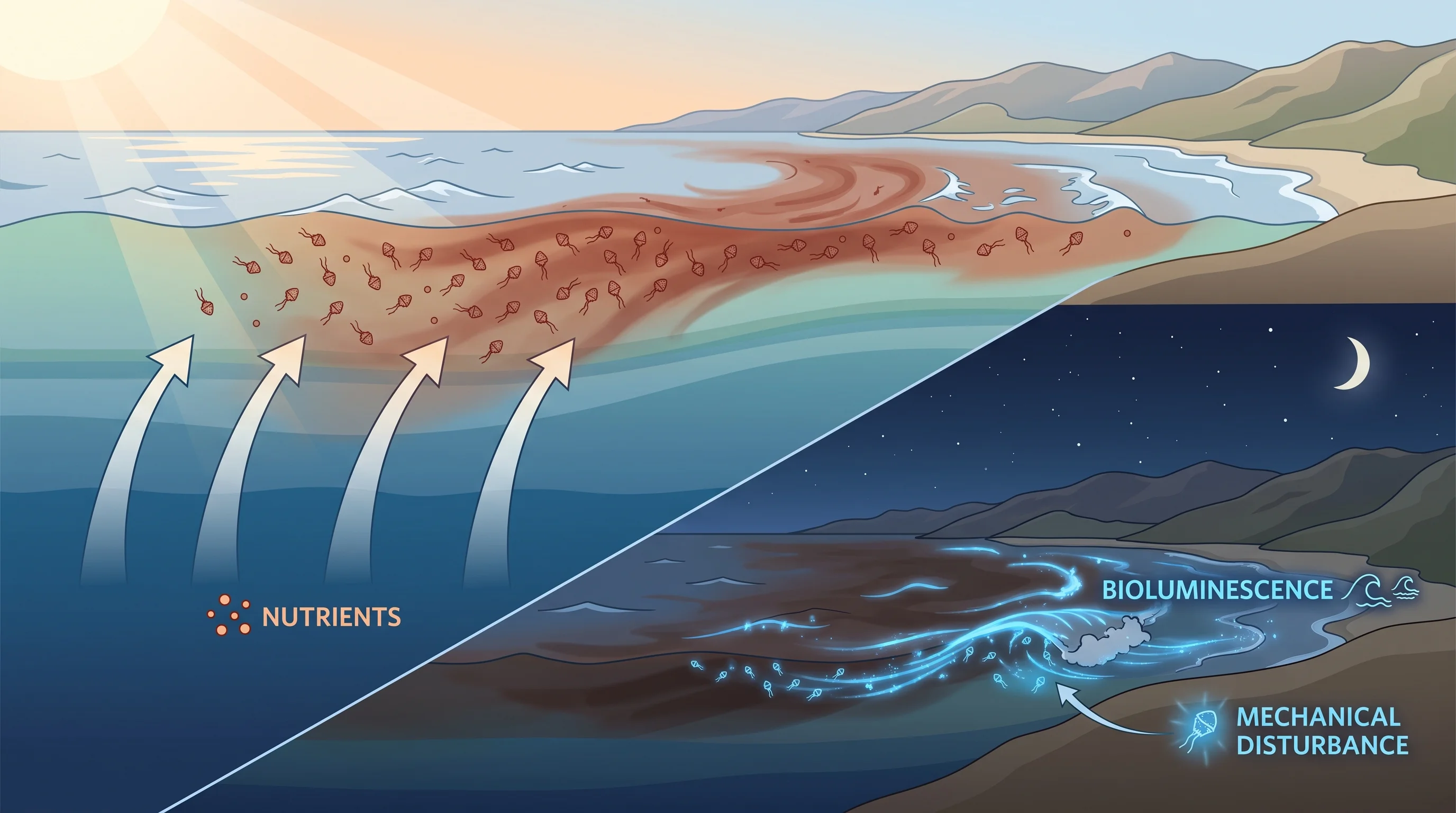
A Southern California bloom forms when dinoflagellates already in the water get nutrients, light, warmth and calm water at the same time; no single factor is enough. Coastal upwelling, when wind pushes surface water offshore and draws nutrient-rich deep water up, is a major nutrient source, especially in spring and early summer. Those nutrients, mainly nitrogen and phosphorus, fuel fast algae growth when they meet strong sunlight and a calm, layered water column that keeps algae near the surface.
Warm, still conditions favor blooms because they slow the mixing that would spread the algae out. Once cells are abundant, nearshore currents and wind can pile a bloom against beaches, into bays or inside harbors.
A bloom can look much denser in one cove than a few miles away on the same day. Upwelling, water temperature and currents change week to week, so no calendar date predicts a bloom. The NWS Los Angeles/Oxnard office and NOAA Tides and Currents track the ocean conditions behind blooms, but neither issues bloom forecasts.
Why Do Some Waves Glow Blue?
Waves glow blue when a bloom includes a bioluminescent dinoflagellate, most often Lingulodinium polyedra along the Southern California coast, and something disturbs the water. The glow is a defense response. A breaking wave, a swimming fish, a paddling surfboard or a footstep in wet sand triggers a chemical reaction inside each cell that makes a brief flash of blue-white light. Millions of cells flashing in one breaking wave make the surf look lit from within.
The light appears only where the water moves, so the glow traces a wave's churning edge, a boat wake or a hand dragged through the water, and fades in still water. Seeing it requires real darkness. Moonlight, fog that scatters city light and nearby streetlights can wash it out even during an active bloom.
Is Every Red Tide Harmful or Bioluminescent?
Not every red tide is harmful or bioluminescent. "Red tide," "harmful" and "bioluminescent" describe three different properties that can overlap.
A bloom can discolor water without toxins or glow. A completely non-toxic bloom can glow spectacularly at night. A harmful bloom, one that produces toxins, depletes oxygen as it dies or otherwise harms marine life, can occur with or without discoloration and with or without glow.
Pseudo-nitzschia, for example, rarely causes red color or blue glow but can produce domoic acid, a toxin that builds up in shellfish and can sicken marine mammals, birds and people who eat contaminated seafood. Lingulodinium polyedra, the usual cause of Southern California's glowing waves, is generally not linked to domoic acid. A dying bloom of any species can still deplete oxygen and kill fish in enclosed harbors and bays. Toxicity depends on the species, not color or glow, so only an official water-quality test shows what a bloom is doing.
When and Where Are Glowing Waves Visible?
Glowing waves appear in episodes, lasting days to a few weeks during an active Lingulodinium bloom, then disappearing for months or years. Glowing waves have no fixed season or guaranteed yearly event. Past blooms have glowed at points from San Diego County to Ventura County, including near Santa Monica and Malibu. A glow at one beach does not mean beaches a few miles away see the same, because currents concentrate blooms unevenly.
Seeing the glow needs three things together: an active bioluminescent bloom, real darkness with little moonlight or city light and moving water to trigger it. Clouds, a full moon or calm, glassy surf can hide the glow even during a confirmed bloom. No source, including WeatherLA, can promise a sighting on a given night, because blooms shift faster than any schedule. Watch for recent, dated local reports during an active bloom instead of planning a trip months ahead.
How Should Beachgoers Check Safety?
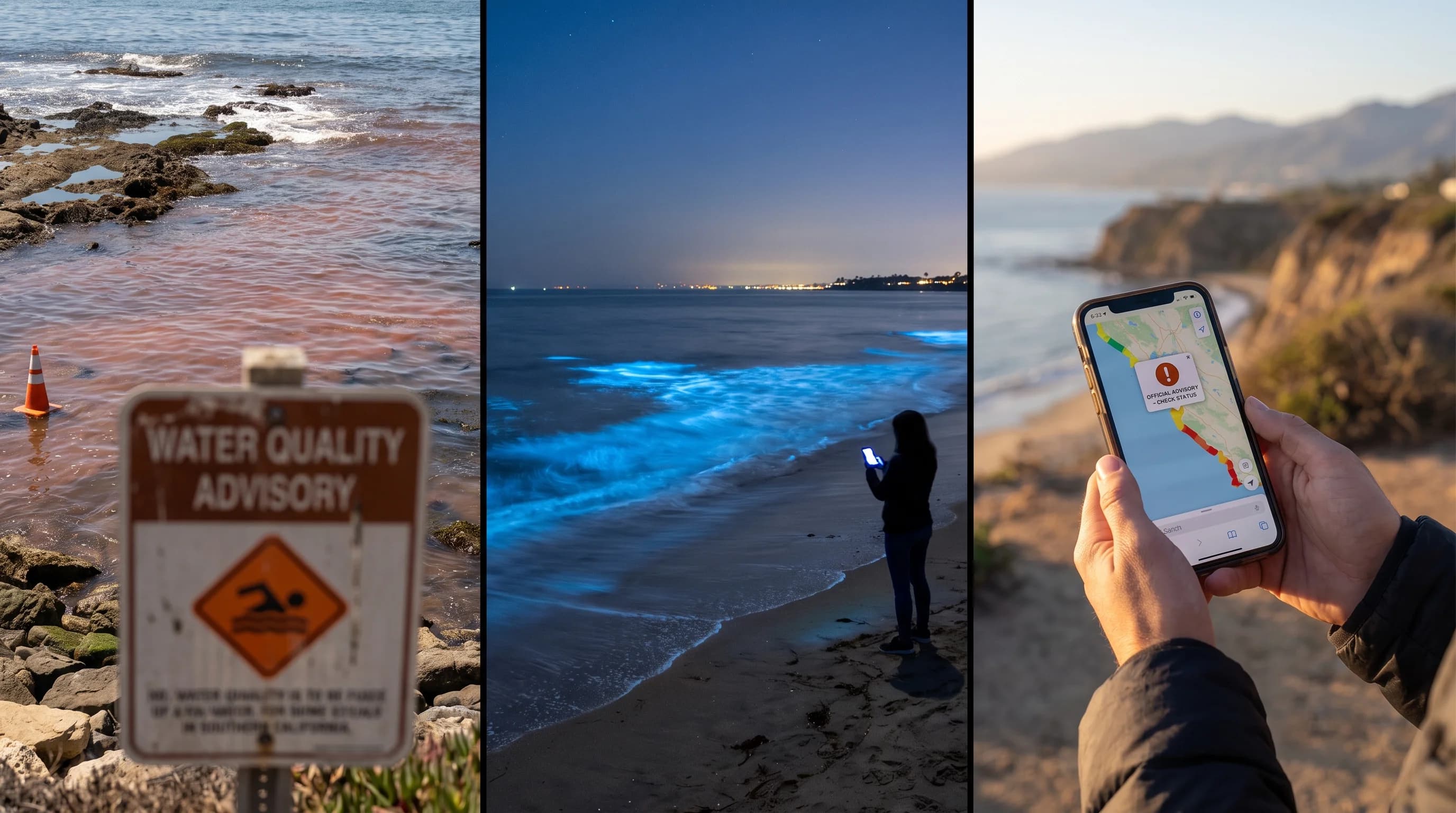
Before swimming during or after a visible bloom, check your county's official water-quality postings and public health advisories, not the water's color or glow reports. Los Angeles County Beaches and Harbors and the Los Angeles County Department of Public Health post current beach advisories, and neighboring counties run their own systems. These postings come from actual water sampling, the same system used to flag bloom concerns, not from social media sightings.
A glowing wave is a viewing report, not a safety clearance, and the absence of glow or color does not prove water is free of a harmful bloom. If you notice unusual water color, a strong sulfur-like smell, foam or dead fish on the shore, check the current advisory before swimming or surfing. Do not harvest or eat shellfish from an area under a bloom advisory. Some bloom species concentrate toxins in shellfish that cooking does not remove.
Surf and currents are separate from bloom risk; see the NWS Beach Hazards guidance. Inland heat that makes a beach day tempting is covered in what is wet-bulb temperature. A colored or glowing tide does not change a beach's normal wave hazards, such as the surge described in what is a sneaker wave.
How Long Does a Red Tide Last, and Is It Safe to Swim?
How long does a red tide last? A Southern California red tide usually lasts several days to a few weeks, sometimes longer, until nutrients run out, water temperature shifts or wind and currents scatter the cells. The same bloom can fade in one exposed cove while lasting in a sheltered bay nearby.
Can you swim in red tide water? Whether you can swim in red tide water depends on the species and the current county water-quality advisory for that beach.
Some blooms only change the water's color and bring no restriction. Others prompt an official advisory because of toxins or bacteria. Check the posted advisory for the specific beach.
Does red tide have a smell? A strong red tide, especially a dying one, can smell sulfur-like or fishy as algae decompose and use up oxygen. Not every bloom smells, and a bloom without odor is not necessarily milder or safer.
A red tide off Southern California produces two separate spectacles, daytime color and nighttime glow, and neither tells you whether the water is safe. Before a night trip to Santa Monica or Malibu to see the glow, or a beach day during a bloom, check your county's water-quality advisory. Check WeatherLA's Los Angeles forecast pages for the clouds and moon conditions that decide whether the glow will be visible after dark.