beach weathersafetyphenomenatips

Sneaker Waves: The One Wave That Reaches Dry Sand

By WeatherLA|Published |Last updated |10 min read
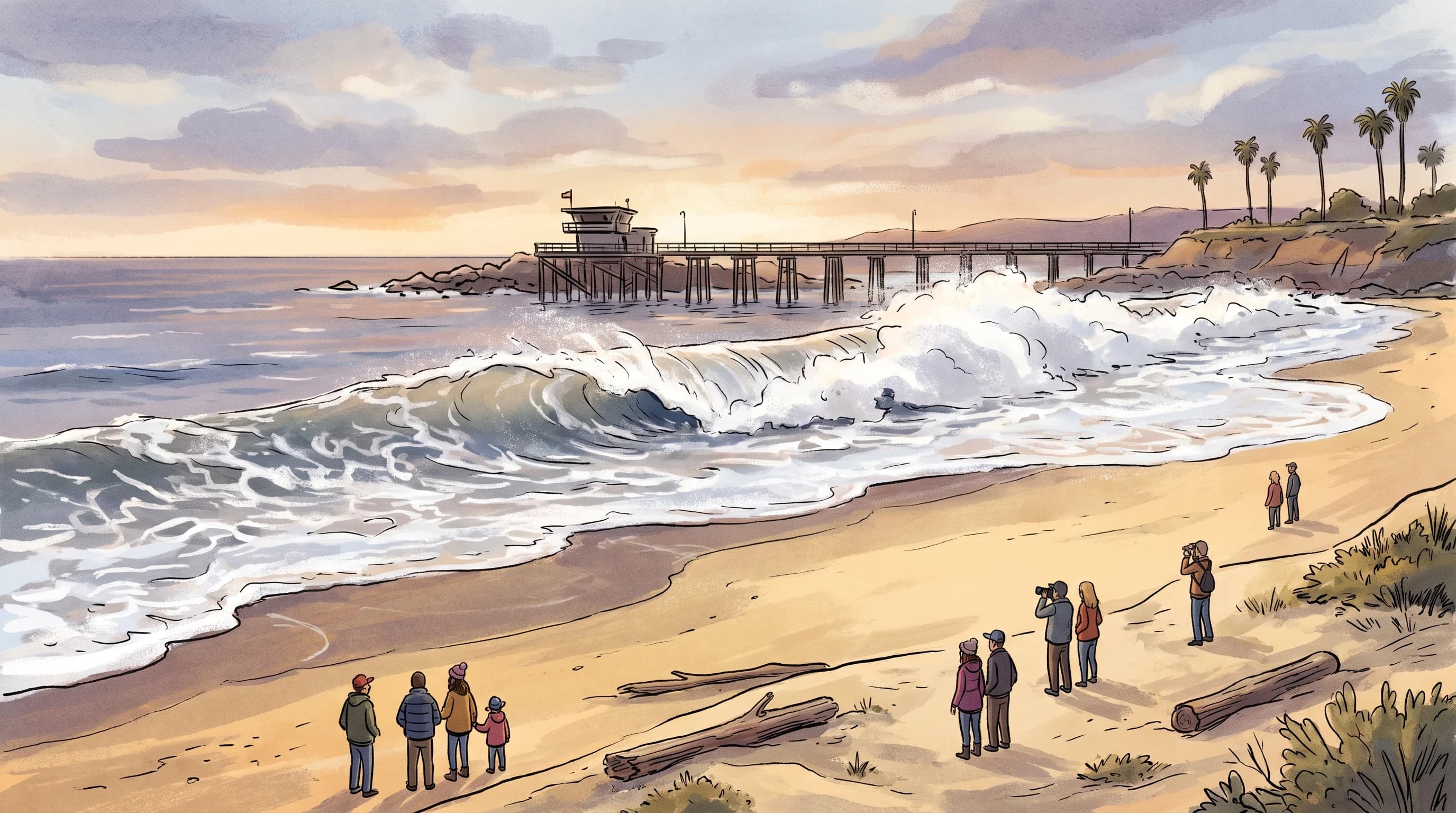
A long-period wave surging higher onto a Southern California beach than the preceding set, while visitors remain well back on dry sand beyond the reach of the water

Key Takeaways

  • A sneaker wave is the one wave in an otherwise ordinary set that surges much farther up the beach than the waves before it, catching people who are standing on dry sand, not swimming.
  • Wave grouping and long-period swell mean a calm few minutes of small waves can be followed by a noticeably larger wave from the same set, without any reliable moment-to-moment warning.
  • Steep beaches, rocky points, jetties, and cliff-backed coves carry the highest risk because they shorten the distance to dry ground and can temporarily trap people between the water and a rock wall.
  • Moving water only a foot or two deep can knock an adult off their feet, and cold Pacific water adds the risk of cold shock during any sudden, unexpected immersion.
  • A sneaker wave, a rogue wave, and a tsunami are three different hazards: shoreline run-up, an open-ocean statistical extreme, and a seismic or landslide-driven surge, each with its own cause and its own official guidance.
  • The core defense is behavioral: never turn your back on the ocean, treat wet sand as part of the active surf zone, and check the current NWS High Surf and tide guidance before walking out onto rocks or a jetty.

A sneaker wave is an unexpectedly large wave that runs much farther up a beach than the waves that came right before it, catching people standing on what looked like dry, safe sand. It is not a bigger version of the wave set you have been watching for the last ten minutes. It is the one wave in that set that breaks differently, carries more water, and keeps pushing up the sand well past the line the ocean had been holding. Along Malibu and Santa Monica, sneaker waves are the reason lifeguards and the National Weather Service keep repeating the same warning: never turn your back on the ocean, even when it looks calm.

What is a sneaker wave?

A sneaker wave is a wave, or occasionally a short run of two or three waves, that surges noticeably higher and farther up a beach than the pattern established by the waves immediately before it. The name describes the effect, not a fixed wave height: it "sneaks" past the mental boundary a beachgoer has drawn based on the last several minutes of wave behavior. Someone standing on dry sand, taking photos near the water's edge, or walking along a rock shelf between sets can be knocked down or swept toward the water by a sneaker wave without ever having stepped into the surf.

This is fundamentally a shoreline run-up hazard, not a current and not an offshore phenomenon. The water that surprises people arrives by climbing higher up the beach face than expected, then pulling back with real force. The National Weather Service beach hazards guidance groups sneaker waves with high surf and rip currents as one of the leading causes of ocean-related injuries and drownings along the Pacific coast, precisely because so many victims never intended to get in the water at all.

Four Coastal Hazards Southern California Beachgoers Confuse
HazardWhat actually happensWhere it catches people off guardTypical trigger
Sneaker waveOne wave surges far up the beach, well past the run-up line of the waves before itOn dry sand, rocks, or logs, not in the waterWave grouping and long-period swell arriving in sets
Rip currentA narrow channel of water flows swiftly seaward through a gap in a sandbarAlready in the surf zone, swimming or wadingBreaking waves piling water up that must drain back out
Rogue waveA single open-ocean wave at least double the surrounding sea heightOffshore, mainly affecting vessels and platformsWave interference, crossing swells, or opposing currents
High surfOverall breaking wave heights are elevated across an entire coastal zoneAnywhere along an exposed beach for the event's durationA distant storm sending a large, sustained swell

Why can a larger set arrive after calm-looking surf?

Ocean waves rarely arrive at uniform height. Swell energy tends to bunch into groups, so a run of smaller waves is often followed by a run of larger ones, then smaller again, in a cycle that can take several minutes to complete. Someone who watches the ocean for only a minute or two can easily sample a lull and conclude the surf is small and safe, without ever seeing the larger set that is still a few minutes out.

Long-period swell adds to the unpredictability. Waves generated by storms far out in the Pacific arrive with more time between crests than locally generated wind chop, and that extra period lets them carry more energy to the shoreline and break with more force and more run-up than a wind-driven wave of similar height. Two wave trains with slightly different periods or directions can also interfere with each other as they approach a beach, occasionally reinforcing into a single larger wave in a way that is not predictable wave by wave, even though the overall swell forecast is well understood.

None of this means a specific sneaker wave can be forecast in advance. It means the underlying physics guarantee that any beach with real swell will occasionally produce an outsized wave, which is exactly why the safety guidance is about position and awareness rather than about timing.

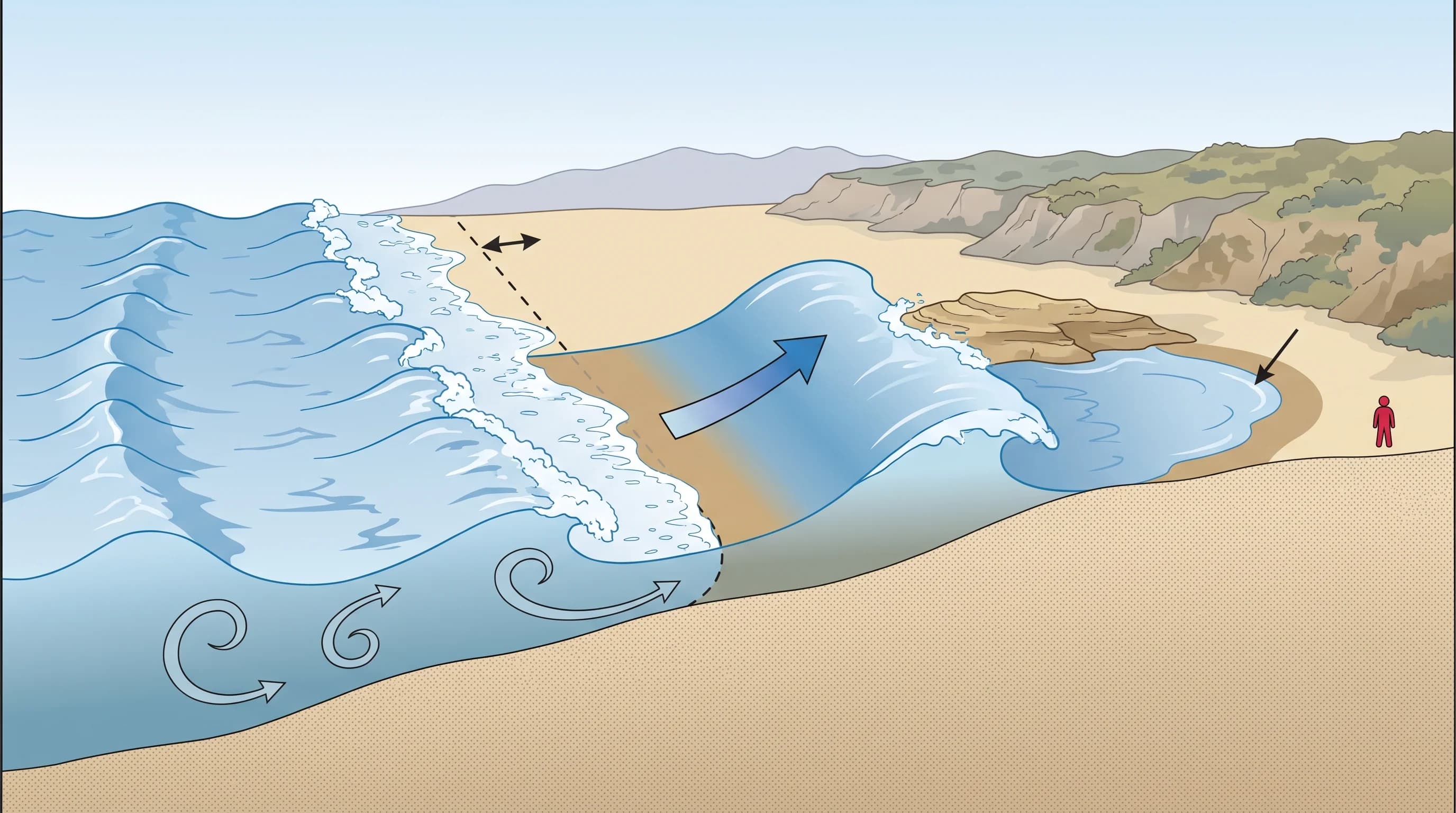
A diagram showing a sequence of smaller ocean waves arriving on a beach followed by one larger wave from the same set that shoals and surges much farther up the sand, temporarily surrounding a low rock and cutting off a small cove
Wave energy arrives in groups. A quiet stretch of small waves can be followed within minutes by a taller wave from the same set that runs far past the previous high-water mark.

Where can Southern California visitors be exposed?

Exposure is highest anywhere the beach profile or shoreline shape gives a sneaker wave a clear path to run and gives a person little room to retreat. Steep or narrow beaches shorten the distance between the normal high-water mark and dry sand where people stand, so a larger-than-usual wave reaches spectators faster and with less warning than it would on a wide, flat beach. Rocky points, jetties, and low rock shelves are a particular concern because visitors climb out onto them specifically to get closer to the water for photos or tide pooling, standing on wet, slick rock with an open path for a surge to sweep them off.

Coves and pocket beaches backed by cliffs carry a second layer of risk: a sneaker wave or a run of high surf can temporarily cut off the only exit path, trapping people between the water and the rock wall behind them with nowhere dry to retreat. Stretches of coastline around Malibu and Santa Monica mix wide sandy beaches with rockier points and piers, so conditions that are genuinely low-risk on the open sand can be considerably more dangerous a short walk away on nearby rocks. Driftwood logs deserve the same caution as rocks: a log that looks like a stable place to sit can be picked up and rolled by a surge with enough force to cause serious injury.

Why are sneaker waves powerful?

Moving water carries far more force than most people expect, even at shin or knee depth. A fast-moving surge just a foot or two deep can be enough to knock an adult off their feet, and once someone is down, the backwash pulling that same water back toward the ocean can drag them across sand, rock, or shell with real speed. The danger compounds when the surge crosses rocks, logs, or other beach debris, since a fallen person can be struck by material the wave is also carrying.

Cold water adds another layer of risk along the Southern California coast. Pacific water temperatures off Los Angeles County stay markedly cooler than air temperature for most of the year, and unexpected full-body immersion, even briefly, can trigger cold shock: involuntary gasping, a spike in heart rate and blood pressure, and a brief loss of muscular control that makes it harder to swim or simply stand back up. Combine cold shock with being knocked down in the surf zone and swept toward rocks, and a wave that looked merely surprising from the beach becomes genuinely dangerous within seconds.

How is one different from a rogue wave or tsunami?

A sneaker wave, a rogue wave, and a tsunami are three separate hazards, and confusing them leads to the wrong response. A sneaker wave is a shoreline event: one wave in an otherwise ordinary set that runs unusually far up the beach, catching people who are standing on sand rather than swimming. A rogue wave is an open-ocean, statistically defined event: a single wave at least double the significant wave height of the surrounding sea, generated by wave interference or opposing currents far from shore, and it is primarily a hazard to ships and offshore platforms rather than to people on a beach.

A tsunami is a different physical process entirely, caused by a sudden displacement of the entire water column from an earthquake, undersea landslide, or volcanic eruption, and it arrives as a surge or series of surges that can keep rising for many minutes, not a single wave that recedes normally. Tsunamis trigger official evacuation orders and a dedicated warning system; sneaker waves do not, because they are a routine, if unpredictable, part of ordinary surf. The full mechanics of West Coast tsunami risk, including how it differs from every wave hazard on this page, are covered in can a tsunami hit Southern California.

General elevated wave heights across a whole stretch of coast, which raise the odds of encountering a sneaker wave but describe a broader event, are covered in high surf in Los Angeles, and the separate hazard of a seaward-flowing current in the water is covered in what is a rip current.

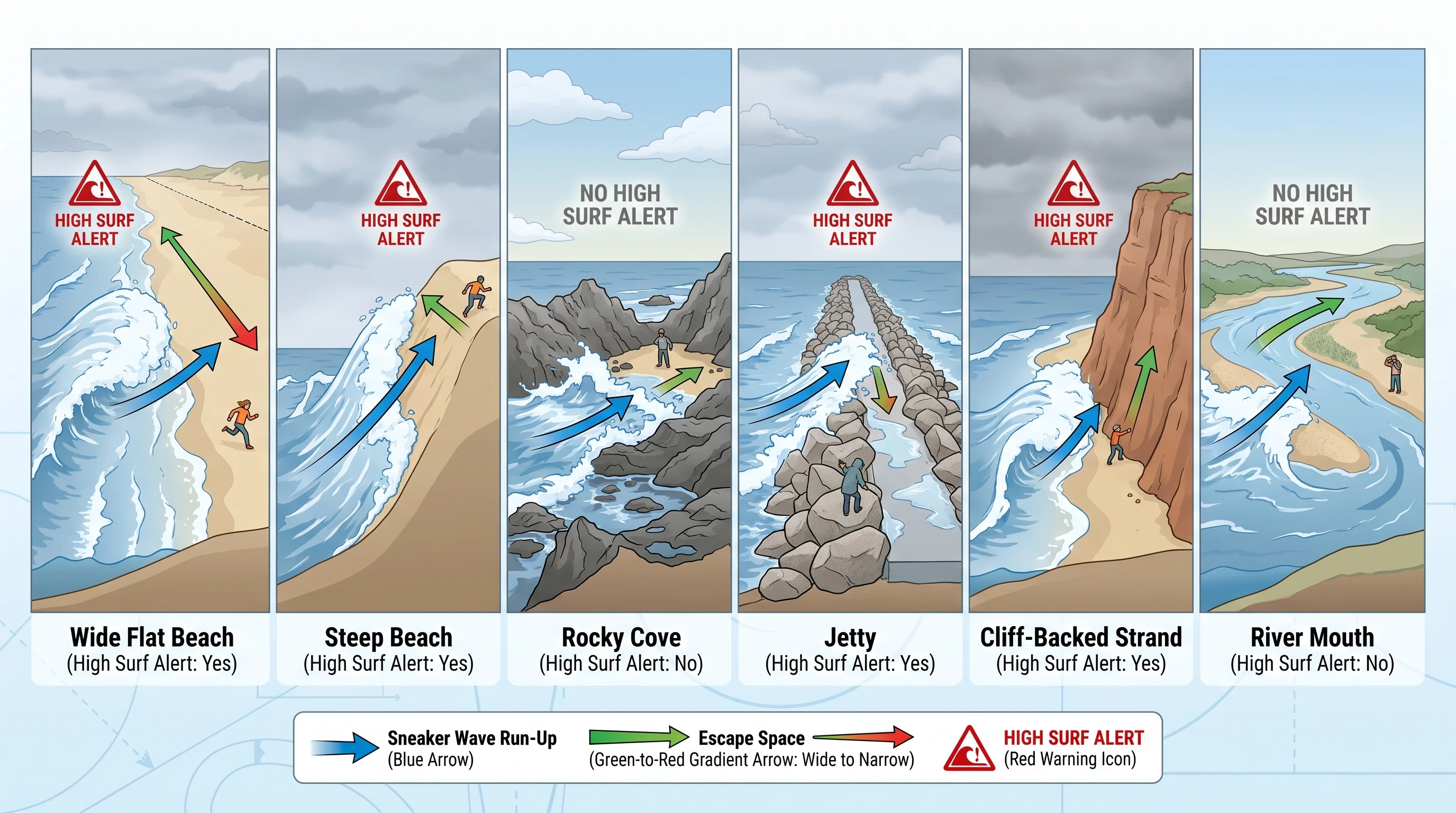
A shoreline comparison graphic showing a wide flat beach, a steep beach, a rocky cove, a jetty, a cliff-backed strand, and a river mouth, each labeled with relative escape space and whether a High Surf alert is in effect
Escape room varies a lot by shoreline type. A wide, flat beach gives people time and space to react to a sneaker wave; a rocky cove or jetty often does not.

How should beachgoers position themselves?

The core rule from coastal safety agencies is simple: never turn your back on the ocean, and keep a real setback distance from the waterline, especially on rocks, jetties, logs, or any narrow beach. Treat wet sand as part of the active surf zone rather than as safe ground, since wet sand is exactly the area a sneaker wave's run-up reaches first. Before walking out onto any rock shelf or jetty for a closer look or a photo, watch the wave pattern for several minutes rather than a few seconds, and identify a dry, elevated escape route before you need one.

Children and pets need extra distance because a surge that only wets an adult's ankles can fully submerge or sweep a small child or dog, and both tend to be drawn toward the water's edge exactly where the risk concentrates. Check the current NWS Los Angeles/Oxnard or NWS San Diego forecast for any active High Surf Advisory or Warning before a beach trip, since sneaker wave risk climbs sharply during these events even when the sky overhead is clear and sunny.

Tide stage matters too: a King Tide or unusually high astronomical tide, trackable through NOAA Tides and Currents, reduces the normal buffer of dry sand between the waterline and the base of a cliff or seawall. Finally, follow posted lifeguard flags and beach closure signage, and if you are knocked down by a surge, get your feet under you and move away from the water as soon as the wave recedes rather than pausing to gather belongings.

What should you do if a sneaker wave catches you?

Sneaker waves keep surprising even experienced beachgoers because the danger sits on dry sand, not in the surf most people are watching for. A few quick answers cover what to do in the moment.

If you see a sneaker wave surging toward you, the priority is to get vertical distance and move away from the water and away from rocks and logs rather than trying to outrun it in a straight sprint up loose sand. If you are knocked down, curl up, protect your head, and try to get your feet under you as the water pulls back, then move immediately to higher, dry ground since another wave in the same set can follow within seconds to minutes. Not every beach carries equal risk: wide, flat, sandy beaches with a large buffer of dry sand see far fewer serious sneaker wave incidents than steep beaches, rocky coves, and jetties, where the same wave arrives with less warning and less room to escape.

Sneaker waves are ordinary physics, not a rare freak occurrence, which is exactly why they catch so many visitors off guard along the Los Angeles County coast. Before your next trip to Malibu, Santa Monica, or any exposed beach, check swell height, swell period, tide stage, and any active High Surf alert on WeatherEscape's Los Angeles forecast pages, then keep real distance from rocks, jetties, logs, and steep shoreline no matter how calm the water looks when you arrive.

Frequently Asked Questions

What is a sneaker wave?

A sneaker wave is a wave, or occasionally a short run of two or three waves, that surges noticeably higher and farther up a beach than the pattern set by the waves right before it. It is a shoreline run-up hazard that catches people standing on what looked like dry, safe sand, not a hazard that requires being in the water.

Why can a larger set arrive after calm-looking surf?

Wave energy arrives in groups, so a run of smaller waves is often followed by a run of larger ones in a cycle that can take several minutes to complete. Someone who watches the ocean for only a minute or two can easily sample a lull and conclude the surf is small, without seeing the larger set that is still on its way in.

Where can Southern California visitors be exposed?

Steep or narrow beaches, rocky points, jetties, and low rock shelves carry the highest exposure because they shorten the distance between the normal high-water mark and where people stand, and often remove any easy escape route. Cliff-backed coves and pocket beaches add a second risk: a sneaker wave or a run of high surf can temporarily cut off the only dry exit path.

Why are sneaker waves powerful?

Moving water carries far more force than most people expect, and a fast-moving surge only a foot or two deep can knock an adult off their feet, with backwash then dragging a fallen person across sand or rock. Cold Pacific water adds cold shock risk, an involuntary gasping and heart-rate spike triggered by sudden, unexpected immersion that makes it harder to recover and stand back up.

How is a sneaker wave different from a rogue wave or tsunami?

A sneaker wave is a shoreline event, one wave in an ordinary set that runs unusually far up the beach. A rogue wave is an open-ocean, statistically defined event, a single wave at least double the surrounding sea height, generated far from shore and mainly a hazard to ships. A tsunami is caused by a sudden displacement of the entire water column from an earthquake, landslide, or eruption, a distinct physical process with its own dedicated warning system.

Can you see a sneaker wave coming?

Sometimes, but not reliably. A slightly darker, taller swell line approaching from farther out can be a clue, but wave grouping and long-period swell mean the specific wave that will surge unusually far up the beach cannot be predicted with confidence from the shoreline. That uncertainty is exactly why the safety guidance focuses on staying back from the water rather than trying to time an escape.

What should you do if you are caught by a sneaker wave?

Curl up, protect your head, and try to get your feet under you as the water recedes, then move immediately to higher, dry ground, since another wave in the same set can follow within seconds to minutes. Avoid grabbing at rocks or structures with sharp edges or heavy debris nearby, and once you are clear, put real distance between yourself and the waterline before checking on belongings or anyone else.

Do all beaches have sneaker waves?

Any beach exposed to real ocean swell can produce a sneaker wave, since the underlying cause, wave grouping and long-period swell, applies broadly along the Southern California coast. Risk is not equal everywhere, though: wide, flat, sandy beaches with a large buffer of dry sand see far fewer serious incidents than steep beaches, rocky coves, and jetties, where the same wave arrives with less warning and less room to escape.

Related Destinations

Live Los Angeles Conditions

Compare temperature, wind, clouds, and comfort across the map.

See which microclimates are clear, cool, windy, smoky, or warming up right now.

Open the Weather Map
Destinations☀️Smog Forecast🌫️Smog Heat Map🔒Privacy Policy📄Terms of Service