beach weathersafetyphenomenaclimate science

Rogue Waves Are Statistical Freaks, Not Big Surf

By WeatherLA|Published |Last updated |9 min read
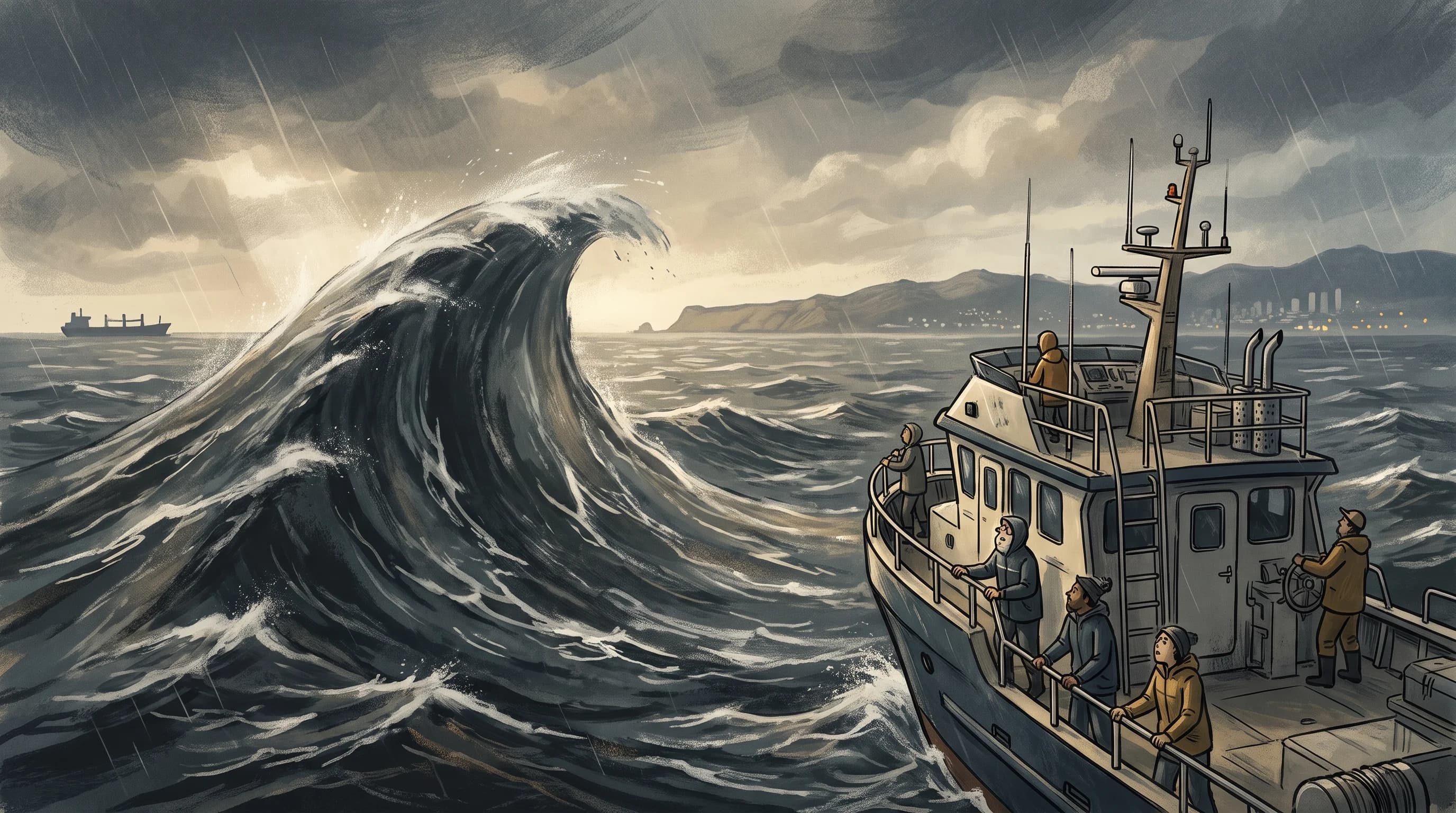
An offshore Southern California research or cargo vessel encountering one steep wave notably larger than the surrounding seas, shown without a cinematic wall of water

Key Takeaways

  • A rogue wave is defined statistically: a single wave at least twice the significant wave height of the surrounding sea state, not simply any unexpectedly large breaker.
  • Rogue waves form from constructive interference, opposing currents, wave-energy focusing, and nonlinear wave dynamics, often with more than one mechanism acting together.
  • Confirmed rogue wave encounters come mainly from ships, offshore platforms, and instrumented buoys, since only those observers can measure a wave against its surrounding sea state at the same time.
  • Forecasters can flag sea states with elevated rogue wave risk, such as crossing swell trains, but they cannot predict the timing, location, or height of one specific wave.
  • Rogue waves, sneaker waves, and tsunamis are three distinct hazards with different causes, different locations, and different levels of official forecasting, and conflating them leads to the wrong safety response.
  • The National Weather Service Los Angeles/Oxnard and San Diego offices issue marine forecasts and High Surf products that address sea-state and nearshore risk, which is the actionable local tool, rather than any rogue-wave-specific alert.

A rogue wave is a single wave that towers over the surrounding sea, typically defined as at least twice the significant wave height of the waves around it. Rogue waves form offshore, usually far from the coast, when multiple wave trains, currents, or storm systems interact in ways that stack energy into one exceptional crest rather than spreading it evenly across the sea surface. They are a real, measured ocean phenomenon, not folklore, but they are also not the same thing as the shoreline sneaker waves that catch beachgoers off guard at Santa Monica or Malibu, and they have nothing to do with tsunamis.

What Is a Rogue Wave?

A rogue wave, sometimes called a freak wave in older oceanographic literature, is defined statistically rather than by a fixed height in feet. Oceanographers measure the significant wave height of a sea state, which is the average height of the highest one-third of waves passing a point over a given period, and a wave qualifies as rogue when it reaches at least double that significant wave height. That threshold matters because it means a rogue wave is always unusual relative to what is already happening around it. A 20-foot wave in a sea state where most waves run 5 to 8 feet is a dramatic outlier and would qualify; the same 20-foot wave during a major winter swell where 15-foot waves are already common would not.

This statistical framing separates rogue waves from ordinary big surf. A large storm can push every wave in a set higher, and Southern California surfers and lifeguards deal with that kind of elevated sea state routinely. A rogue wave is different in kind: it is one wave, appearing with little warning, that stands well above its neighbors rather than the whole sea state simply running larger. The NOAA Ocean Service tracks rogue waves as a documented open-ocean hazard, distinct from coastal surf hazards that the National Weather Service handles through beach and marine products.

Rogue Wave vs. Sneaker Wave vs. Ordinary High Surf
HazardWhere it occursWhat causes itCan it be forecast?
Rogue waveOpen ocean, usually well offshoreWave interference, opposing currents, and focusing that stack energy into one crestSea-state risk only, not the single wave itself
Sneaker waveShoreline, at the water's edgeAn unusually large run-up wave surging much farther up a beach than the waves before itGeneral beach hazard advisories, not a single wave
Ordinary high surfNearshore, breaking on the sandbar or reefDistant storm swell raising the entire wave set, not one anomalous crestYes, via NWS High Surf Advisories and Warnings
TsunamiBasin-wide, from source to coastlineSudden displacement of the water column from an earthquake, landslide, or eruptionYes, via tsunami warning systems once triggered

How Can One Wave Become Unusually Large?

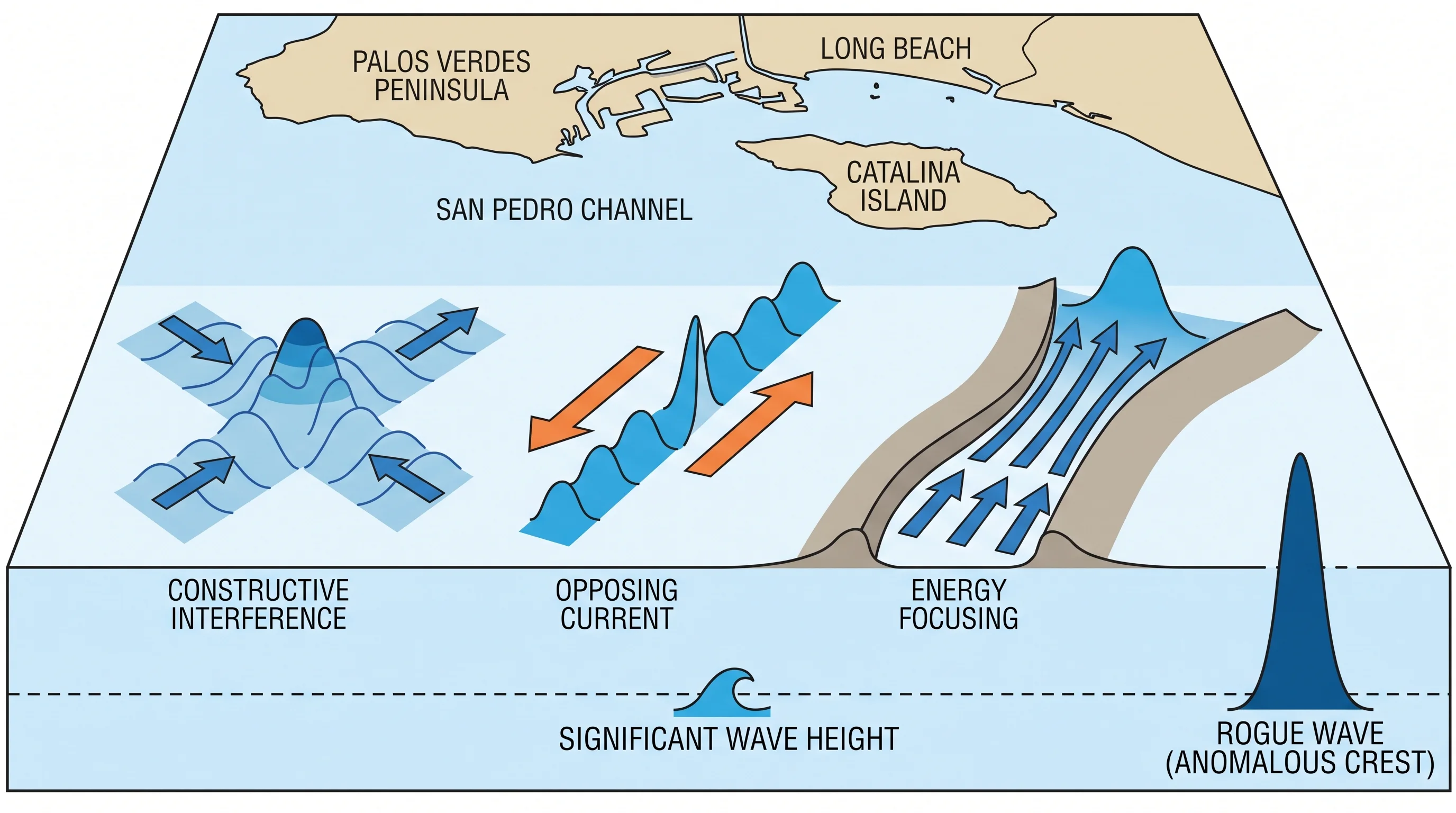
Oceanographers point to several contributing mechanisms rather than one settled recipe, and more than one can act at the same time. Constructive interference happens when two or more wave trains, often generated by different storm systems or traveling from different directions, cross paths and briefly align crest to crest, adding their heights together for a short distance before separating again. Opposing currents can steepen waves sharply: when a wave train moves against a strong current, such as where swell meets the edge of a fast-moving current system, wave energy compresses into shorter, taller crests.

Underwater or current-driven focusing works like a lens, bending wave energy from a broad front into a narrower zone where individual waves gain height. Nonlinear wave dynamics, where wave energy transfers between neighboring waves in a group in ways that simple linear wave theory does not fully predict, can also let one wave in a group briefly draw energy from the waves around it.

None of these mechanisms guarantees a rogue wave, and none of them announces itself in advance to an observer on a ship or shoreline. That combination, a real physical process with a probabilistic rather than deterministic outcome, is why rogue waves remain understood in principle but unpredictable in the specific moment they will appear.

A wave-field diagram showing constructive interference between two crossing wave trains, a wave train steepening against an opposing current, current-driven focusing of wave energy into a narrow zone, and a labeled significant-wave-height reference line for comparison
Rogue waves are not caused by one single mechanism. Interference between wave trains, opposing currents, and energy focusing can each independently stack height into a single anomalous crest.

Can Rogue Waves Occur Off Southern California?

Yes, rogue waves are a recognized open-ocean and maritime hazard in the waters off Southern California, though they are documented primarily through ship encounters and maritime and offshore research rather than everyday shoreline observation. The conditions that support rogue wave formation, crossing swell trains, current interaction, and complex wave fields, occur in the North Pacific, and vessels operating off the California coast fall within the same general ocean-hazard framework that the NWS Los Angeles/Oxnard office and the NWS San Diego office use for offshore and coastal waters marine forecasting.

It is important to be precise about what counts as evidence here. A dramatic wave breaking over a jetty at Malibu or surging across a beach parking lot during a big swell is very likely ordinary high surf or a sneaker wave, not a rogue wave in the technical sense, because rogue waves are a statistically defined open-ocean event measured against surrounding sea state, and most viral beach videos do not include the wave-height record needed to make that comparison. Confirmed rogue wave encounters are almost always reported by ships, oil platforms, or offshore buoys with instrumentation capable of recording the surrounding sea state at the same time, which is a very different observation than a shoreline camera catching one big breaker.

Can Forecasters Predict an Individual Rogue Wave?

No. Forecasters can identify sea states where rogue wave formation is statistically more likely, such as when multiple swell trains from different storms cross paths or when swell runs against a strong opposing current, but they cannot predict the timing, location, or height of one specific crest. This is a probability problem, not a precision problem: the physics of rogue wave formation involves enough randomness in how individual wave trains happen to align that no forecast model resolves down to a single wave days, hours, or even minutes in advance.

What forecasters and mariners actually rely on is sea-state risk. Marine forecasts from NWS describe combined seas, swell height, swell period, and swell direction for offshore waters, and a forecast calling for complex or converging swell trains is a signal that the sea state carries elevated risk of an anomalous wave, even though no specific wave can be named in advance. Treating a favorable-looking forecast as a guarantee that no oversized wave will appear misunderstands how this hazard works.

How Is a Rogue Wave Different From a Sneaker Wave or Tsunami?

These three hazards get confused constantly, but they differ in where they happen, what causes them, and how they can be tracked. A rogue wave is an open-ocean, statistically defined event: one wave that is anomalously large relative to the surrounding sea state, generated by wave interference, currents, or focusing far from shore. A sneaker wave is a shoreline phenomenon: an unusually large wave in an ordinary wave set that runs much farther up the beach than the waves before it, often catching people standing on wet sand who assumed the water's reach had a predictable limit.

The full mechanics and practical safety guidance for that shoreline hazard are covered in what is a sneaker wave, and the broader pattern of dangerous nearshore surf conditions along LA County beaches is covered in high surf in Los Angeles.

A tsunami is a fundamentally different physical process. Rather than originating from wind and wave interaction at the ocean surface, a tsunami begins with a sudden displacement of the entire water column, typically from an undersea earthquake, landslide, or volcanic event, and it propagates outward from that source as a series of long-wavelength waves that can cross an entire ocean basin. Tsunamis trigger official warning systems the moment a qualifying source event is detected, while rogue waves, by contrast, arise from ordinary wind-driven sea states and have no equivalent basin-scale warning system, because there is no discrete triggering event to detect in advance.

Another offshore hazard that gets confused with big-wave events for unrelated reasons is the marine tornado covered in what are waterspouts, which forms from a completely different atmospheric process and has no connection to wave mechanics at all.

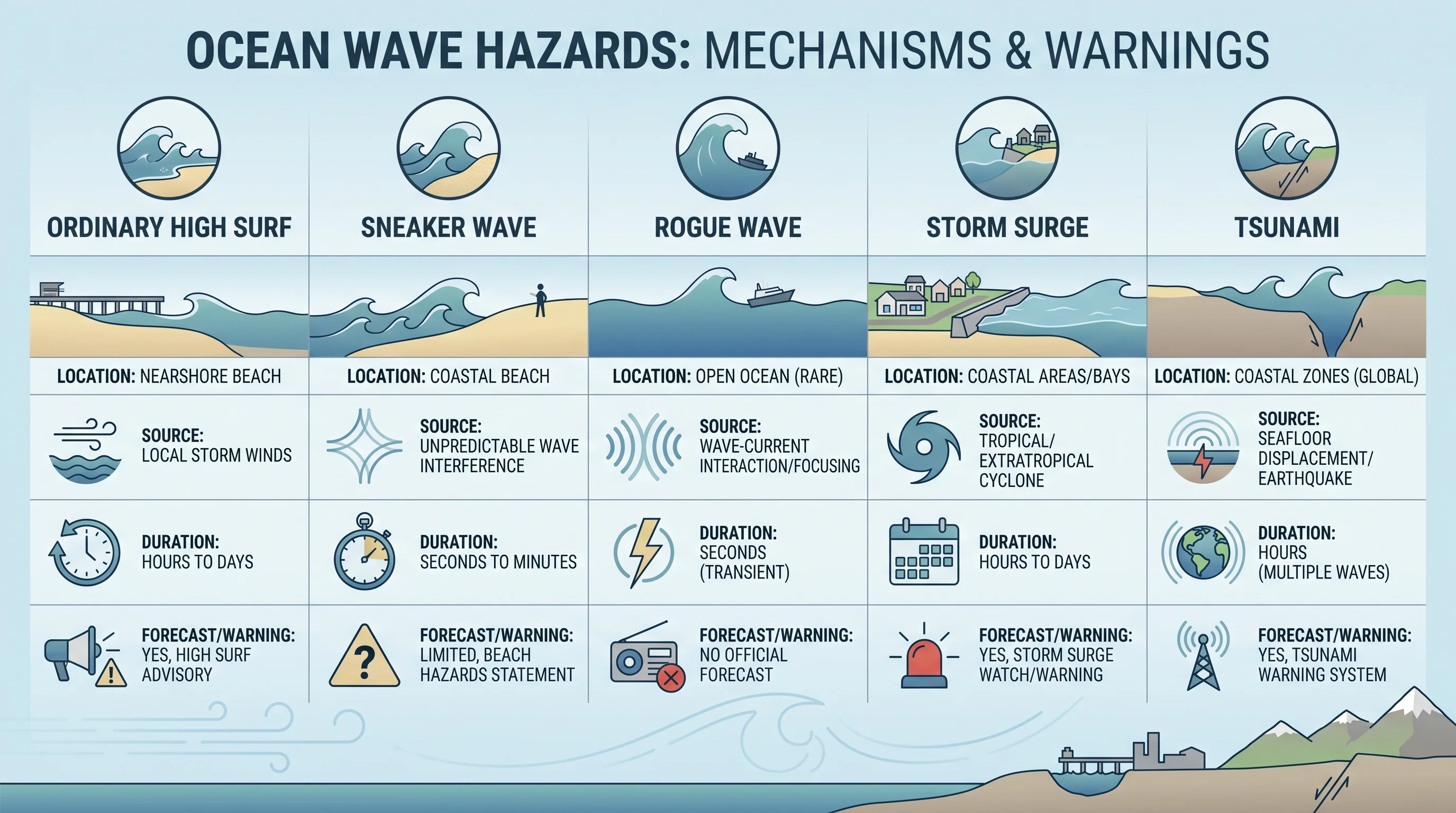
A scale comparison chart placing rogue wave, sneaker wave, ordinary high surf, storm surge, and tsunami side by side by typical location, generating source, duration, and whether an official forecast or warning product exists for each
Four ocean hazards that get confused often look similar on video but come from different mechanisms, different locations, and different levels of forecast warning.

What Precautions Matter in Large Seas?

No precaution can guarantee avoidance of a rogue wave specifically, since the hazard is inherently unpredictable at the level of a single wave. What does reduce risk is treating elevated sea-state forecasts seriously and avoiding unnecessary exposure during marginal conditions. Boaters and anyone operating offshore Southern California should check the NWS marine forecast for combined seas, swell height, swell period, and swell direction before heading out, since a forecast describing crossing or converging swell trains is a cue for extra caution even without a specific wave prediction attached to it.

On shore, the relevant products are different but related. High Surf Advisories and Warnings from NWS Los Angeles/Oxnard and NWS San Diego describe elevated breaking wave conditions at the coast, and beachgoers at exposed locations such as Santa Monica, Malibu, or anywhere along the open coast should keep a safe setback from wet sand and rocks during active advisories, per NWS beach hazards guidance. Checking NOAA Tides and Currents for the current tide stage adds useful context, since wave run-up reaches farther inland at high tide regardless of which specific hazard is producing the large waves.

None of these steps promise rogue-wave avoidance, but they meaningfully reduce exposure to the much more common nearshore hazards that people mistake for rogue waves in the first place. Readers curious about how Southern California's coastline itself responds to repeated wave energy over time, rather than any single event, can see coastal erosion in Southern California, and those tracking unusually high tides specifically should read king tides in Southern California.

Rogue waves are real, measured, and physically explainable, but they are an open-ocean statistical event, not a label that fits every dramatic wave video filmed from a Pasadena couch or a beach parking lot. The far more common and far more preventable hazards for Southern California beachgoers are ordinary high surf and sneaker waves, both of which come with real forecasts and real warning products. Before heading to the coast during an active swell, check WeatherEscape's Los Angeles marine and beach conditions alongside the current NWS High Surf and Coastal Flood products for your specific stretch of shoreline.

Frequently Asked Questions

What is a rogue wave?

A rogue wave is a single wave that reaches at least twice the significant wave height of the surrounding sea state, the statistical threshold oceanographers use rather than a fixed height in feet. Because the definition is relative, a wave that would qualify as rogue during calm seas might not stand out at all during a major storm swell where large waves are already common.

How can one wave become unusually large?

Several mechanisms can contribute, often together: constructive interference between crossing wave trains, steepening as swell moves against an opposing current, current-driven focusing of wave energy into a narrow zone, and nonlinear wave dynamics that let one wave briefly draw energy from its neighbors. No single mechanism is the settled explanation, and none of them makes a specific rogue wave predictable in advance.

Can rogue waves occur off Southern California?

Yes. The wave-interaction conditions that support rogue wave formation occur in the North Pacific, and vessels operating off the California coast fall within the same open-ocean hazard framework used elsewhere. Confirmed evidence comes from ship and offshore platform encounters rather than shoreline video, since only instrumented observers can measure a wave against the surrounding sea state at the same time.

Can forecasters predict an individual rogue wave?

No. Forecasters can identify sea states with elevated rogue wave risk, such as when multiple swell trains cross or swell runs against a strong current, but they cannot predict the timing, location, or height of any single wave. Marine forecasts describe sea-state risk, not a forecast for one specific crest.

How is a rogue wave different from a sneaker wave or tsunami?

A rogue wave is an open-ocean, statistically defined event caused by wave interference or currents far from shore. A sneaker wave is a shoreline event, an unusually large wave in an ordinary set that runs farther up the beach than the waves before it. A tsunami is caused by a sudden displacement of the entire water column from an earthquake, landslide, or eruption, a completely different physical process with its own dedicated warning system.

What is the biggest rogue wave ever recorded?

The Draupner wave, recorded by a laser sensor on Norway's Draupner oil platform in the North Sea on January 1, 1995, is widely cited as the first rogue wave confirmed by direct instrumental measurement, reaching roughly 84 feet in a sea state where surrounding waves were far smaller. It remains a landmark case in oceanography because it gave researchers a precise, instrument-verified record rather than an eyewitness account.

Does a bigger storm always mean a higher chance of a rogue wave?

Not directly. Rogue wave risk depends more on how wave trains interact, such as crossing swells or opposing currents, than on storm size alone. A complex sea state with multiple swell directions can carry meaningful rogue wave risk even when the storm generating it is not the largest system of the season.

Should Los Angeles beachgoers worry about rogue waves specifically?

Rogue waves are primarily an open-ocean and maritime hazard rather than a routine beach concern. The far more common and far more relevant hazards for Southern California beachgoers are ordinary high surf and sneaker waves, both of which come with real NWS forecast products and practical safety guidance for the shoreline.

Related Destinations

Live Los Angeles Conditions

Compare temperature, wind, clouds, and comfort across the map.

See which microclimates are clear, cool, windy, smoky, or warming up right now.

Open the Weather Map
Destinations☀️Smog Forecast🌫️Smog Heat Map🔒Privacy Policy📄Terms of Service