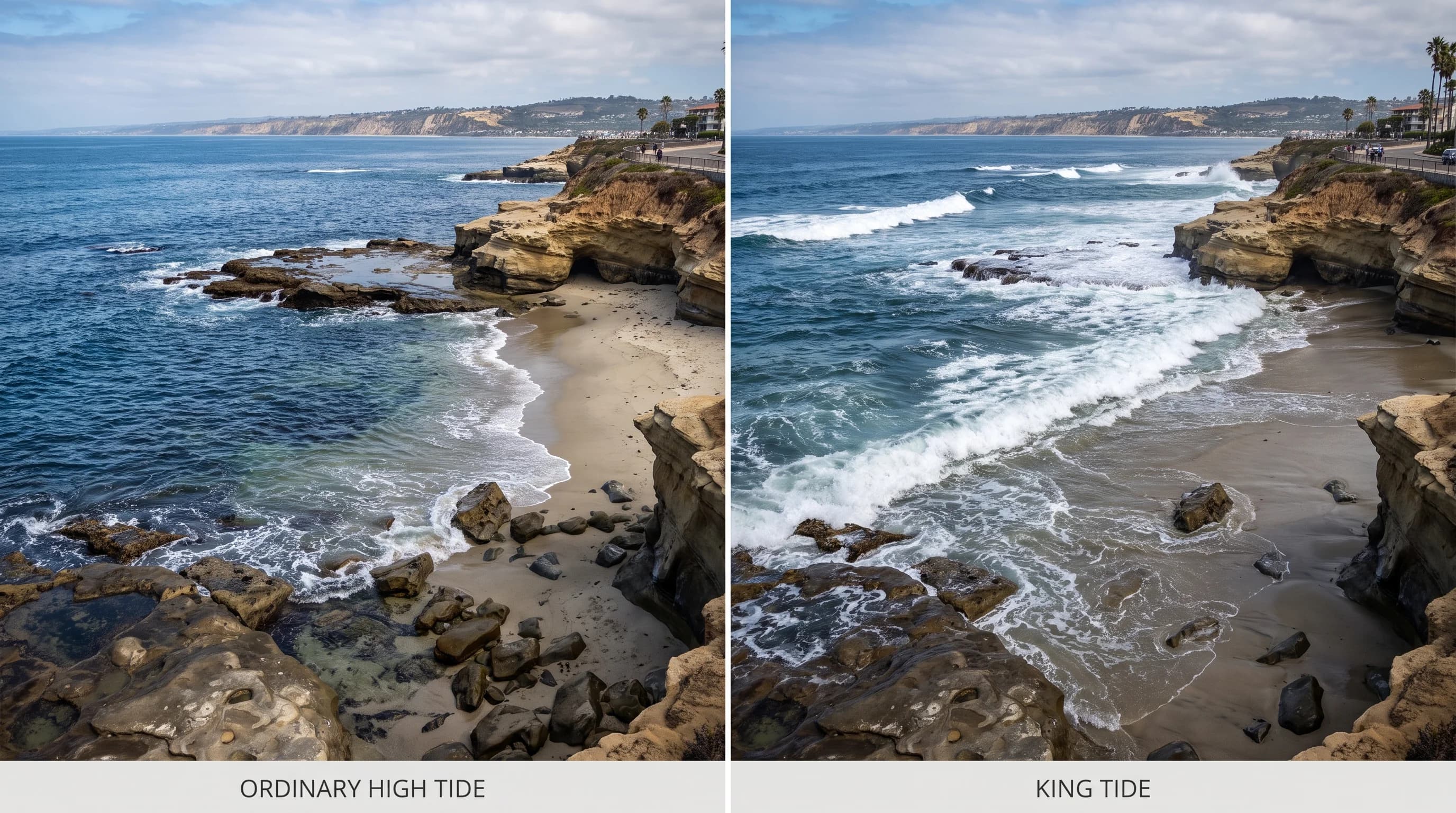
King tides are the highest predicted tides of the year. They happen when the sun, moon and Earth line up so their gravitational pulls add together instead of partly canceling out.
King tides are not storms and not sea-level rise. They are predictable, calendar-driven events that Southern California beaches see a few times a year, mostly in winter. Because king tides push water higher than any other routine high tide, they preview where an average day's water could reach decades from now as sea level rises.
What Is a King Tide?
A king tide is the popular name, not a scientific term, for the year's highest predicted tides, which NOAA Tides and Currents tracks at tide stations along the coast. King tides are calculated years in advance from the orbits of the sun, moon and Earth. That predictability separates a king tide from a storm surge or a tsunami, which depend on unpredictable weather or earthquakes.
Confusing a king tide with a storm surge is a common mistake. A king tide arrives on its predicted date, clear sky or storm. A storm surge is extra water that wind and low pressure push ashore during a storm, and it can happen at any point in the tide cycle. The worst coastal flooding happens when both occur at once, as the sections below explain.
Why Do the Highest Tides Occur?
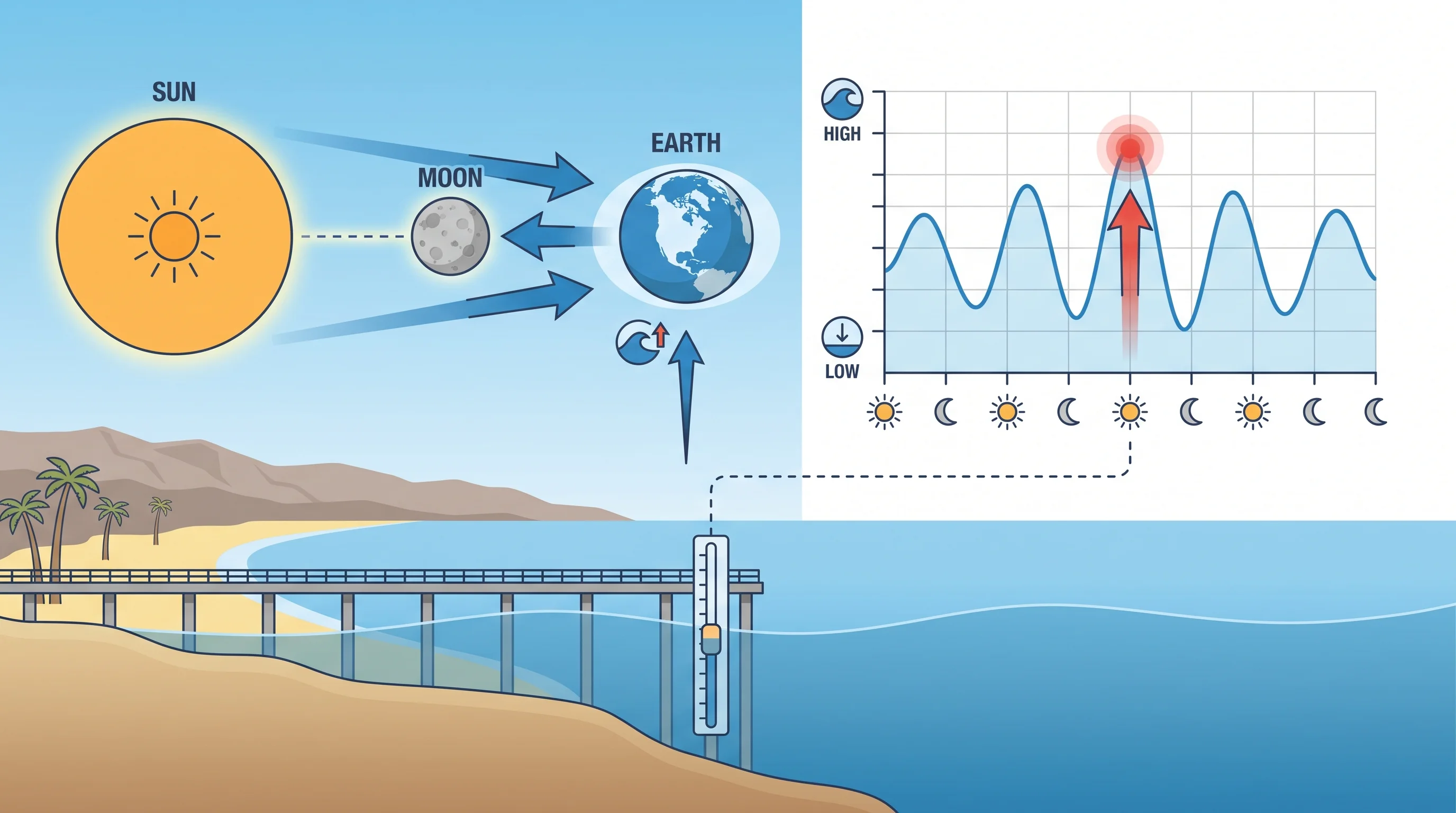
The highest tides occur when the sun's and moon's pulls combine at their strongest. Daily tides come mainly from the moon's gravity pulling on the ocean as Earth rotates, with a smaller pull from the sun. Twice a month, at new moon and full moon, the sun and moon line up with Earth and their pulls combine into a spring tide, with higher high tides and lower low tides. A king tide is the strongest spring tide: it happens when a spring tide coincides with the moon at its closest point to Earth, called perigee, and Earth near its closest point to the sun, called perihelion.
| Event | Predictable? | What drives it |
|---|---|---|
| Ordinary high tide | Yes, daily | Moon and sun gravity, twice-daily cycle |
| King tide | Yes, calendar-based | Sun, moon, and Earth alignment at closest approach |
| Storm surge | No, weather-dependent | Low pressure and onshore wind pushing extra water inland |
When and Where Can Southern California See King Tides?
Southern California king tides cluster in winter, when Earth is closest to the sun, usually from November through January. NOAA publishes tide predictions for each station years in advance, so check the official date, time and height for the station you plan to visit. The highest water at a station usually arrives in a short window around sunrise or sunset, not at the same clock time each year.
Every coastal community gets king tides, but the effect depends on local shoreline shape. Low, gently sloped shoreline near Long Beach and harbor areas near San Pedro can see water reach parking lots, boat ramps and walkways that stay dry the rest of the year. Steeper, rockier coast near Malibu shows the same extra water as a smaller rise against the cliffs. Check the predicted date, time and height for the tide station nearest your destination.
How Can Weather and Waves Increase Impacts?
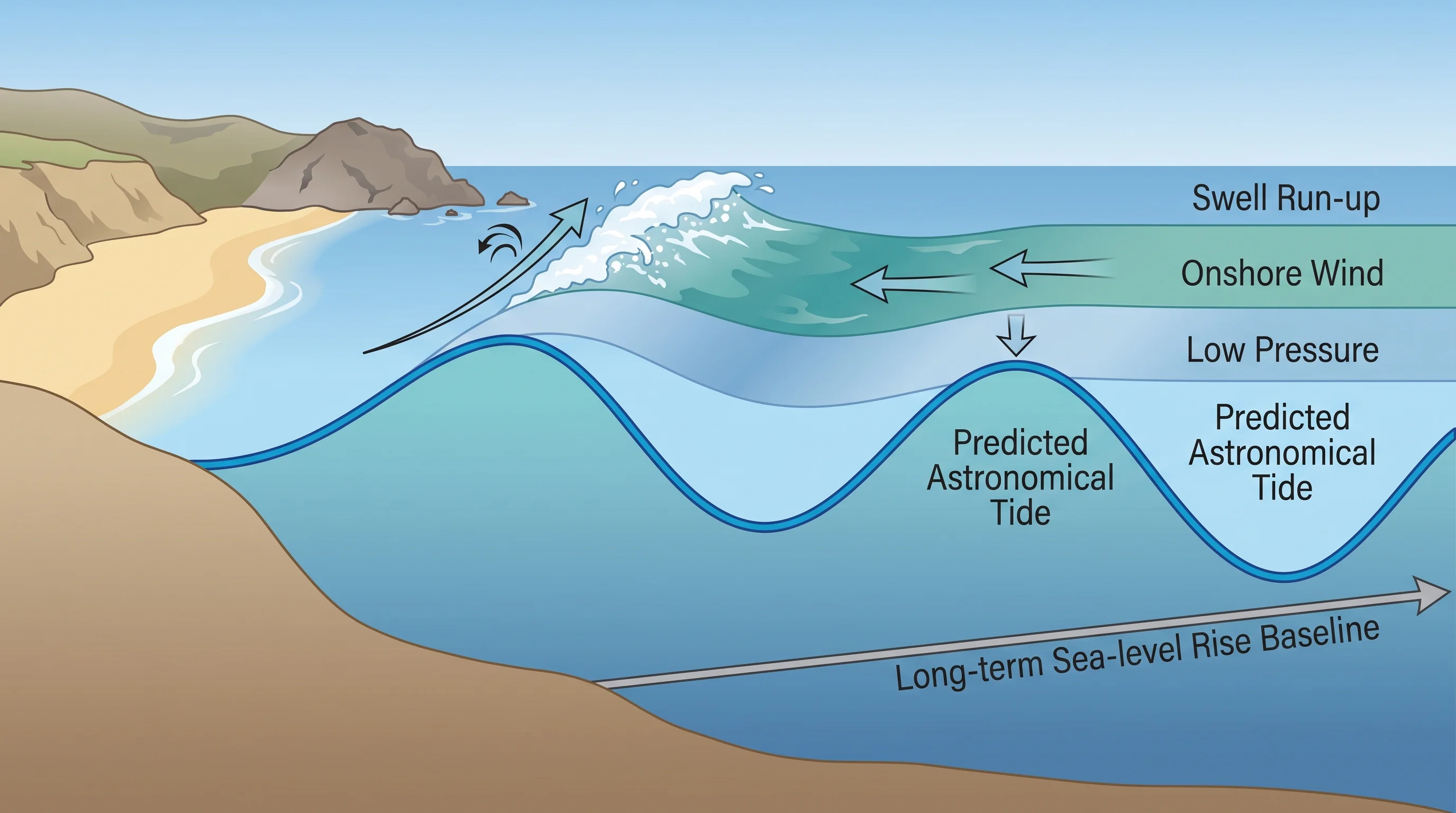
Weather and waves raise king tide impacts above the predicted level. Low air pressure lets the ocean surface rise slightly, onshore wind piles water against the coast and swell from a distant storm adds wave run-up. When several of these stack on an already high king tide, the water at the shore can run noticeably higher than NOAA's predicted tide height.
Beach shape also matters. A wide, gently sloped beach spreads extra water over a larger area, while a narrow beach backed by a seawall, road or bluff has little room.
The same tide and swell can therefore have very different effects a few miles apart. For how waves and storms reshape the shoreline, see coastal erosion in Southern California. For large waves that arrive regardless of tide, see what are rogue waves. A king tide combined with big swell is most dangerous on narrow beaches; see high surf in Malibu.
Heavy rain adds to the problem by filling channels and storm drains just as the high ocean slows their drainage. Compare flash flooding in Santa Monica with flash flooding in Ventura, where larger rivers carry runoff to the coast.
Are King Tides Caused by Climate Change?
Climate change does not cause king tides. King tides follow an astronomical cycle set by the sun, moon and Earth, and they would follow the same schedule without climate change. Climate change raises the baseline sea level that every tide, including a king tide, starts from. As average sea level rises, the same king tide reaches higher water than it did a generation ago.
Coastal scientists use king tides as a preview, not as proof from one flooded sidewalk. A king tide shows, several times a year on clear days, roughly where water could sit on an average day once sea level rises that much. One flooded spot on one day is a single data point. The pattern repeated across many king tides over years helps coastal planners identify vulnerable low-lying areas.
How Can People Observe King Tides Safely?
Watch a king tide from a stable public viewpoint in daylight, well back from cliff edges, seawalls and the surf line. The conditions that raise the tide can also bring larger waves and stronger rip currents. Treat a king tide outing like a day with an active NWS beach hazard advisory: check conditions first, stay back from the water and never turn your back on the ocean, especially on rocks or jetties.
Before going to the coast, compare the NOAA tide table for your nearest station with current high-surf and coastal-flood alerts from NWS Los Angeles/Oxnard or NWS San Diego. A king tide with high surf is far more dangerous than a calm king tide. Waterspouts, a separate storm hazard off the Southern California coast, are covered in what are waterspouts.
King tides are among the few Southern California coastal events you can put on a calendar years ahead, and that makes them useful: a low-risk way to see roughly where the ocean could sit on an ordinary day as sea level rises. Before going to watch one, check the predicted time and height at your nearest NOAA tide station, confirm there is no high-surf or coastal-flood alert and check conditions for Santa Monica, Malibu or your stretch of coast on WeatherLA.