The coldest temperature officially recorded in Downtown Los Angeles is 28°F, set on February 6, 1883 and tied on January 7, 1913 and January 4, 1949. The coldest reading anywhere in the city is 18°F at Woodland Hills in the San Fernando Valley on February 6, 1989. LAX's record is 23°F, from January 1937. Downtown has not dropped to freezing since January 29, 1979.
The 1979 date matters most. Anyone in Los Angeles younger than about 47 has never lived through an official freeze Downtown. Today, the city's coldest nights happen in the valleys, and even there hard freezes have become rare.
What Is the Coldest Temperature Ever Recorded in Los Angeles?
Los Angeles has two answers for its coldest temperature: 28°F Downtown and 18°F at Woodland Hills. Downtown's 28°F is the official record for the city's long-running climate station, the number most rankings use. Woodland Hills' 18°F, measured at the Pierce College weather station, is the lowest reading within the City of Los Angeles. This article covers the city and the basin; the mountains and the Antelope Valley in Los Angeles County get far colder.
| Station | Record low | Date |
|---|---|---|
| Woodland Hills (city record) | 18°F | February 6, 1989 |
| Pasadena | 21°F | January 7, 1913 |
| Van Nuys | 22°F | January 12, 1949 |
| LAX | 23°F | January 22, 1937 |
| Torrance | 24°F | January 23, 1937 |
| Long Beach | 25°F | January 13, 1963 |
| UCLA | 25°F | December 25, 1941 |
| Burbank | 26°F | January 14, 2007 |
| Downtown Los Angeles (official) | 28°F | 1883, 1913 and 1949 |
| Santa Monica (records since 1998) | 32°F | January 14, 2007 |
Source: RCC ACIS station records. Periods of record differ.
When Did Downtown LA Last Freeze?
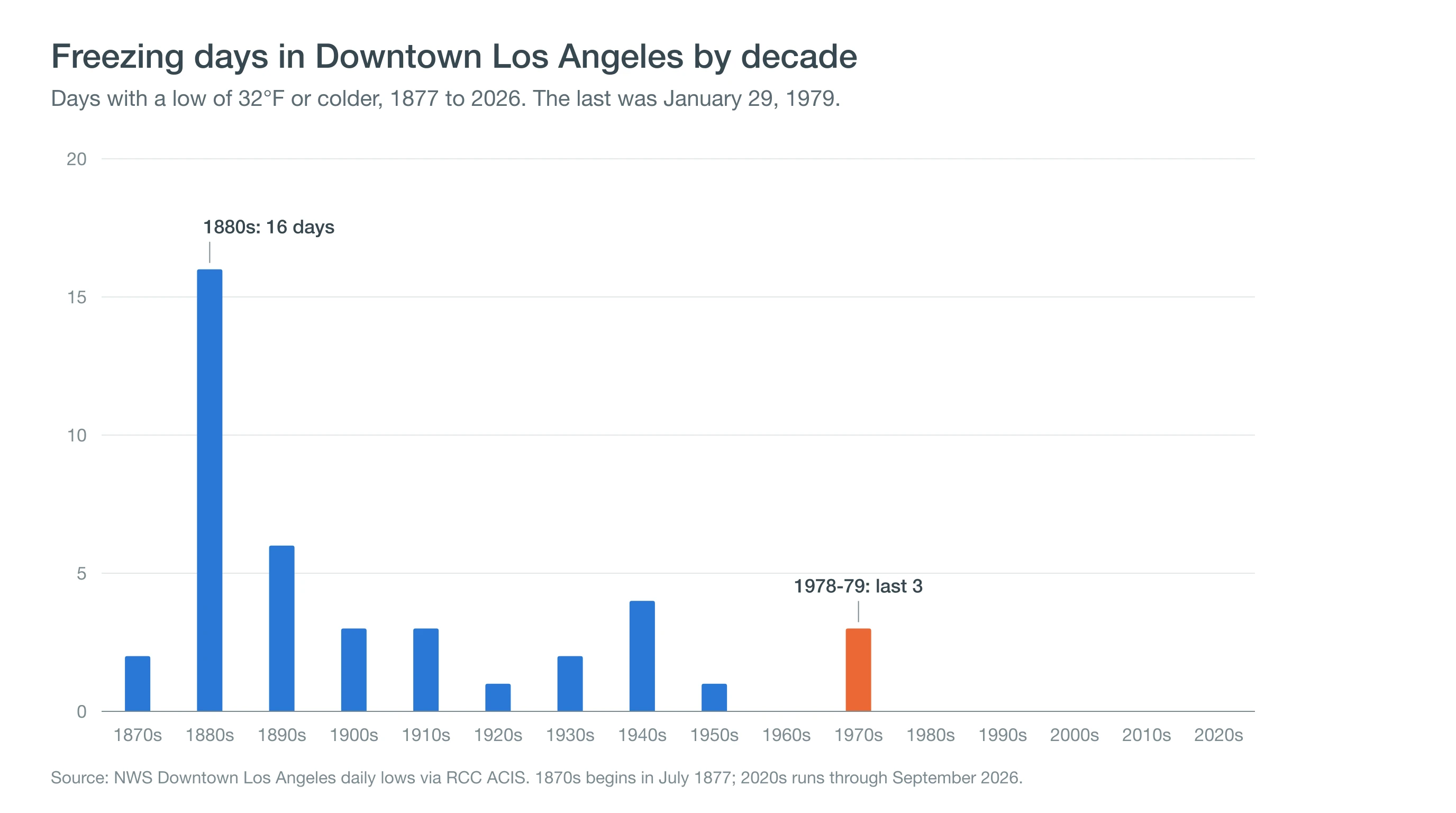
Downtown Los Angeles last froze on January 29, 1979, when its thermometer read 32°F. The record since 1877 holds just 41 freezing days, and 16 of them came in the 1880s.
After a lone 32°F reading in December 1951, the city went 27 years without another, then logged three in quick succession: December 7 and 8, 1978, and January 29, 1979. Downtown has not frozen since. The coldest Downtown readings of this century are 34°F on January 14, 2013, and 36°F in January 2007, January 2013 and December 2015.
The Downtown thermometer has also moved twice, from a downtown site to the USC campus in 1999 and to Elysian Park in 2024, and every move shifts the numbers a little. The record 28°F readings all came from earlier downtown sites. The site history is covered in the hottest temperature ever recorded in LA.
Why Is the San Fernando Valley So Much Colder at Night?
The San Fernando Valley is much colder at night because cold air sinks. On clear, calm winter nights, the ground loses heat quickly and chills the air just above it. That heavy air drains downhill and pools on the valley floor, while the coast stays mild next to an ocean that stays near 58°F to 60°F all winter. The effect is the same kind of temperature inversion that traps smog, with cold air held under warmer air.
The difference is large. Woodland Hills still averages about 11 freezing nights a year and January lows near 43°F. Downtown and Santa Monica average no freezing nights and January lows near 49°F.
Hillsides above the valley floor stay even warmer, which is why UCLA, on the slopes of Westwood, has not dropped to freezing since 1957. The microclimates explainer shows how a few miles and a few hundred feet of elevation change nighttime temperatures.
What Were LA's Worst Cold Waves?
Four cold waves stand out in Los Angeles history. In January 1937, a cold wave set records that still stand at LAX (23°F) and Torrance (24°F), and growers burned smudge pots across the citrus belt. In January 1949, Downtown tied its record 28°F on January 4, and a storm a week later brought 0.3 inch of snow Downtown and more in the valleys; Burbank measured 2.5 inches. That was the city's last measurable Downtown snow, and the full story is in does it snow in Los Angeles.
On February 6, 1989, Woodland Hills fell to 18°F, the city's all-time low. And on January 14, 2007, a freeze across Southern California took Woodland Hills to 20°F, Burbank to a record 26°F and Santa Monica to 32°F, the beach city's coldest reading since its records began in 1998. That freeze damaged a large share of California's citrus crop.
Is Frost Disappearing From Los Angeles?
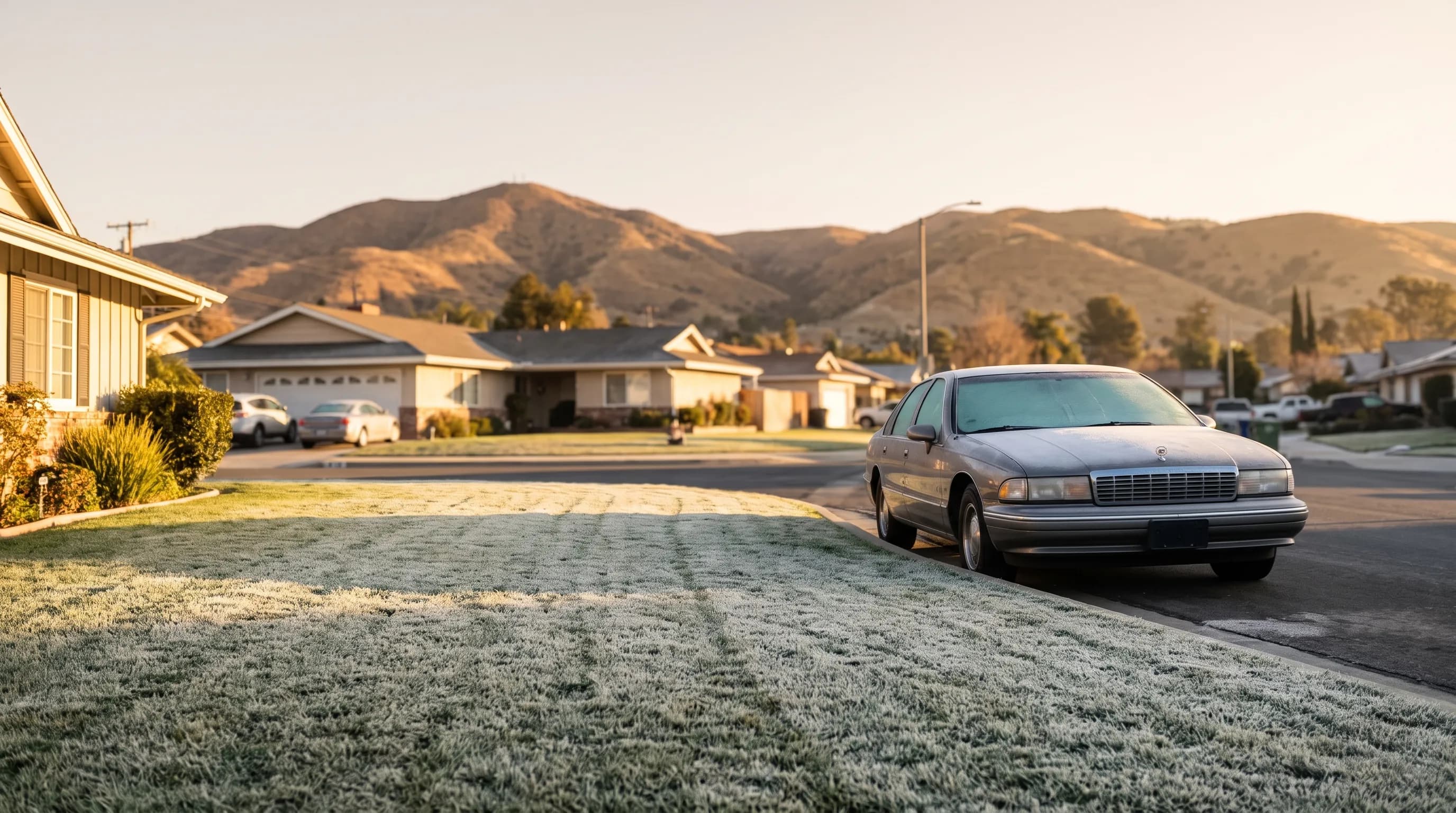
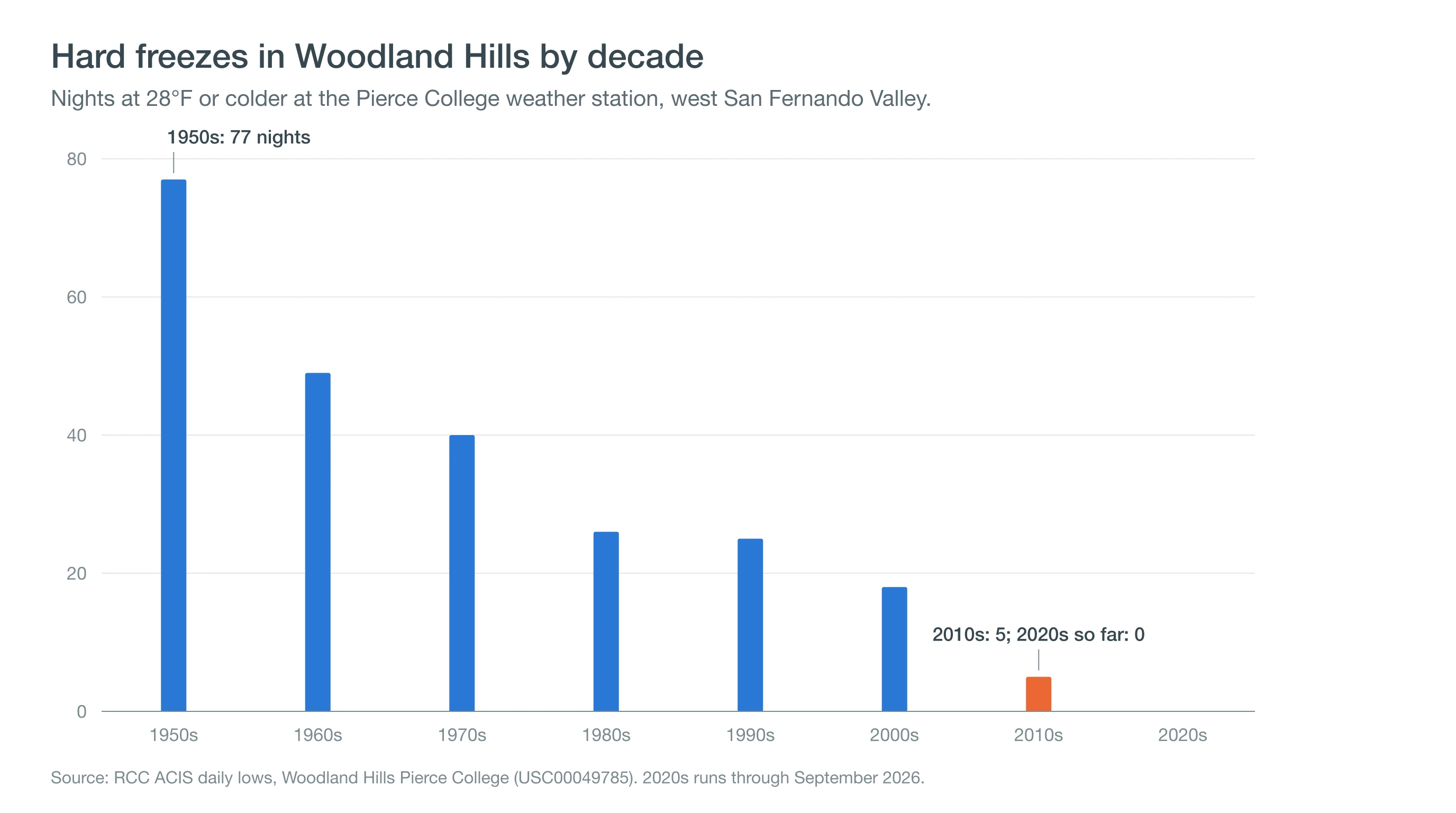
Frost is disappearing from the valleys of Los Angeles. Woodland Hills recorded 77 nights at 28°F or colder in the 1950s, 26 in the 1980s, 18 in the 2000s and 5 in the 2010s. So far in the 2020s, through September 2026, it has recorded none, and the 2025-26 winter brought only one night at 32°F. Frost still settles on lawns and windshields in the Valley on the coldest mornings, but a hard freeze is now a rare event rather than a regular part of winter.
Several causes are likely at work, and they are hard to separate. The Valley has filled in with pavement and buildings that hold heat overnight, the land around a weather station can change over decades, and the climate itself has warmed. The difference between a single cold night and a long-term trend is explained in weather vs. climate in Southern California.
How Cold Does LA Get on a Typical Winter Night?
A typical winter night in Los Angeles is mild by most standards. December and January lows average about 48°F to 49°F Downtown and at the beach, about 45°F to 46°F at Van Nuys, and about 42°F to 43°F at Woodland Hills. A few nights each winter dip into the 30s in the valleys, usually after a storm clears out and leaves dry, calm air behind.
On those nights, the National Weather Service issues frost and freeze warnings for the valleys. Cover or bring in tender plants, bring pets indoors, and check on neighbors, especially people living outdoors, for whom a 35°F night with wind or rain can be dangerous. Los Angeles opens winter shelters during cold snaps. Check the overnight low for Downtown, Van Nuys and Woodland Hills when a cold front is on the way.