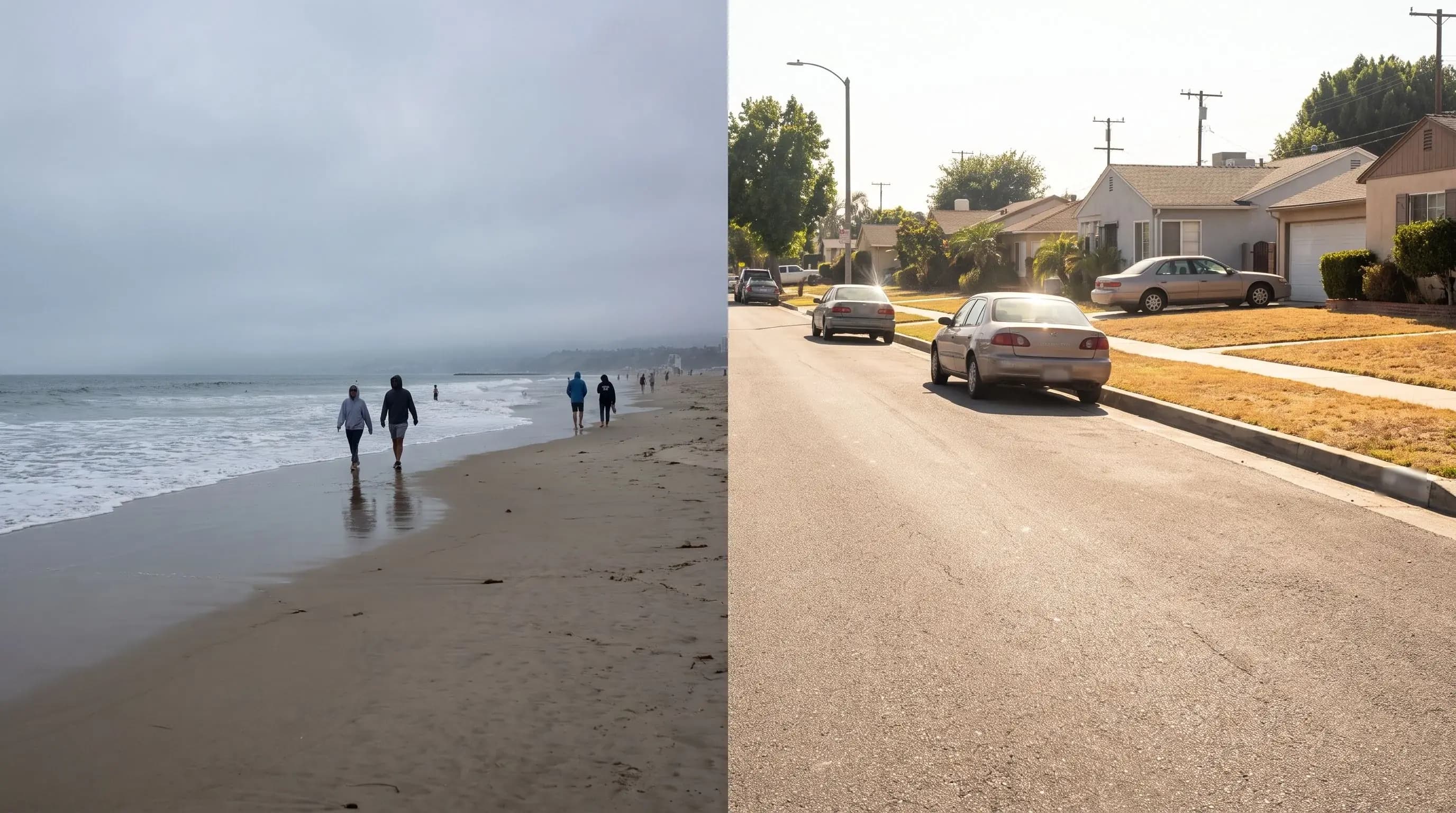
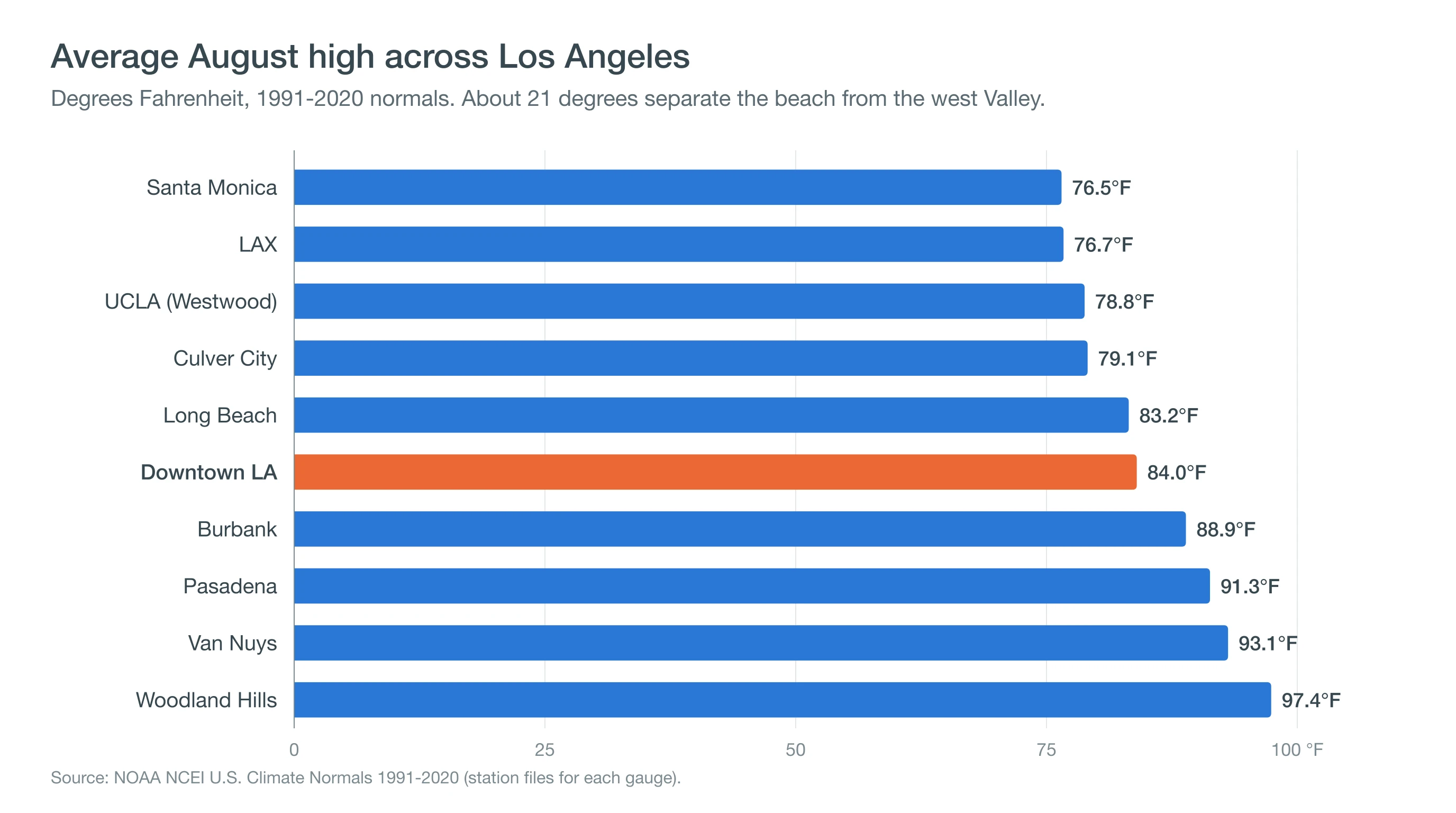
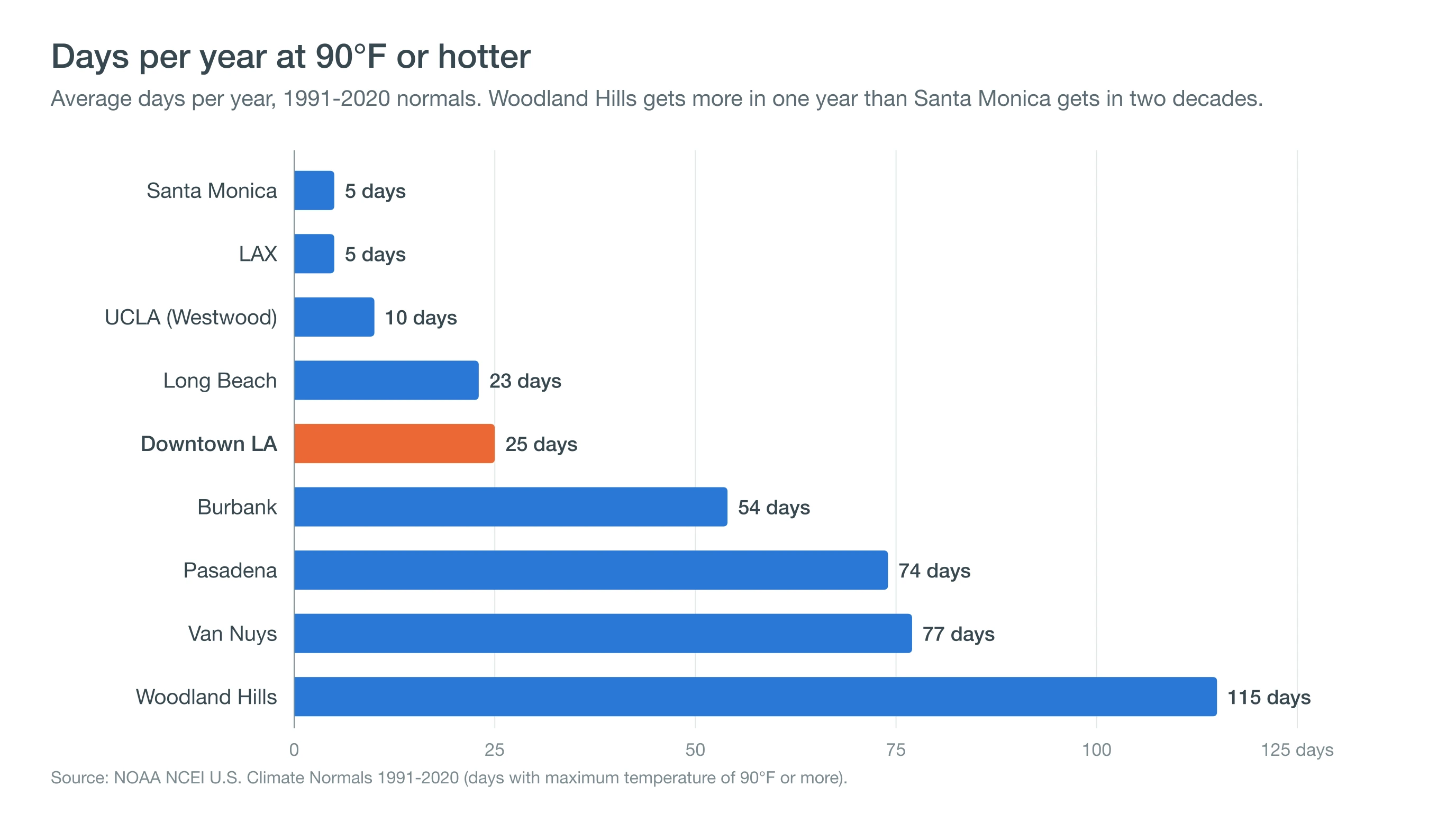
Los Angeles weather depends on how far you are from the ocean. Santa Monica averages 76.5°F in August and sees about five days a year at 90°F or hotter. Woodland Hills, about 13 miles away on the far side of the Santa Monica Mountains, averages 97.4°F in August and sees about 115. Downtown and Pasadena sit in between.
In LA, the forecast depends on your neighborhood. (Month-by-month beach numbers are in Santa Monica weather by month.)
On October 1, 2024, Santa Monica topped out at 71°F. Downtown reached 88°F. Woodland Hills hit 113°F. The three felt like different seasons on the same afternoon.
October 1, 2024 was extreme, but the pattern was not. On a typical July afternoon, Woodland Hills runs about 21 degrees hotter than Santa Monica, and the gap reaches 20 degrees or more on roughly 74 days a year.
How Much Does the Weather Change Across LA Neighborhoods?
Temperatures across Los Angeles neighborhoods differ by as much as 20 degrees on an ordinary summer afternoon, and far more during heat waves and offshore wind events. In winter the daytime gap nearly disappears, and at night it reverses: the Valley floor becomes the coldest part of the city while the coast stays mild. The table compares seven neighborhoods using each area's nearest long-running weather station.
| Neighborhood | August high | January low | Days at 90°F+ | Rain per year |
|---|---|---|---|---|
| Santa Monica / Venice | 76.5°F | 48.7°F | about 5 | 13.45 in |
| Westwood (UCLA) | 78.8°F | 51.9°F | about 10 | 17.73 in |
| Long Beach | 83.2°F | 46.9°F | about 23 | 12.02 in |
| Downtown LA | 84.0°F | 48.9°F | about 25 | 14.25 in |
| Burbank | 88.9°F | 45.3°F | about 54 | 13.91 in |
| Pasadena | 91.3°F | 45.5°F | about 74 | 20.08 in |
| Woodland Hills | 97.4°F | 43.1°F | about 115 | 16.41 in |
Distance from the ocean drives the difference. Cool ocean air flows inland every afternoon as a sea breeze, and it warms and weakens with every mile and every ridge it crosses. The full mechanism, including the marine layer, the mountains and pavement, is covered in why Los Angeles has so many microclimates.
Beach Cities: Why Santa Monica and Venice Stay Cool All Summer
The ocean keeps the beach cities cool all summer. Santa Monica's average high climbs only from 66°F in January to 76.5°F in August, and the gap between an August afternoon and night is just 13 degrees. Summer arrives late at the beach. In June, the month of June Gloom, Santa Monica averages 71°F while Woodland Hills is already near 89°F, and about six in ten June mornings start under a low gray ceiling at the Santa Monica airport.
Venice and the South Bay share that pattern. Long Beach looks like an exception, but only on paper: its official gauge averages 83.2°F in August and about 23 days a year at 90°F or hotter. That gauge, though, sits at Long Beach Airport, about four miles from the water. Neighborhoods right on the shore are cooler than the airport number suggests. The sea breeze explainer shows how that daily wind works.
Westside and Downtown: LA's In-Between Zone
Summer finally shows up on the Westside and in Downtown Los Angeles, a few miles inland. Westwood and Culver City average about 79°F in August, only a few degrees above the beach, while Downtown averages 84°F and about 25 days a year at 90°F or more. Downtown is also where heat lingers after dark, because pavement and buildings release stored warmth through the evening, the urban heat island effect.
UCLA has the mildest winter nights of any station here, with an average January low of 51.9°F. The campus sits on a slope above the Westside flats, and on clear nights cold air drains downhill, away from slopes like it. For the same reason, hillside homes across LA stay warmer on winter nights than the neighborhoods below them.
The San Fernando Valley: LA's Hottest Neighborhoods
The San Fernando Valley has the hottest summers in Los Angeles. Woodland Hills averages 97.4°F in August and reaches 90°F or hotter on about 115 days a year, nearly a third of the year. Woodland Hills also holds the Los Angeles County record, 121°F on September 6, 2020. Heat eases from west to east across the Valley: Van Nuys averages about 77 days at 90°F or more and Burbank, at the Valley's eastern edge, about 54.
In winter, the Valley swings the other way. Dry air and clear skies let it lose heat fast after sunset. Woodland Hills averages a January low of 43.1°F and about 11 nights a year at or below freezing, while Santa Monica almost never freezes.
The city's record low, 18°F, was set at Woodland Hills in 1989; see the coldest temperature ever recorded in LA. In August, the average Woodland Hills day swings 37 degrees from the afternoon high to the overnight low.
Pasadena and the Foothills: Hot Summers, the Most Rain
Pasadena combines Valley-style heat with the region's wettest winters. Pasadena averages 91.3°F in August and about 74 days a year at 90°F or hotter. It also gets 20.08 inches of rain a year, the most of any station here, because the San Gabriel Mountains force storm air upward and squeeze more rain out of it. Santa Ana winds also blow hardest in the foothills as they pour out of the canyons, so fire weather matters more here than on the Westside.
Which LA Neighborhood Has the Best Weather?
The LA neighborhood with the best weather depends on what you want from it. For the mildest temperatures all year, the coast wins: Santa Monica rarely leaves the 60s and 70s, though it comes with gray early-summer mornings and cool evenings.
For warmth without much extreme heat, the Westside and Culver City are the best choice. For reliable sunshine and real summer heat, choose the Valley, as long as a few triple-digit days and chilly winter nights are acceptable. Downtown and Pasadena fall in between on temperature, with Pasadena getting the most rain.
How Do You Pick a Neighborhood for Today's Plans?
To pick a neighborhood for today, start with the forecast high for the Valley. When it is heading above 95°F, move outdoor plans west toward the coast, where it is often 20 degrees cooler. On a May or June morning, wait until late morning or early afternoon for the marine layer to clear before heading to the beach. After dark, bring a layer to the coast year-round and to the Valley in winter, where nights cool the most.
Los Angeles has many climates, and knowing which one you are in changes how you plan a day. Before heading out, compare the hourly highs and evening lows for Santa Monica, Downtown, Burbank and Woodland Hills on our destination pages, and pick the neighborhood whose weather fits what you want to do. Source data for the table comes from the NOAA 1991-2020 U.S. Climate Normals.