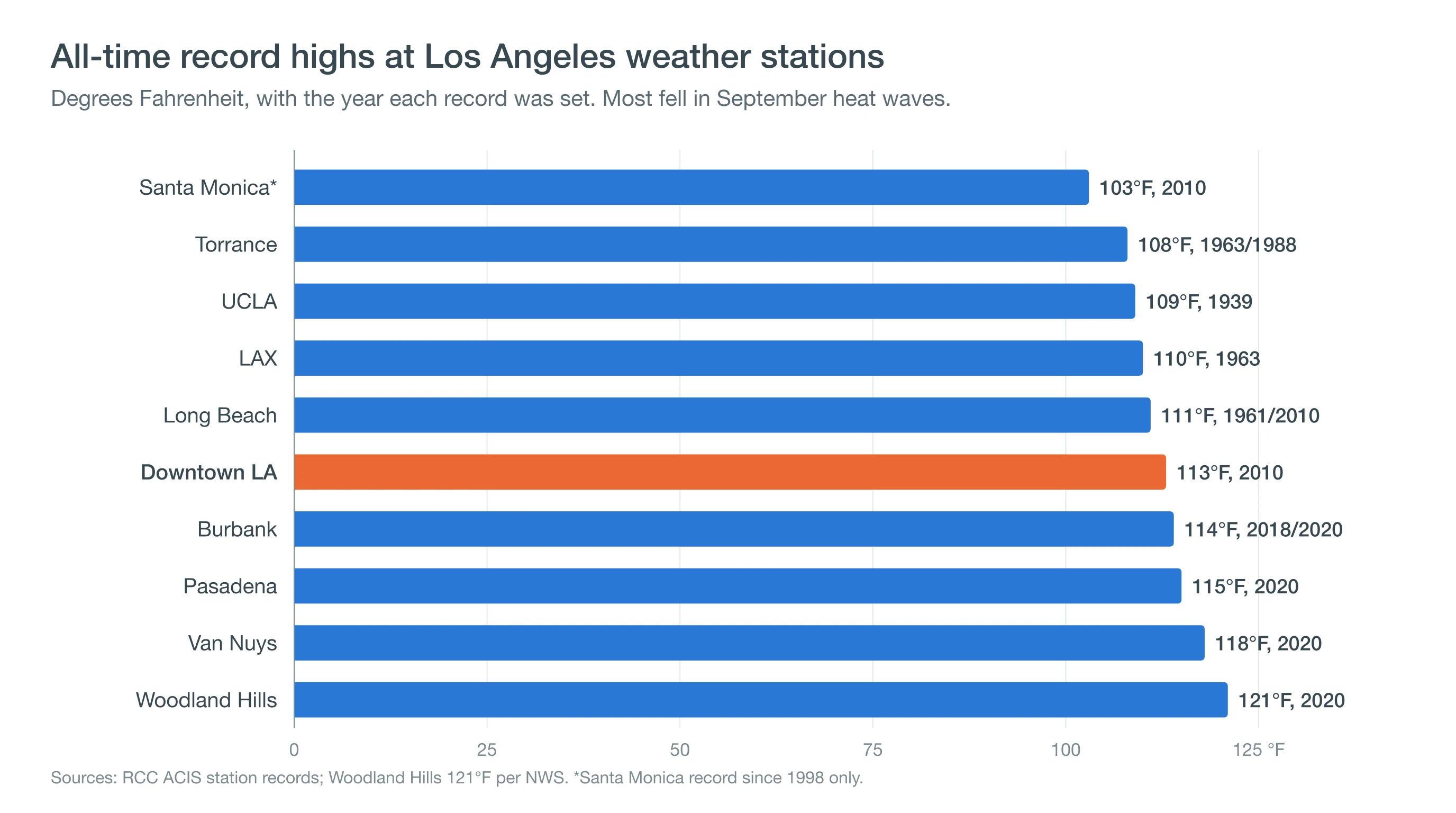
The hottest temperature officially recorded in Downtown Los Angeles is 113°F, set on September 27, 2010. The hottest reading anywhere in the city, and in all of Los Angeles County, is 121°F at Woodland Hills in the San Fernando Valley on September 6, 2020. LAX's record is 110°F and Santa Monica's is 103°F. Most of LA's heat records were set in September.
At about 12:15 p.m. on September 27, 2010, the Downtown thermometer at USC read 113°F, the hottest in records going back to 1877. Then the sensor malfunctioned. The National Weather Service rushed a technician from its Oxnard office to repair it, and officials acknowledged the true peak may have been higher. So the answer depends on which thermometer you mean.
What Is the Hottest Temperature Ever Recorded in Los Angeles?
Los Angeles has two correct answers for its hottest temperature: 113°F Downtown and 121°F at Woodland Hills. Downtown's 113°F is the official record for the city's long-running climate station, the number used in most rankings. Woodland Hills' 121°F, measured at the Pierce College weather station, is the highest official reading in Los Angeles County and, because Woodland Hills is part of the City of Los Angeles, the highest in the city too.
| Station | Record high | Date |
|---|---|---|
| Woodland Hills (county and city record) | 121°F | September 6, 2020 |
| Van Nuys | 118°F | September 6, 2020 |
| Pasadena | 115°F | September 6, 2020 |
| Burbank | 114°F | July 6, 2018 and September 5-6, 2020 |
| Downtown Los Angeles (official city record) | 113°F | September 27, 2010 |
| Long Beach | 111°F | October 15, 1961 and September 27, 2010 |
| LAX | 110°F | September 26, 1963 |
| Santa Monica (records since 1998) | 103°F | September 27, 2010 |
What Happened on LA's Hottest Day, September 27, 2010?
LA's hottest day came when a strengthening ridge of high pressure over the West, with light offshore winds, held back the cool, moist ocean air that normally tempers Los Angeles. With no sea breeze to fight it, the heat reached the coast. Downtown hit 113°F, breaking the 112°F record from June 26, 1990. Long Beach tied its all-time high of 111°F, UCLA reached 108°F, and Santa Monica hit 103°F, still its highest reading since its records began in 1998.
The sensor failure is part of the record. News reports that day described 113°F lasting for a few minutes around 12:15 p.m. before the equipment failed, which is why many weather watchers treat the official mark with some doubt. For comparison, Death Valley holds the world record of 134°F, set in 1913; see how hot Death Valley gets.
How Did Woodland Hills Reach 121°F in 2020?
Woodland Hills reached 121°F on September 6, 2020, during a Labor Day weekend heat wave, when the Pierce College station beat the previous county record of 119°F set at the same station on July 22, 2006. The same afternoon, Van Nuys reached 118°F, Pasadena 115°F, Burbank 114°F and Downtown 111°F. (NOAA's daily archive lists 120°F for Woodland Hills that day; the National Weather Service's announced figure, 121°F, is the one used for the record.)
The west San Fernando Valley runs hottest because it sits farthest from the ocean's influence behind the Santa Monica Mountains, in a basin that traps heat on still afternoons. Woodland Hills averages 97.4°F in August and about 115 days a year at 90°F or hotter. The full comparison is in Los Angeles weather by neighborhood.
Why Are LA's Hottest Days in September, Not July?
LA's hottest days come in September because that is when the two things that protect Los Angeles from heat are weakest. The marine layer thins out after early summer, and offshore winds start to return, pushing desert air toward the coast instead of letting ocean air flow inland. Nine of Downtown's 12 hottest readings came in September. Across 148 years of records, the year's hottest day fell in September 53 times and in October 23 times, more often than in July.
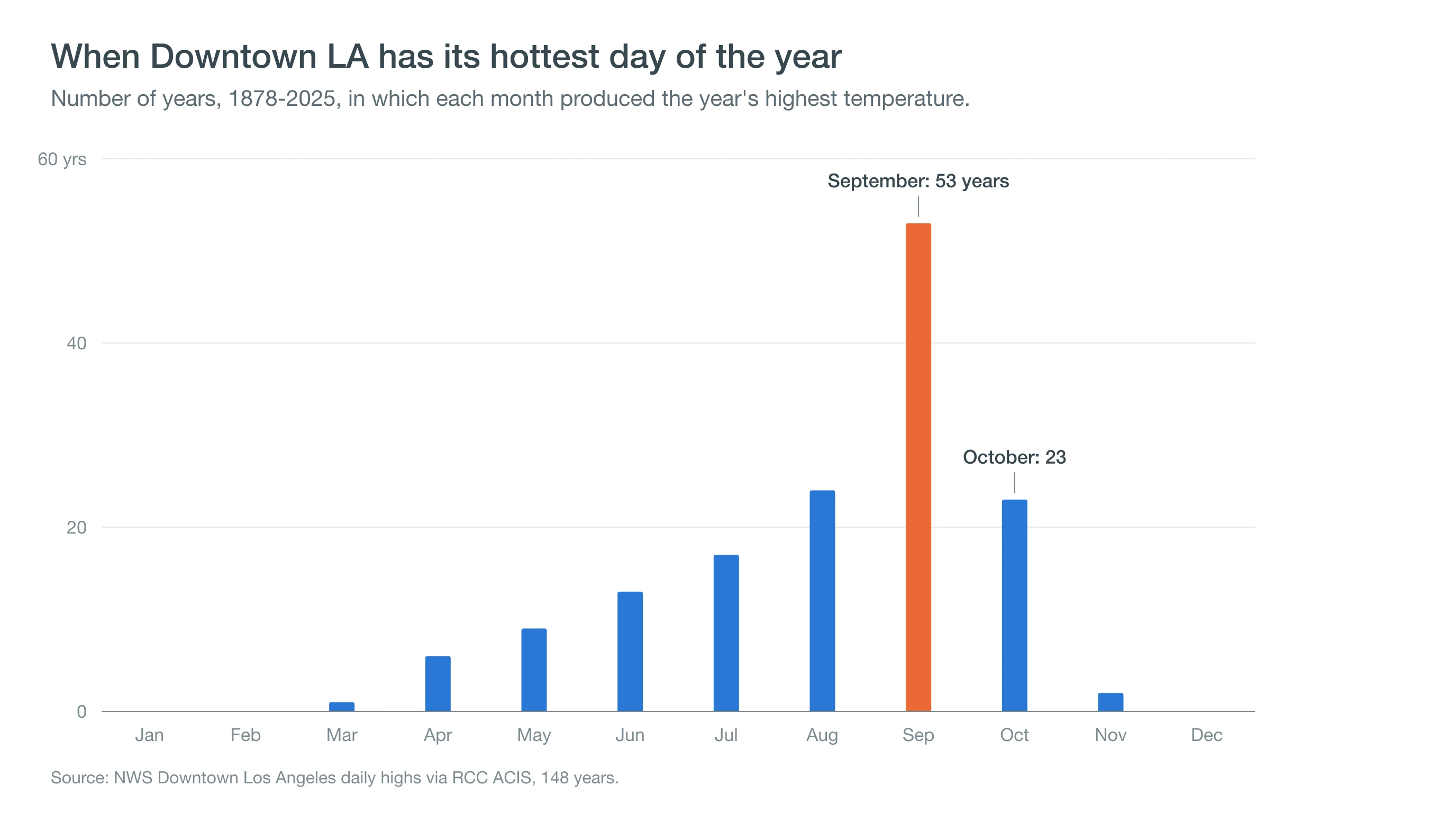
Heat can last well into fall. Downtown's October record is 108°F (1987), its November record is 100°F (1966), and even January and February have hit 95°F. The causes of those spikes are explained in what causes a heat wave in LA and when LA's heat peaks.
Does Moving the Thermometer Change the Record?
Moving the thermometer does change the record, and Downtown's station has moved twice. It sat on a parking structure at the Department of Water and Power building until August 1999, then on the tree-shaded USC campus, where a study found daily highs ran about 2.4°F cooler than the old site. On May 20, 2024, the National Weather Service moved it again, to the Frank Hotchkin Memorial Training Center in Elysian Park beside Dodger Stadium, saying the USC site sat too close to the ocean's influence to represent downtown. In its first September there, on September 6, 2024, the new site recorded 112°F, one degree short of the all-time record.
The station's moving history is why official records only come from standardized, shaded instruments in fixed locations. A car dashboard or a bank sign in direct sun can read far above the real air temperature.
Is Los Angeles Getting More Extreme Heat Days?
Los Angeles is getting more extreme heat days, according to the recent record. Van Nuys has a nearly complete record since 2000. There, the number of days at 100°F or hotter averaged about 11 a year in the 2000s, 16 a year in the 2010s and about 22 a year from 2020 through 2025. Four of the station records in the table above were set in 2018 or later, and urban heat keeps paved neighborhoods warmer after dark.
Los Angeles heat records follow geography and timing: the farther from the ocean and the later in the summer, the higher the record. When a heat wave is forecast, check the highs for Downtown and the Valley on our destination pages, follow National Weather Service heat warnings, and plan outdoor time for early morning, especially in September. For the other extreme, see the coldest temperature ever recorded in Los Angeles.