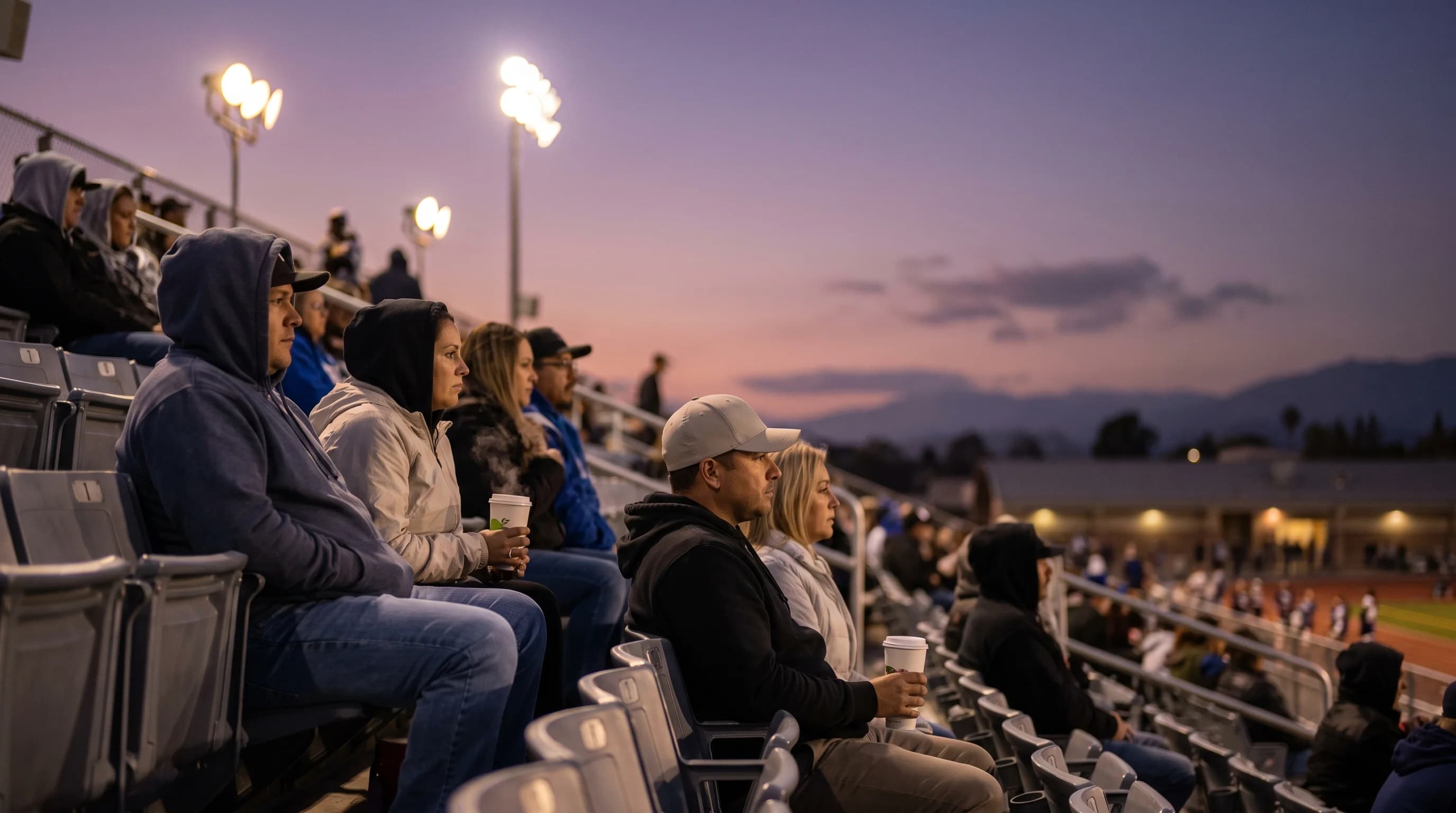
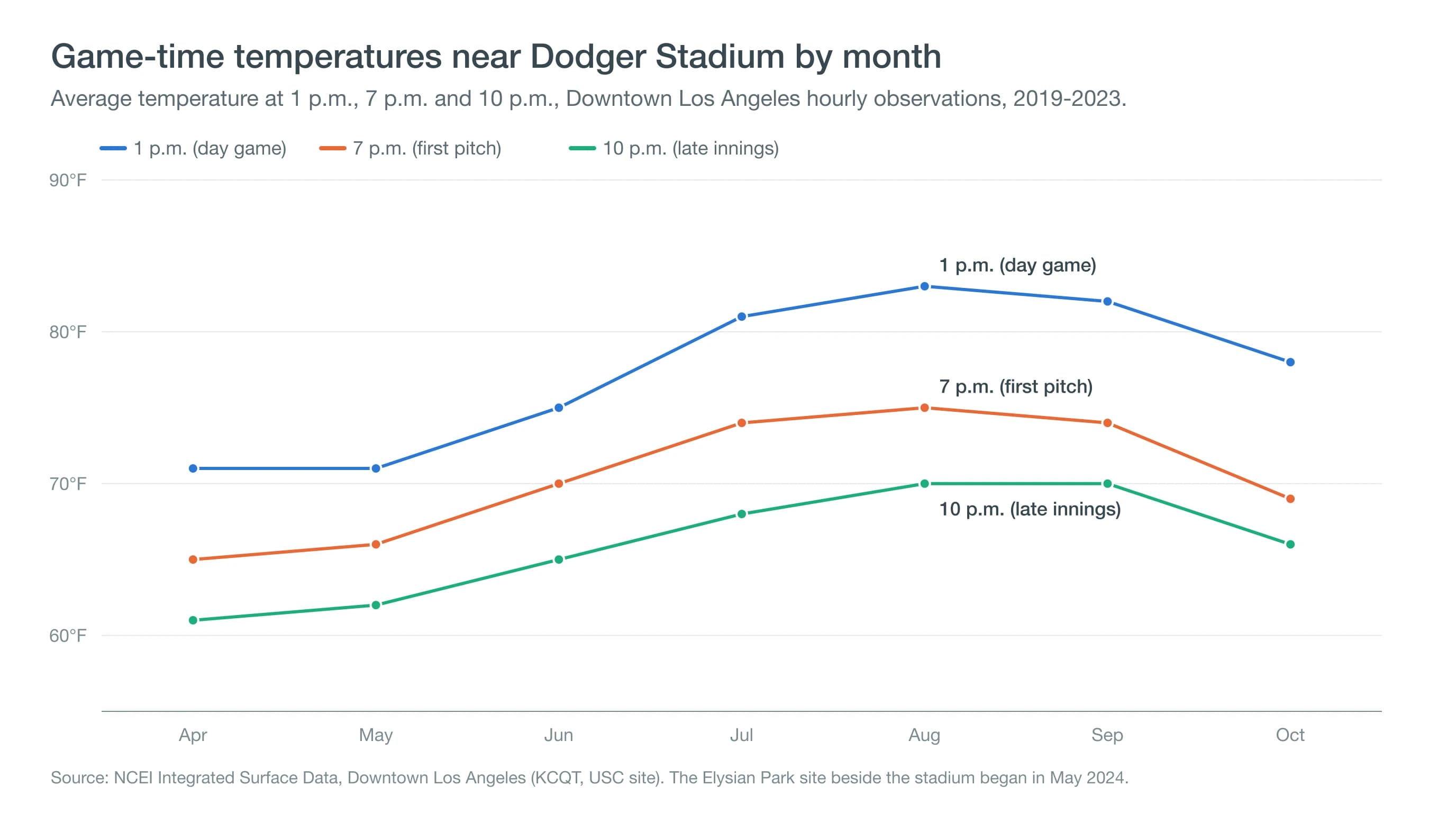
Dodger Stadium weather is mild most of the season. For a 7:10 p.m. game, expect about 65°F at first pitch in April, 70°F in June, 75°F in August and 69°F in October, dropping another 4 to 7 degrees by the late innings. Summer day games run in the low 80s. The third-base side, the odd-numbered sections, gets shade first, and rainouts are rare: only 17 in the ballpark's first six decades.
When the National Weather Service reports the temperature in Downtown Los Angeles, it is now reading a thermometer beside Dodger Stadium. On May 20, 2024, the official Downtown station moved to the Frank Hotchkin Memorial Training Center on the south side of the stadium, in Elysian Park.
The new site's first September brought 112°F. Most nights are much milder. Chavez Ravine sits inland, away from the ocean breeze, so it heats up in the afternoon and cools off fast after dark.
What Is the Weather Usually Like at Dodger Stadium?
Dodger Stadium weather is pleasant for most games, with two exceptions: chilly spring and postseason nights, and a few scorching day games in late summer. The averages below come from hourly observations at the Downtown station from 2019 to 2023, when it sat at USC. The new site beside the stadium sits farther from the ocean, so hot afternoons there may run a bit warmer than these numbers.
| Month | First pitch (7 p.m.) | Late innings (10 p.m.) | What it means |
|---|---|---|---|
| April | 65°F | 61°F | Jacket weather by the late innings |
| May | 66°F | 62°F | Often gray and cool at night |
| June | 70°F | 65°F | Long sleeves for the last few innings |
| July | 74°F | 68°F | T-shirt weather with a light layer |
| August | 75°F | 70°F | Warmest nights of the season |
| September | 74°F | 70°F | Heat-wave risk for day games |
| October | 69°F | 66°F | Postseason nights call for a jacket |
How Cold Does Dodger Stadium Get at Night?
Dodger Stadium gets colder at night than visitors expect. A typical April night game starts near 65°F and ends near 61°F, and a breeze in the upper deck makes it feel cooler. May and June nights are often gray and damp when the marine layer pushes inland.
From July through September, most night games stay in the low 70s, though temperatures still drop after sunset. October playoff nights average about 69°F at first pitch and 66°F by the late innings, and some nights run well below that.
April nights surprise many fans. From 2019 to 2023, the Downtown station dropped below 60°F by 10 p.m. on about half of April nights and on roughly one May night in five. From June through September it almost never did.
Is Dodger Stadium Warmer Than the Beach?
Dodger Stadium is warmer than the beach in the afternoon, but only barely by the late innings. Chavez Ravine sits about 14 miles from the ocean, and on a typical July day from 2019 to 2023 the Downtown station ran about 9 degrees warmer than the Santa Monica Airport station at 1 p.m. By 7 p.m. the gap is about 6 degrees, and by 10 p.m. it is down to about 3. Inland air heats up quickly in the afternoon sun and loses that heat quickly after dark, while the ocean holds the coast's temperature steady.
| Time | Downtown (stadium area) | Santa Monica Airport | Difference |
|---|---|---|---|
| 1 p.m. | 81°F | 72°F | 9°F |
| 7 p.m. | 74°F | 68°F | 6°F |
| 10 p.m. | 68°F | 65°F | 3°F |
Fans coming from the Westside will want about the same hoodie for the ninth inning that they would wear on the beach at night. Fans coming from the San Fernando Valley get the opposite surprise: on a summer afternoon the stadium is usually cooler than home. The microclimates explainer covers why a few miles make that much difference in Los Angeles.
Which Seats at Dodger Stadium Are in the Shade?
At Dodger Stadium, the third-base side gets shade first during day games. Home plate faces roughly north and the sun sets beyond the left-field side. The upper decks along the third-base line, where the odd-numbered sections are, fall into the stadium's shadow earlier in the afternoon.
The first-base field level and the right-field pavilion stay in direct sun the longest. For a 1:10 p.m. game in summer, a third-base seat under an overhang is far more comfortable than a sunny pavilion seat.
At night games in June and July, the sun does not set until after 8 p.m. (about 8:08 p.m. near the summer solstice). As a result, fans on the first-base side can have low sun in their eyes for the first few innings. By mid-September, sunset is around 7:01 p.m., just before first pitch, and by mid-October it is about 6:20 p.m., so postseason night games start in the dark and cool from the first inning. Southern California sun is strong enough to burn in an afternoon; the LA UV index explainer shows why.
How Hot Are Day Games at Dodger Stadium?
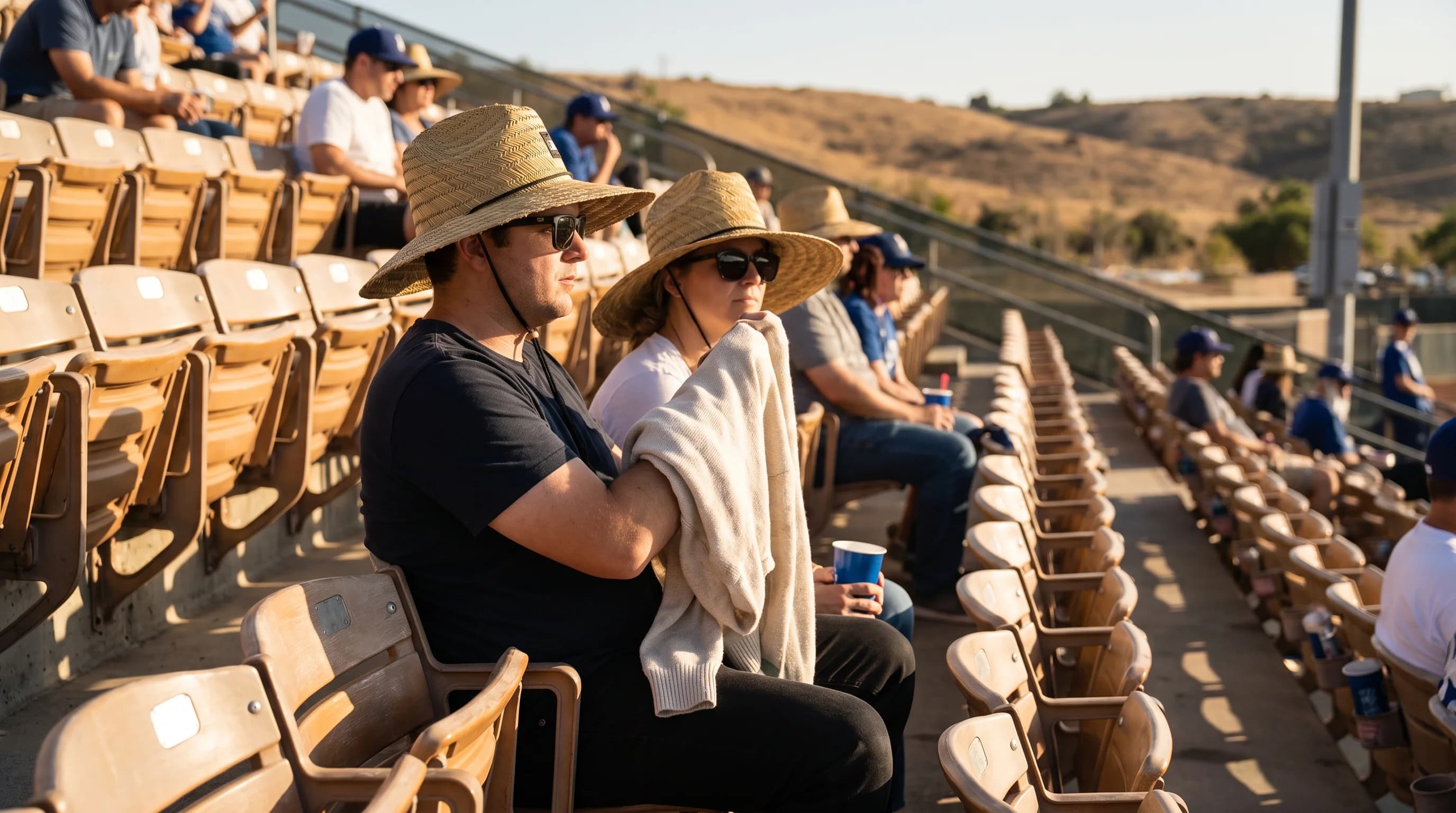
Day games at Dodger Stadium run warm to hot. The 1 p.m. average is about 71°F in April, 81°F in July, 83°F in August and 82°F in September, and heat waves push far beyond that. The Downtown station beside the stadium hit 112°F on September 6, 2024, and 105°F on September 9, 2026. Late-season day games carry the most heat risk because LA's hottest weather comes late in summer.
On the muggy late-summer days when tropical moisture drifts in, the air feels hotter than the thermometer reads, which is what the heat index measures. Bring water: the ballpark allows sealed plastic bottles of one liter or less.
Does It Ever Rain Out a Dodgers Game?
Rain rarely stops a Dodgers game. The stadium opened in 1962 and did not see its first rainout until April 21, 1967, and it counted only 17 rainouts through 2023, nine of them in April. From 2000 to 2018 the Dodgers played 1,471 straight home games without one.
Downtown averages less than a tenth of an inch of rain a month from June through September and 0.58 inches in October, so the rain risk is mostly in April and, occasionally, October. Most of the city's rain falls from November through March, outside the regular season, as LA's wet-winter guide explains.
If showers are in the forecast, bring a poncho or rain jacket. Umbrellas are not allowed inside UNIQLO Field at Dodger Stadium.
What Is the Best Month for Weather at a Dodgers Game?
The best months for weather at a Dodgers night game are June through September. First pitch averages 70°F to 75°F, and the late innings average 65°F to 70°F. June nights are often gray under the marine layer, but they are mild.
For day games, April and May are the most comfortable, at about 71°F at 1 p.m. The riskiest games come at either end of the season: an April night game, which can end in the 50s, and a September day game, when LA's worst heat waves usually arrive.
What Should You Wear to a Dodgers Game?
Wear layers to a Dodgers night game: a T-shirt for first pitch and a hoodie or light jacket for the late innings, especially in April, May, June and October. For day games, wear a hat, sunglasses and sunscreen, and choose light colors. Check the bag rule before you go: the stadium allows clear bags up to 12 by 12 by 6 inches or small clutches up to 5 by 8 by 2 inches.
Dodger Stadium rarely has bad weather, but temperatures change during a game, and one extra layer usually makes the difference. Before you head to Chavez Ravine, check the hourly forecast for first pitch and the ninth inning on our Downtown Los Angeles and Echo Park pages, the closest neighborhoods to the stadium. For football in Inglewood, see SoFi Stadium weather.