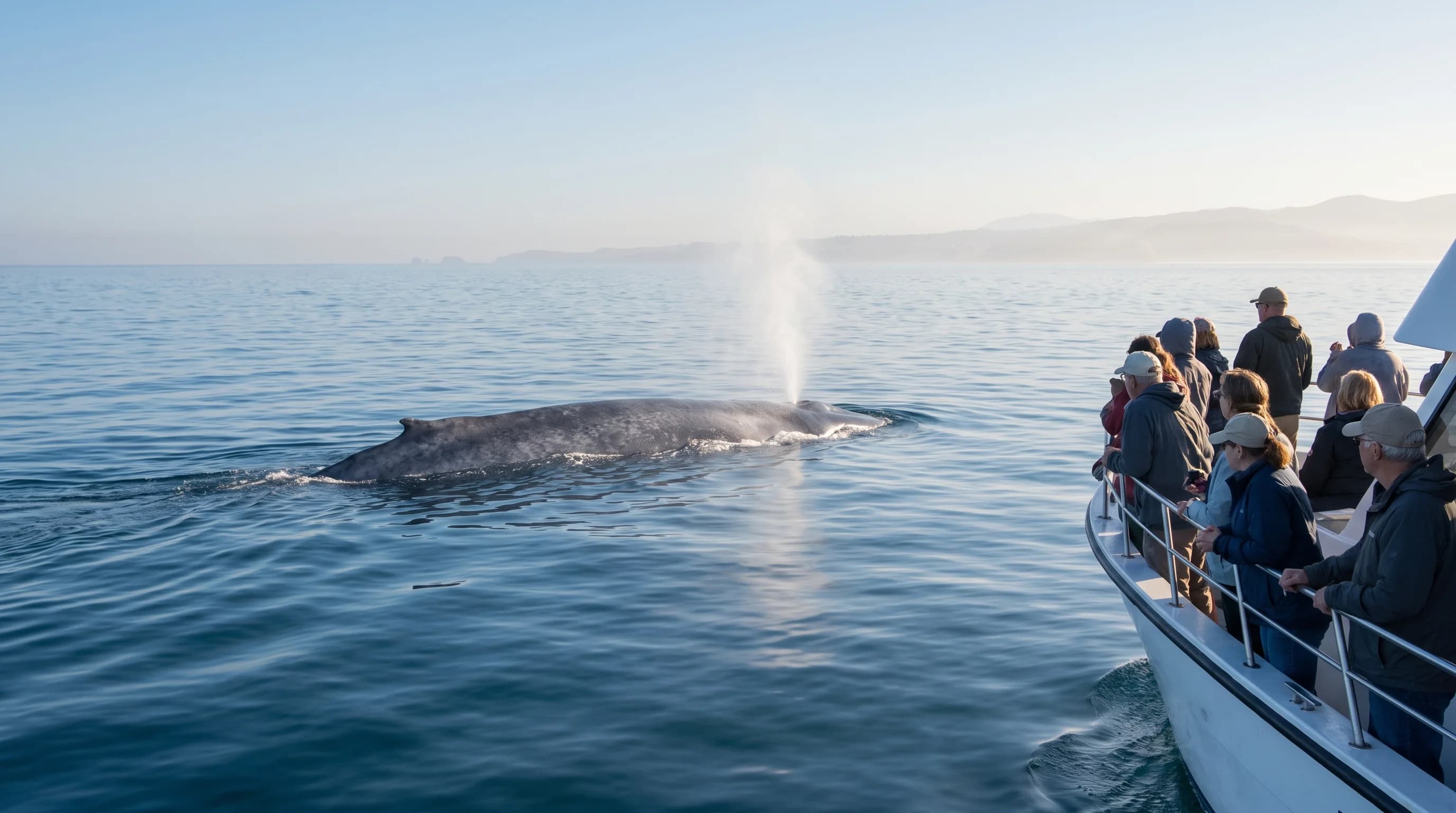
Southern California has two main whale seasons. Gray whales migrate past the coast from about December to May, and blue whales feed offshore from about late June to early October, peaking in July and August. Sea conditions follow the opposite pattern: gray whale season brings the roughest water, with waves averaging 4 to 5 feet offshore in winter, while blue whale season brings the calmest, about 3 feet. For the smoothest ride, go in summer or early fall and book a morning trip.
The Santa Monica Basin buoy, about 35 miles off Santa Monica, shows the difference. In February, about one afternoon reading in seven shows wind of 15 knots or more. From June through August, almost none do. Blue whales, the largest animals that have ever lived, feed off Los Angeles during that calm stretch.
When Is Whale-Watching Season in Southern California?
Gray whales pass from December to May, blue whales visit from summer into early fall, and common and bottlenose dolphins are around all year. Humpback, fin and minke whales also appear, often in the warmer months. Most trips leave from Long Beach, San Pedro, Redondo Beach, Marina del Rey, Newport Beach and Dana Point.
| Months | Whales | Sea conditions |
|---|---|---|
| December-February | Gray whales heading south to Baja | Roughest seas: waves average 4 to 5 ft offshore; cold on deck |
| March-May | Gray whales heading north, some with calves | Waves easing; windy spring afternoons |
| June-September | Blue whales, peaking in July and August | Calmest seas, about 3 ft; gray mornings in June |
| October-November | Late blue whales; dolphins year-round | Generally calm; occasional gusty Santa Ana days |
Winter sightings are less certain than they were a decade ago. At the long-running ACS-LA census at Point Vicente in Palos Verdes, volunteers counted just 130 southbound gray whales in 2024-25, a record low, with no newborn calves for the first time. The 2025-26 season ended in May with 214 southbound and a record-low 445 northbound.
NOAA's newest population estimate, released in July 2026, jumped to about 17,750 from about 12,890, but NOAA cautioned that the increase likely exceeds what the population could produce, so changes in migration habits may explain part of it. Fewer gray whales are passing close to shore, whatever the total.
Which Months Have the Calmest Seas for a Whale-Watching Trip?
The calmest seas for whale watching off Southern California come from June through October. At buoy 46025 in the Santa Monica Basin, average wave height falls from about 4.9 feet in January to 3.1 feet in July and August, and strong afternoon winds nearly disappear. January through March are the roughest months, when Pacific storms send long-period swell toward the coast and strong northwest winds follow each storm. How that swell affects the shore is covered in high surf in LA.
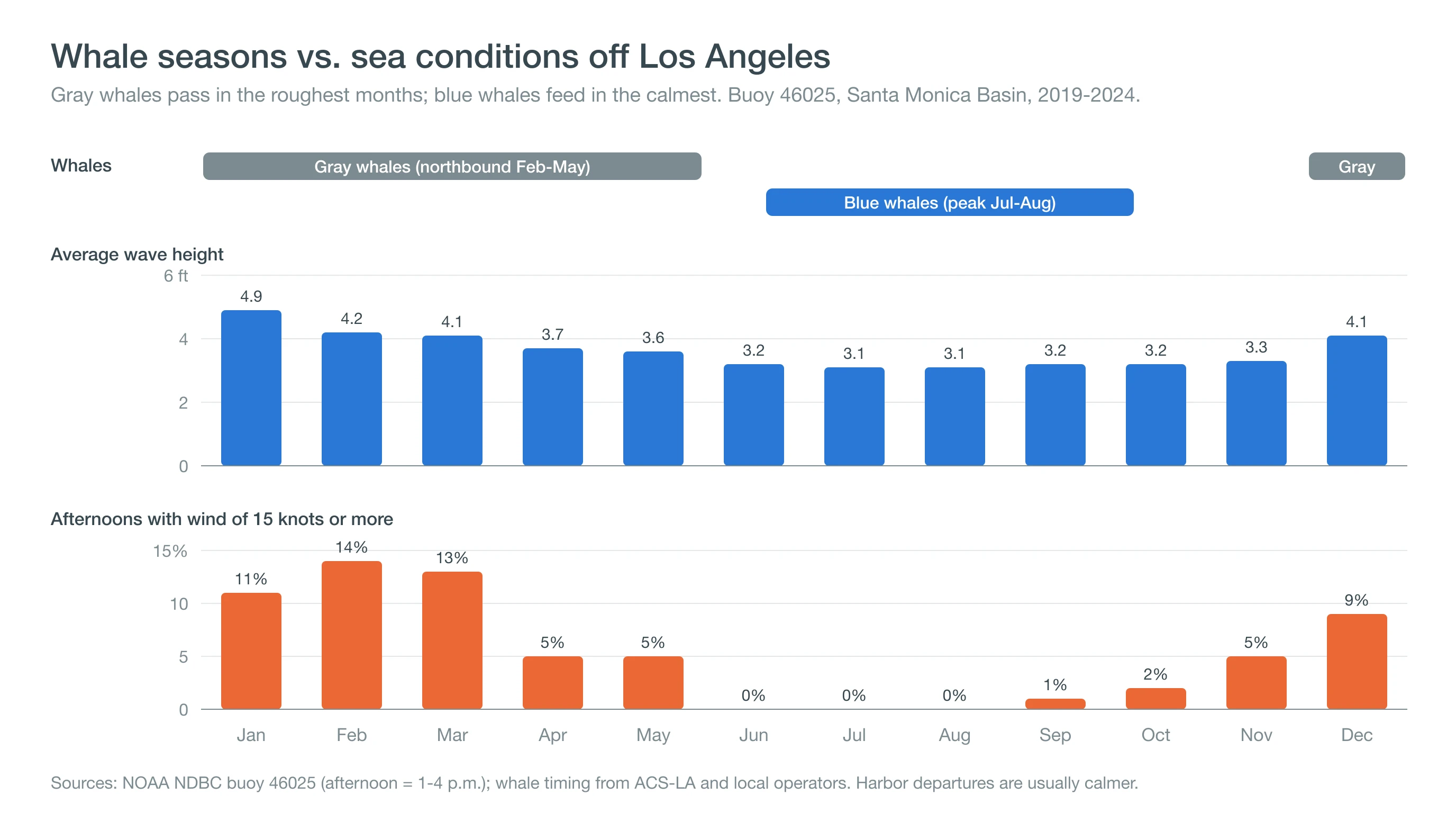
The buoy sits in open water. Harbor departures and trips that stay along the coast are usually calmer, and a boat moving with the swell rides more smoothly than one heading into it. Spring can still be rough: April and May waves are smaller than winter's, but northwest winds can still make afternoons choppy. Boats sometimes cross reddish-brown patches of water during a red tide, a dense plankton bloom.
Is a Morning or Afternoon Whale-Watching Trip Better?
A morning whale-watching trip is better from spring through fall. Between March and November, the buoy's average wind is lighter from 7 to 10 a.m. than from 1 to 4 p.m. every month. In July it averages 4.6 knots in the morning and 6.7 in the afternoon, as the sea breeze builds. Winter is the exception. From December through February, morning and afternoon winds are about the same, because the wind comes with passing storms rather than the daily sea breeze, so check the forecast rather than assuming mornings are calmer.
If you are prone to seasickness, a calm morning helps more than anything else. Sit low and near the middle of the boat, where motion is smallest, keep your eyes on the horizon, stay out of the diesel fumes, and take any motion-sickness medicine before you board rather than once you feel ill.
Can Fog or June Gloom Ruin a Whale-Watching Trip?
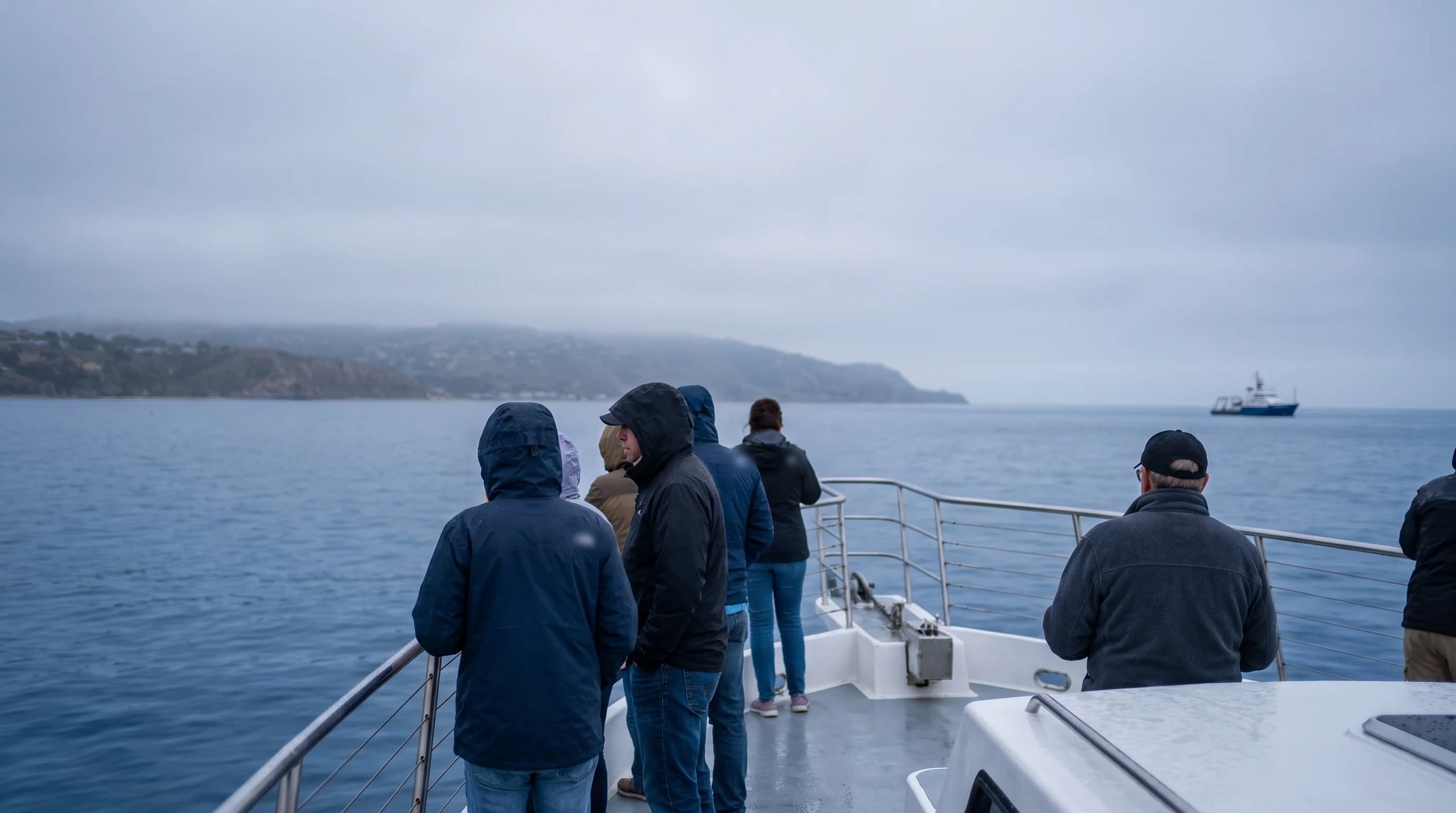
Fog or June Gloom rarely cancels a whale-watching trip, but it can make whales harder to spot. From May into July, the marine layer often covers the coast in the morning, and in thick fog the distant blow of a whale, the first thing crews look for, can disappear in the gray. The clouds usually lift by late morning or early afternoon, but that is also when the wind picks up. On gray days, a midday trip balances visibility and a smooth ride.
Blue whales come here to eat krill, which thrive in the cold, nutrient-rich water that upwelling brings to the surface. The same process that makes the ocean cold for swimmers feeds the largest animals on Earth.
What Should You Wear on a Whale-Watching Boat?
Wear more on a whale-watching boat than you think, in every season. The ocean off Los Angeles averages about 59°F in winter and only reaches about 70°F in late summer, according to NOAA's Santa Monica Pier gauge, and the air over the water stays cool. With the breeze of a moving boat, a winter deck can feel close to 50°F. Bring a windproof jacket and a warm layer year-round, plus a hat in winter.
Add sunglasses and sunscreen, since glare off the water is strong even under thin clouds, and wear closed-toe shoes with good grip for wet decks. Pack a dry layer in a small bag on winter trips, when spray can soak the bow.
How Do You Check Conditions Before a Whale-Watching Cruise?
Before a whale-watching cruise, read the National Weather Service coastal waters forecast for the inner waters from Point Mugu to San Mateo Point, including Catalina (see Catalina Island weather by month for ferry-crossing seasons). It lists wind speed, wave height and swell period for each period of the day, along with any small craft advisory. Winds under about 10 knots and waves under about 4 feet are a good sign for a comfortable trip; an advisory usually means a rough one, or a cancellation. The wind hazards guide explains how to read gusts, and rogue waves explains why a calm-looking sea can still produce a large wave.
Then check the operator's policy. Many offer a free return trip if no whales are seen, and most will cancel or shorten a trip when conditions are unsafe. Sightings are never guaranteed. Pick your season for the whales you want to see, pick the morning for the calmest water, and check the coastal forecast for Long Beach or Santa Monica the day before you go.