phenomenaskybeach weathertips

What Causes the Green Flash at a SoCal Sunset?

By WeatherLA|Published |Last updated |11 min read
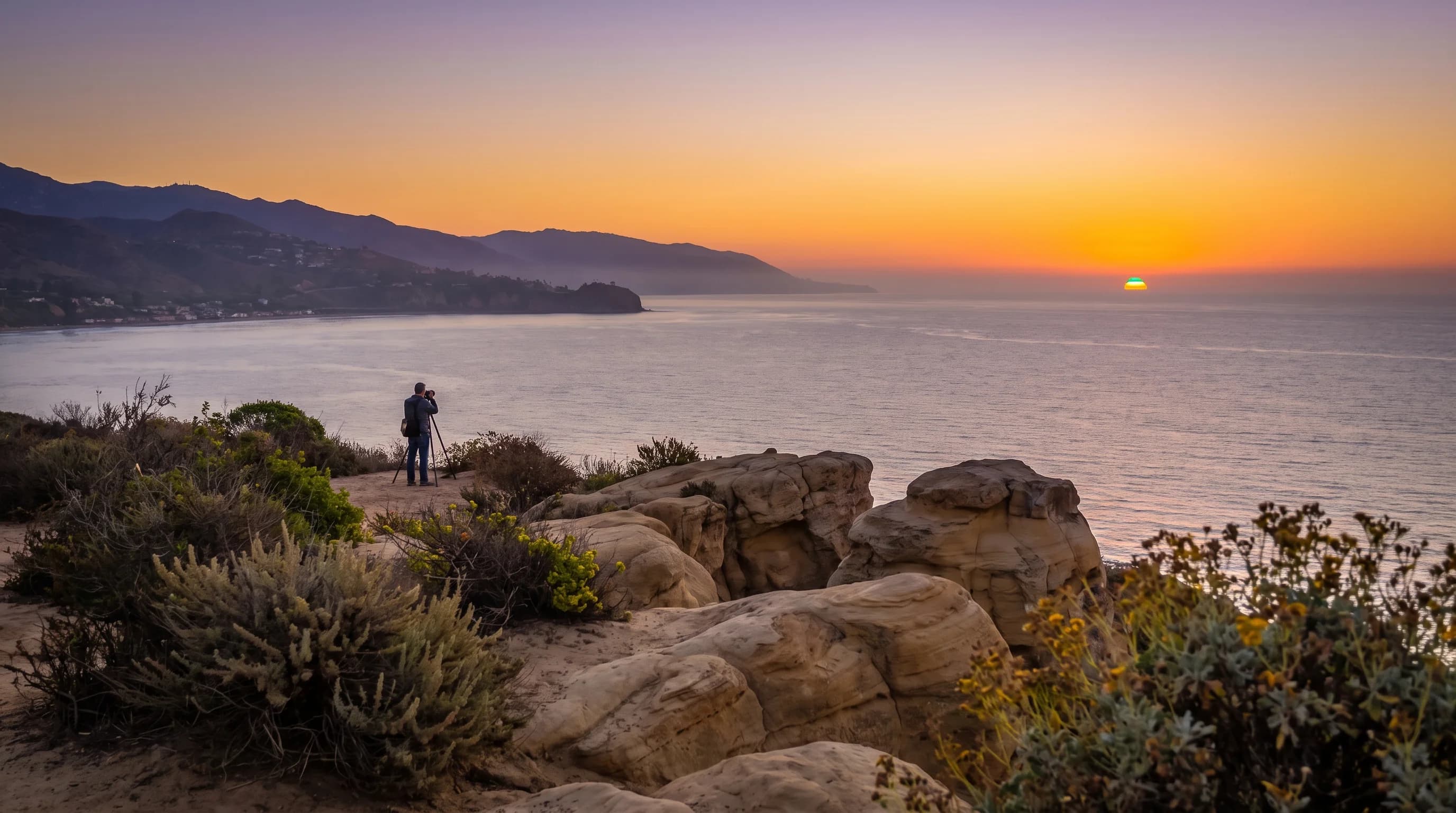
A small, real green rim glowing at the top edge of the Sun as it sets into a clear Pacific Ocean horizon off the Southern California coast

Key Takeaways

  • The green flash is a real, documented atmospheric refraction effect, not a myth, a camera artifact, or an afterimage, though it is genuinely easy to miss.
  • It appears as a small green rim, dot, or brief flare at the very top of the Sun in the last second or two before the disc fully disappears below the horizon, not a sky-filling green burst.
  • The cause is refraction and dispersion: Earth's atmosphere bends and slightly separates sunlight by color, and green light lingers a fraction of a second after red, orange, and yellow have already sunk from view.
  • A clear, distant, unobstructed horizon is the single biggest factor in whether a green flash is visible; haze, clouds, and a low marine layer near the horizon are the most common reasons a sighting fails.
  • West-facing Southern California beaches with an open Pacific horizon, including Malibu, Santa Monica, Newport Beach, and Laguna Beach, give viewers a genuine shot, though nothing guarantees a sighting on a given evening.
  • Never stare at the Sun through binoculars, a telescope, or a camera viewfinder without certified solar protection; watch with the naked eye only in the final moment before sunset, following NASA solar-viewing safety guidance.

The green flash is a real atmospheric refraction effect that can appear for a second or two at the top edge of the Sun as it sets over a clear, distant horizon. It is not a camera trick, an afterimage, or a myth. Along the open Pacific horizon off Malibu, Santa Monica, Newport Beach, and Laguna Beach, a clean sunset with no haze or clouds sitting on the water gives Southern California coast watchers a genuine, if brief, chance to see it.

What Is the Green Flash at Sunset?

The green flash is a brief green rim, spot, or flare that can appear at the upper edge of the Sun as its final sliver disappears below a distant horizon. It is small. Anyone expecting a neon burst that lights up the sky is picturing the wrong thing; the real effect is a thin, bright green edge or a compact green dot that survives for roughly a second or two after the rest of the solar disc has gone out of view. It happens at the exact moment of sunset, not several minutes before or after, and it can also happen at sunrise, at the instant the Sun's upper limb first clears the horizon.

Sunset versions are easier to catch simply because the timing is easier to anticipate: an observer watches the Sun visibly approach the horizon and knows roughly when to be ready, while a sunrise sighting requires being in position and watching a spot on the horizon before there is any Sun to track yet.

By definition, the green flash is not lightning, not a bioluminescent glow off the ocean surface, and not a lens artifact introduced by a phone or camera. It is a genuine optical event happening in the sky, caused by how the atmosphere bends and separates sunlight right at the horizon. That distinction matters because a lot of online chatter blurs the green flash together with unrelated green lights, from ship running lights to algae blooms, none of which have anything to do with the actual phenomenon.

Is the Green Flash Real?

Yes, the green flash is a documented optical effect, described in atmospheric optics references and covered by NOAA's overview of optical phenomena, though photographs and telephoto video can make it look larger and more saturated than what most naked-eye observers actually see. A picture shot with a long lens and processed for color can turn a subtle green sliver into a vivid green fireball, which sets expectations that the real sky event rarely meets. That gap between photographed and naked-eye versions of the green flash is probably the single biggest reason people doubt it is real after failing to see the dramatic version they expected.

It is also worth separating the green flash from retinal afterimages, which are a completely different phenomenon. After staring at any bright light source, including the Sun, the eye can produce a lingering colored ghost image once you look away, often reddish or greenish depending on how the retina's light receptors were fatigued. That afterimage is real too, but it originates in the eye, not in the sky, and it is a separate reason on its own not to stare at the setting Sun for an extended period while waiting for a flash. The genuine green flash is a brief external event visible at the horizon, not something your eyes generate after the fact.

What Causes the Green Flash?

The green flash forms because Earth's atmosphere refracts the setting Sun and separates its colors slightly, a process that lets green light remain visible for a moment after red, orange, and yellow light have already sunk out of view. Refraction is the bending of light as it passes through a medium of changing density, and the atmosphere gets denser closer to the ground. Sunlight grazing the horizon travels through the thickest, most angled slice of atmosphere it will encounter all day, so it bends more there than at any other point in the Sun's path across the sky.

That bending does not treat every color of light identically, a related effect called dispersion. Just as a glass prism splits white light into a spectrum, the atmosphere splits the setting Sun's light by wavelength, bending blue and violet light the most and red light the least. In principle that should put a blue or violet rim above the red one at the top of the setting Sun's disc. In practice, blue and violet light scatter across the sky and get absorbed by the long, hazy path of atmosphere near the horizon far more than green light does, which is why the sky itself looks blue in the first place.

By the time sunlight has traveled the extremely long, low path to a horizon observer, most of the blue and violet has been filtered out, leaving green as the last color still concentrated enough at the Sun's upper limb to be seen as a distinct flash after red and yellow have already disappeared.

Temperature layering in the air near the ocean surface adds a second variable. When air temperature changes sharply with height just above the water, usually because the ocean surface is cooler than the air above it, the resulting temperature gradient can stretch, compress, or duplicate the image of the Sun's upper limb in ways related to mirage formation. That stretching can make a green flash more visible by holding the thin green rim in view slightly longer, or it can distort the solar disc in ways that make the effect harder to pick out. This is part of why the same beach can produce a clean, easy-to-see flash on one evening and nothing at all the next, even under what looks like a similarly clear sky.

Conditions That Help or Hide a Green Flash
ConditionEffect on viewingSouthern California example
Clear, distant horizonLets the final solar rim remain visibleOpen Pacific view from a west-facing beach or bluff at Laguna Beach
Low haze and few horizon cloudsReduces obscuration of the last solar limbA clean, post-front coastal evening
Strong near-horizon refractionCan stretch and separate the solar imageTemperature layering over the ocean surface
Elevated viewpointCan extend the visible horizon slightlyA safe coastal bluff or overlook, not a crowded roadway
Marine haze or a low cloud bankUsually blocks the final limb entirelySunset disappearing into a cloud deck before reaching the water

Favorable conditions improve the opportunity to see a green flash, but nothing on that list guarantees a sighting on a given evening. The atmosphere near any real ocean horizon is rarely perfectly uniform, and small pockets of haze or a passing wisp of low cloud can block the view even after a day that looked completely clear from the beach.

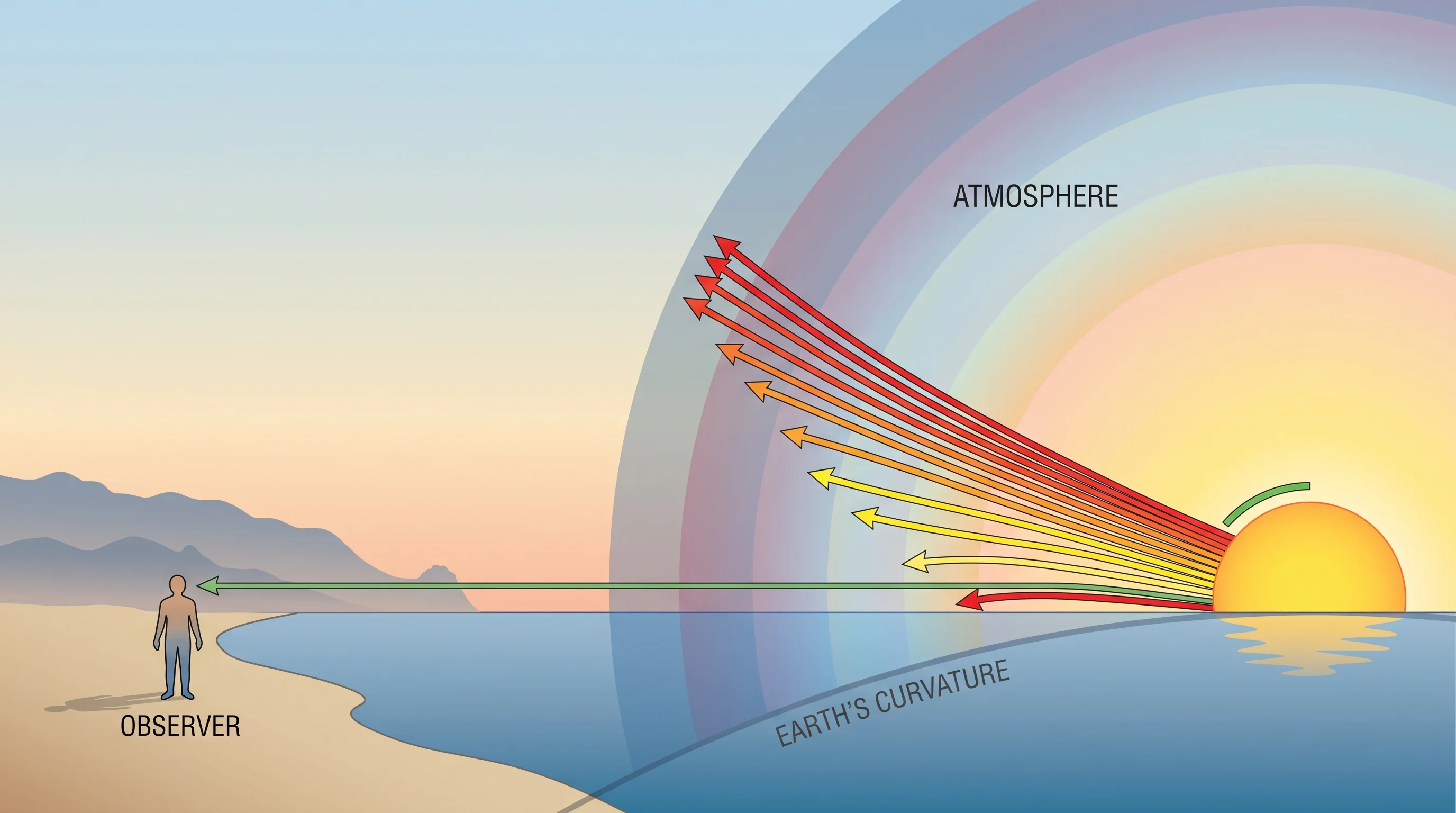
Diagram showing sunlight from the setting Sun's upper limb bending through the atmosphere near the ocean horizon, with red, orange, and yellow rays sinking out of view first and a thin green ray remaining visible to an observer on a beach
Atmospheric refraction bends sunlight near the horizon, and dispersion separates it slightly by color, leaving a brief green rim visible after red and yellow light have already set.

How Rare Is the Green Flash?

The effect is uncommon in ordinary, casual viewing because it is tiny, brief, and easily blocked, but it is not extraordinarily rare in the atmosphere itself when observers repeatedly watch a clear ocean horizon under favorable conditions. Someone who glances at the sunset once, from an inland patio with hills, buildings, or haze along the actual horizon, is unlikely to see it regardless of how often the effect technically occurs somewhere along the coast that evening. Someone who deliberately watches a clean, unobstructed Pacific horizon on repeated clear evenings, paying attention specifically to the final second of sunset, reports success far more often.

It helps to separate two different claims that get blurred together. "Rare to a casual observer" is true: most people who have watched hundreds of sunsets in their life have still never deliberately looked for a green flash at the correct moment with a genuinely open horizon. "Rare in the atmosphere" is a different and weaker claim, since the physical conditions that produce a green flash, namely a clear low-angle sight line to the setting Sun, occur on plenty of evenings along the SoCal coast. The gap between those two ideas is mostly about horizon quality, atmospheric haze that varies night to night, and whether anyone is actually watching closely at the right second.

Where Can You See the Green Flash in Southern California?

The best SoCal opportunities come from safe, west-facing beaches and elevated coastal viewpoints with an unobstructed Pacific horizon. Malibu's coastline and bluffs, Santa Monica's beach and pier area, Newport Beach, and Laguna Beach's coves and overlooks are commonly cited examples, not a ranked list and not a guarantee that any one of them outperforms the others on a given evening. What matters most at any of these spots is whether the sight line straight toward the setting Sun is open ocean rather than obstructed by land, since a beautiful beach with a great sunset view can still have its horizon partly blocked depending on exactly where the Sun sets relative to the coastline that day.

Offshore land is a real factor to check before counting on a clear horizon. Santa Catalina Island sits far enough offshore that it can interrupt a portion of the horizon from certain SoCal beaches depending on the viewer's exact location and the time of year, since the Sun's setting position, its azimuth, shifts along the horizon through the seasons. A spot that has open ocean straight ahead in one season can have the island sitting almost exactly where the Sun sets a few months later.

Long Beach's more sheltered, harbor-facing stretches are a good example of a coastal location where the immediate view is often more obstructed than a fully open beach further up the coast, so it is worth checking the sunset direction and horizon before setting up. Checking sunset time along with coastal cloud cover, haze, and visibility for the specific evening and specific beach, rather than assuming yesterday's clear sky repeats tonight, is the most useful single step before heading out.

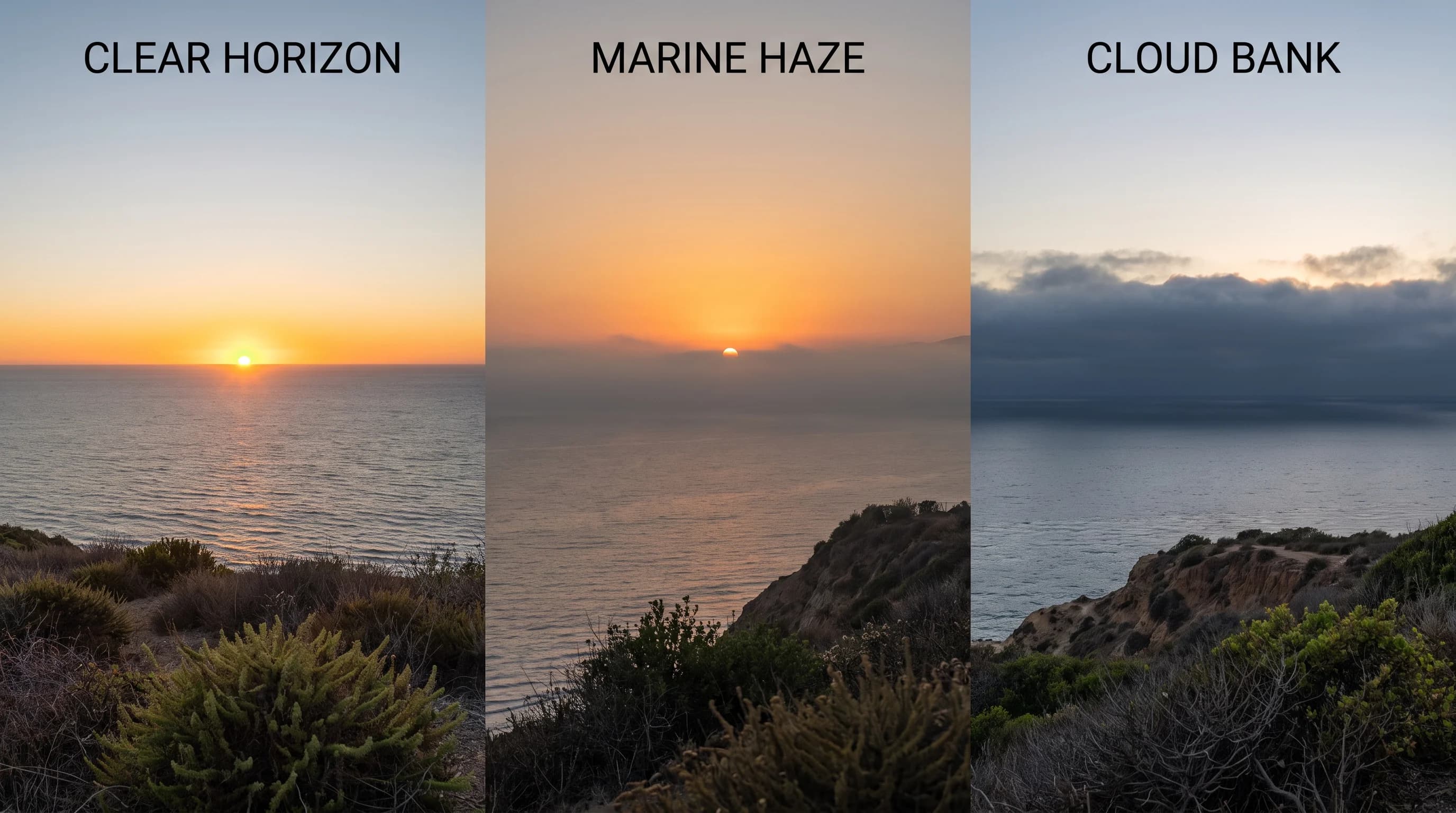
Side-by-side comparison of Southern California coastal horizons, one open and clear over the Pacific Ocean, one with low marine haze near the water, and one blocked by a bank of clouds sitting on the horizon
A clear, open Pacific horizon gives a green flash its best chance, while marine haze or a low cloud bank sitting right on the water usually hides the final moment of sunset entirely.

How Do You Watch or Photograph the Green Flash Safely?

Wait until the Sun is essentially at the horizon, avoid staring at it for any extended period beforehand, and never look at the setting Sun through binoculars, a telescope, or an optical camera viewfinder without certified solar protection. The safest approach is to glance toward the Sun only briefly as it nears the horizon, look away between glances, and reserve sustained attention for the final few seconds once the disc is mostly below the water line and its brightness has dropped enough to view comfortably with the naked eye. The NASA solar-viewing safety guidance developed for eclipse viewing applies here too: unprotected magnified viewing of the Sun, even a partially set Sun, can damage your eyes, and standard sunglasses are not adequate protection for magnified optics.

For photography, frame the scene in advance using the camera's screen rather than a magnified optical viewfinder, and use a long enough lens or crop to see the Sun's upper limb clearly without needing to view it directly and magnified through an eyepiece. A tripod helps, since the flash lasts only a second or two and a shaky handheld frame can miss it entirely. This page intentionally does not provide technical solar-filter specifications for extended direct viewing, since that goes beyond a brief sunset glance and should be handled with equipment rated for solar observation, per NASA's authoritative safety guidance linked above.

Before heading out, check the sunset time and coastal visibility for the destination you have in mind. A hazy afternoon with a clean-looking sky overhead can still have enough moisture or particulate sitting right at the horizon to block the flash, so conditions should be checked close to sunset rather than assumed from earlier in the day. WeatherEscape's Los Angeles destination pages show current cloud cover, visibility, and sunset time for coastal spots like Malibu and Newport Beach, which is a practical way to decide whether tonight is worth the trip to the water's edge.

The green flash rewards patience more than luck. It takes a genuinely open horizon, a clear final few minutes of daylight, and someone actually watching the exact moment the Sun's last sliver sinks from view, not a special camera or a rare celestial alignment. Southern California's west-facing coast gives that combination a real chance on plenty of evenings each year. Check the coastal cloud cover and sunset time for your chosen beach, get in position early, and watch the horizon closely in that last safe second before the Sun disappears. Check the Los Angeles marine layer before choosing a viewing night, and see the Southern California red-tide guide for another coastal optical phenomenon with a very different cause.

Frequently Asked Questions

What is a green flash at sunset?

A green flash is a brief green rim, spot, or flare that can appear at the upper edge of the Sun in the last second or two before it fully disappears below a distant horizon. It is small and fast, not a sky-wide glow, and it is easiest to notice over a clear, unobstructed ocean horizon like the open Pacific off the Southern California coast. The same effect can occur at sunrise, but sunset is easier to anticipate since observers already know roughly where and when the Sun will set.

Is the green flash real?

Yes. The green flash is a documented optical effect caused by how Earth's atmosphere refracts and separates sunlight near the horizon, described by NOAA and covered in atmospheric optics literature. It is not folklore, and it is not the same thing as the harmless colored afterimage the eye can produce after looking toward a bright light, which is a separate retinal effect rather than something actually happening in the sky. Photographs and telephoto video can make the effect look larger and more saturated than what the naked eye typically sees, so expectations set by a dramatic photo are often disappointed by the real, subtler sight.

What causes the green flash over the ocean?

The green flash forms because the atmosphere acts like a weak prism for the setting Sun, refracting its light and separating that light slightly by color, a process called dispersion. Blue and violet light bend the most but usually scatter out of view or get absorbed before reaching an observer at the horizon, while red, orange, and yellow light sink out of sight first as the Sun sets. That leaves a narrow window where green light from the Sun's upper limb is the last color still visible, producing the flash. Temperature layering in the air near the ocean surface can add mirage-like stretching or distortion that makes the green rim easier or harder to see.

How rare is the green flash?

It is uncommon for a casual, one-time sunset watcher to see it, mainly because the flash is small, brief, and easily hidden by haze, clouds, or an obstructed horizon, not because the atmosphere rarely produces the conditions for it. Observers who repeatedly watch a clear, open ocean horizon under good conditions report seeing it more often than the effect's reputation suggests. It is best described as rare to an inattentive or unlucky observer, but not extraordinarily rare in the atmosphere itself when the horizon is genuinely clear.

Where can you see a green flash in Southern California?

The best opportunities are safe, west-facing beaches and elevated coastal viewpoints with an unobstructed Pacific horizon, including stretches of Malibu, Santa Monica, Newport Beach, and Laguna Beach. An elevated bluff or overlook can extend the usable horizon slightly compared to standing at sea level on the sand. Offshore land such as Catalina Island can interrupt part of the horizon depending on exactly where along the coast someone is standing, so it helps to check the sunset azimuth and confirm the horizon in that direction is actually open ocean rather than land.

How long does a green flash last?

A green flash typically lasts only a second or two, right at the moment the last sliver of the Sun's upper limb sinks below the horizon. That brevity is one of the main reasons the effect is easy to miss even when conditions are favorable; a shift in attention of even a few seconds around sunset can mean missing the entire window.

Has the green flash ever been recorded?

Yes, the green flash has been photographed and documented many times, including in imagery and observation notes referenced by NOAA. Well-exposed photographs and telephoto sequences can capture the effect clearly, though they often make the green rim look larger and more vivid than what a naked-eye observer sees in person, since magnification and image processing exaggerate the color and size of the actual sky event.

Can you see a green flash at sunrise instead of sunset?

Yes, the same atmospheric refraction and dispersion that produce a sunset green flash can also produce one at sunrise, at the instant the Sun's upper limb first breaks the horizon. Sunrise sightings are less commonly reported mainly because they require knowing the precise moment and direction in advance and being in position before first light, which is logistically harder than watching a sunset that is already visibly approaching the horizon.

Related Destinations

Live Los Angeles Conditions

Compare temperature, wind, clouds, and comfort across the map.

See which microclimates are clear, cool, windy, smoky, or warming up right now.

Open the Weather Map
Destinations☀️Smog Forecast🌫️Smog Heat Map🔒Privacy Policy📄Terms of Service