Ground-level ozone is Southern California's most persistent air pollutant, an invisible gas that forms when sunlight reacts with vehicle and industrial emissions. No source releases ozone directly. Ozone builds through sunny afternoons and is usually worse inland, from the San Gabriel Valley to the Inland Empire, than at the beach, even though much of the traffic that supplies its ingredients is near the coast. Knowing when ozone peaks and how to read its AQI category lets you avoid breathing air the EPA classifies as unhealthy.
What Is Ground-Level Ozone?
Ground-level ozone is a gas that forms near the Earth's surface, in the air people breathe. No smokestack or tailpipe emits it. Ozone is a secondary pollutant: it forms through chemical reactions after other gases are already in the air. For that reason, the EPA and the California Air Resources Board (CARB) track ozone separately from the gases that create it.
Ground-level ozone is the main harmful ingredient in Los Angeles photochemical smog, covered in what is smog and how LA's photochemical haze forms. This article covers ozone itself: how it behaves, why it rises and falls through the day, what health guidance applies and how to read its AQI category. Ozone is invisible and has no smell. The brownish haze sometimes seen over the basin comes from other particles, so a clear sky over Downtown Los Angeles can still carry high ozone.
| AQI category | AQI value | 8-hour ozone (ppm) | General guidance |
|---|---|---|---|
| Good | 0-50 | 0.000-0.054 | Air quality is satisfactory for everyone |
| Moderate | 51-100 | 0.055-0.070 | Unusually sensitive individuals should consider limiting prolonged outdoor exertion |
| Unhealthy for Sensitive Groups | 101-150 | 0.071-0.085 | Children, older adults, people with lung disease, and active outdoor workers should reduce prolonged exertion |
| Unhealthy | 151-200 | 0.086-0.105 | Everyone should reduce prolonged or heavy outdoor exertion |
| Very Unhealthy | 201-300 | 0.106-0.200 | Everyone should avoid prolonged or heavy outdoor exertion |
The table above lists the official EPA 8-hour ozone breakpoints, which AirNow uses to convert a measured concentration into the 0-500 AQI scale. South Coast AQMD applies the same breakpoints across the South Coast Air Basin. An ozone AQI of 105 means the same ozone concentration at the coast or far inland.
How Do Sunlight, Nitrogen Oxides, and VOCs Create Ozone?
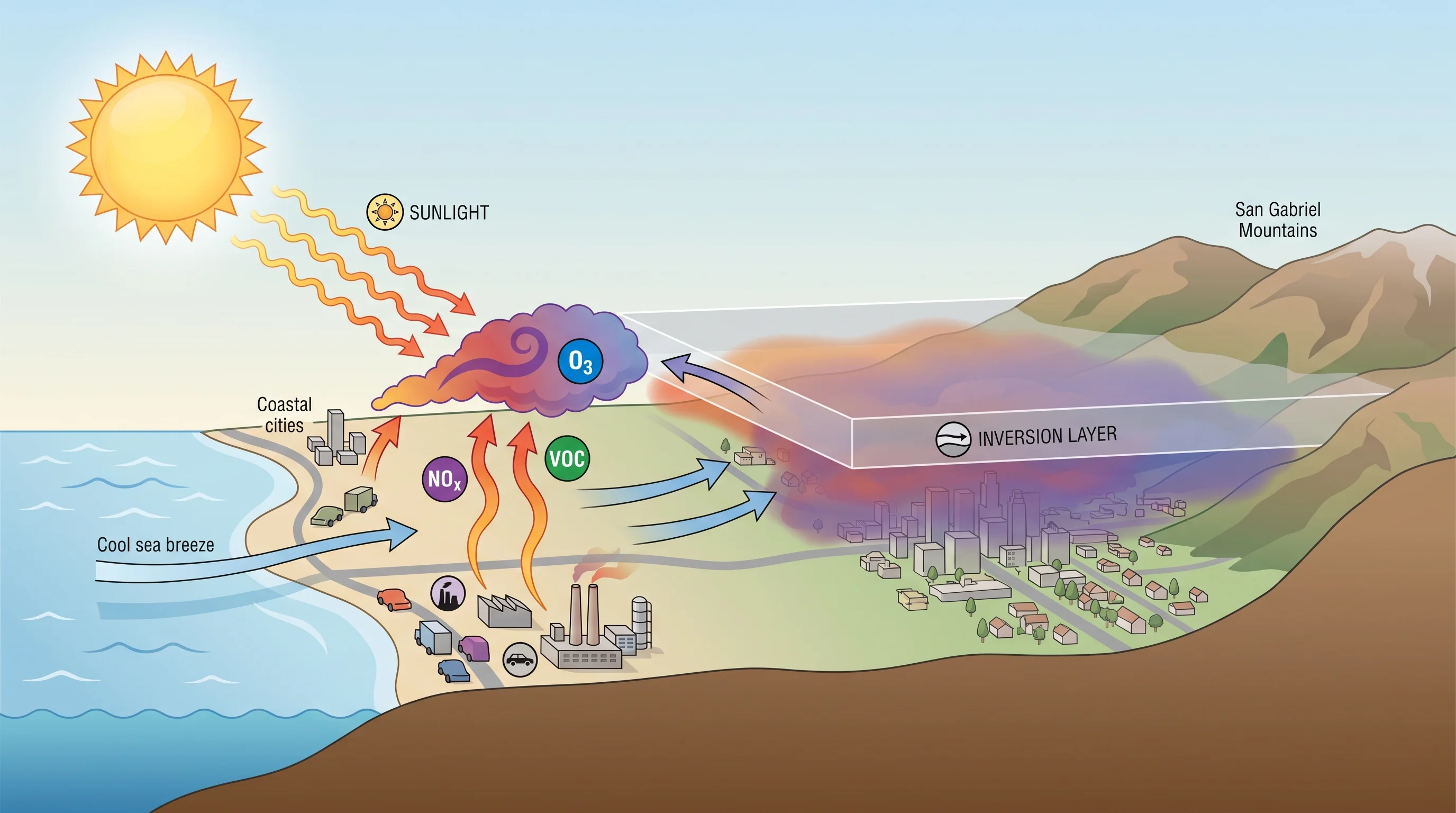
Ozone forms when nitrogen oxides (NOx) and volatile organic compounds (VOCs) react in strong sunlight over several hours. Nitrogen oxides come mainly from burning fuel in vehicles, diesel engines, industry and power equipment.
VOCs come from gasoline vapor, solvents, paints and other fuel and chemical products, which CARB and the EPA track as ozone precursors. Neither gas is ozone. Sunlight-driven chemistry between them, continuing in the air over the South Coast Air Basin, produces ozone over the following hours.
For how the basin's mountains and temperature inversions concentrate that reaction, see the photochemical smog explainer. Because the chemistry takes hours, ozone forms downwind and later in the day. Gases from morning traffic in one part of the basin often become ozone hours later, somewhere else.
Why Can Ozone Be Worse Inland Than Near the Coast?
Ozone is often worse inland than at the coast because the daytime sea breeze carries precursor gases and forming ozone east, giving the chemistry more time before the air reaches the San Gabriel Valley and the Inland Empire. Inland monitors in the South Coast Air Basin frequently record higher ozone than coastal ones. The onshore wind cleans the air near the Pacific, but it also pushes the morning's NOx and VOCs toward inland cities through the afternoon.
Terrain adds to the effect. The San Gabriel, San Bernardino and Santa Ana Mountains wall in the basin's northern and eastern edges, so ozone and its ingredients pool against the foothills instead of escaping. A seasonal inversion, warm air above cooler surface air, caps the basin and limits how high pollution can mix. Inland valleys are also hotter and sunnier than the coast in the afternoon, so the chemistry runs faster by the time the air reaches Pasadena or Woodland Hills.
South Coast AQMD monitors regularly show this coast-to-inland pattern. The community with the highest reading changes from year to year with weather and emissions, so check a current monitoring period for any specific comparison.
When Is Southern California Ozone Usually Highest?
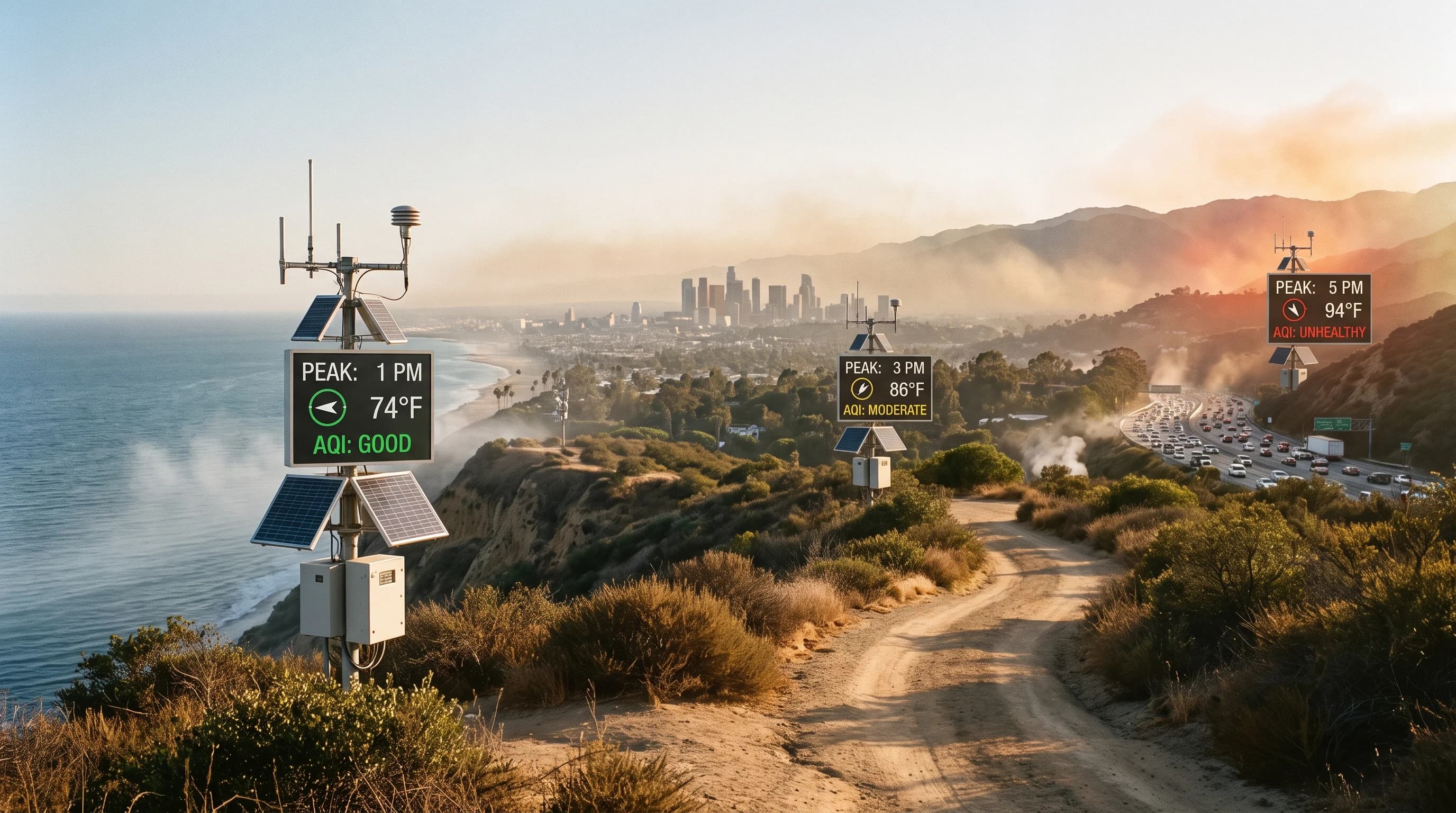
Southern California ozone is usually highest on warm, sunny, stagnant afternoons from late spring through early fall, when sunlight is strongest and the inversion most reliable, according to South Coast AQMD and CARB records. Within a day, ozone is lowest overnight and in early morning. It builds as the sun climbs and traffic adds fresh ingredients, and it peaks in mid-to-late afternoon after hours of reaction.
Ozone's afternoon timing separates it from Southern California's other air quality problems. Winter stagnation that traps fine particles (PM2.5) does not need sunlight and can build overnight.
Wildfire smoke can push the AQI up at any hour in any season. An ozone-driven AQI follows the sun, and a particle-driven AQI from smoke or winter inversions does not. For more on this timing, see when and where LA smog is usually worst.
How Is Ozone Different From PM2.5 and the Ozone Layer?
Ground-level ozone, PM2.5 and the stratospheric ozone layer are three different things. Ground-level ozone is a gas formed by sunlight-driven chemistry near the surface and is regulated because people breathe it. PM2.5 is fine particles, not a gas: tiny bits of solid and liquid from burning, dust and, in Southern California especially, wildfire smoke, small enough to lodge deep in the lungs. The AQI tracks ozone and PM2.5 separately because they form differently and affect the body differently; see what is PM2.5, the tiny particles in LA's wildfire smoke.
The stratospheric ozone layer is the same molecule, three oxygen atoms, but it sits many miles up and absorbs ultraviolet radiation, protecting life at the surface. Ground-level ozone offers no protection. The same chemical does opposite jobs at different altitudes, so a healthy ozone layer says nothing about ground-level ozone on a given day.
How Do You Use the Ozone AQI?
To use the ozone AQI, check the dominant pollutant, the reading from the nearest official monitor, its timestamp and the day's ozone forecast. One citywide number does not apply evenly across the basin. South Coast AQMD runs the monitoring network across the South Coast Air Basin and issues ozone forecasts and health advisories. AirNow collects official monitor data nationally and applies the EPA breakpoints in the table above.
A PurpleAir sensor does not measure ozone. Low-cost consumer sensors detect fine particles, not ozone gas, so a PurpleAir reading can look clean while the official ozone monitor a few miles away reads Unhealthy for Sensitive Groups. For how to read every AQI category and pollutant, see AQI explained for Southern California. South Coast AQMD also declares No-Burn Days that ban residential wood burning when air is stagnant; see what no-burn days in Southern California mean.
Ozone builds through the day, so one location can go from Good in the morning to Unhealthy for Sensitive Groups by afternoon with no change in how the sky looks. If you have asthma or another lung condition, or plan a long workout in Downtown Los Angeles, Pasadena or Woodland Hills, check the current AQI and dominant pollutant before heading out on a hot, sunny, stagnant afternoon, not only in the morning.
Ground-level ozone follows a predictable pattern: it is invisible, it builds with sunlight and it peaks inland in the afternoon. Before a run, youth sports practice or other hard outdoor exercise on a warm Southern California day, check the current ozone AQI, dominant pollutant and forecast for the official monitor nearest your destination. Do not judge the air by how clear the sky looks.