air qualityhealthsafety

AQI Explained: The Worst-Pollutant Rule

By WeatherLA|Published |Last updated |10 min read
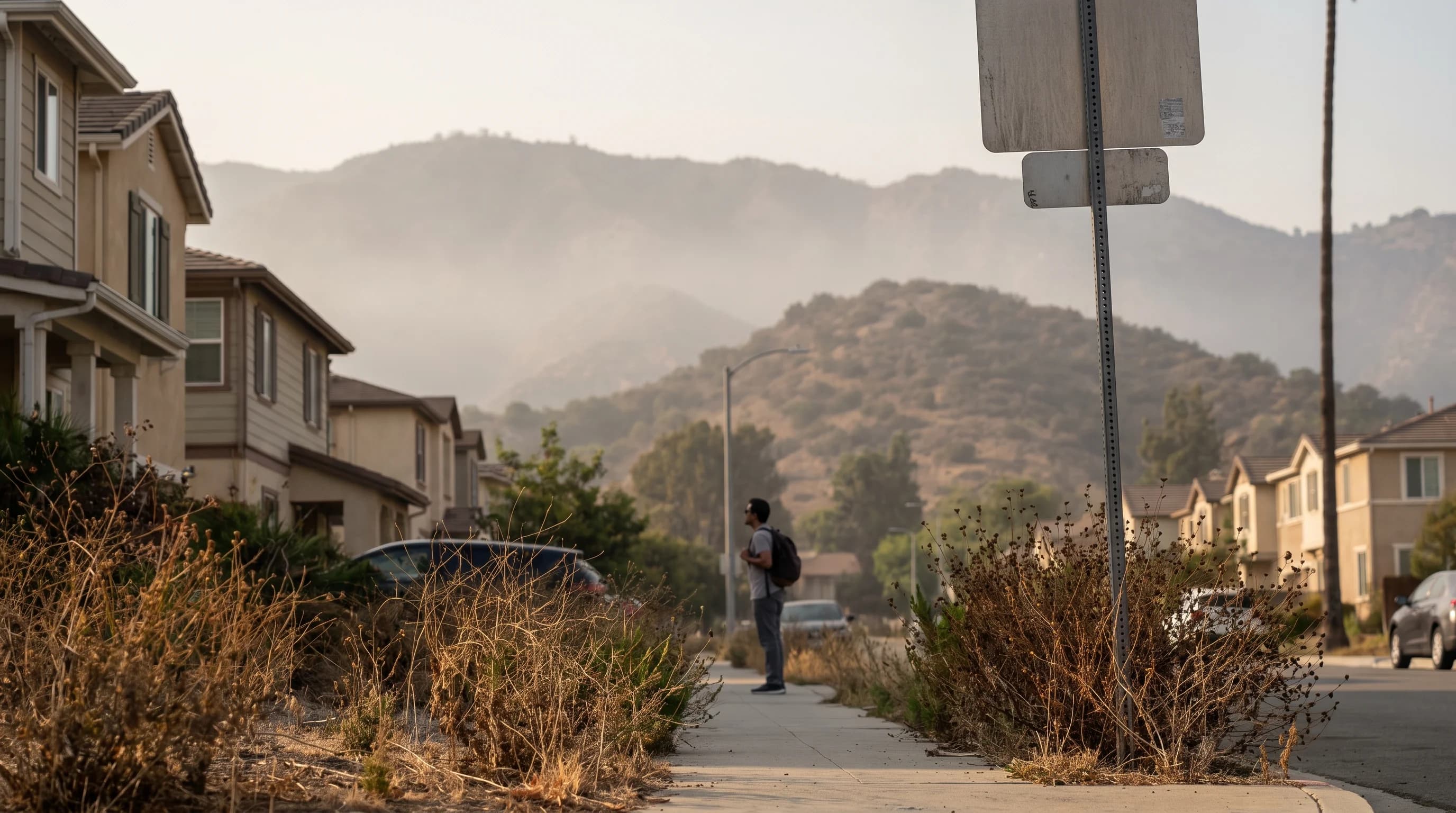
A South Coast Air Basin skyline split between a clear coastal morning and a hazy inland afternoon, with a phone in the foreground showing an AQI reading and dominant pollutant label

Key Takeaways

  • The overall AQI is set by whichever of five regulated pollutants scores worst at that hour and location, not an average of all pollutants combined.
  • Ground-level ozone typically drives Southern California AQI on hot inland afternoons, while PM2.5 takes over during wildfire smoke and winter stagnation.
  • The "dominant pollutant" label attached to a reading tells you which pollutant is actually responsible, since the same AQI number can come from completely different concentrations depending on the pollutant.
  • AQI values can vary meaningfully between nearby neighborhoods due to monitor placement, wind direction, terrain, and whether the number comes from a regulatory monitor, a modeled map, or a low-cost sensor.
  • AirNow's guidance shifts from sensitive-group caution at AQI 101 to general-population caution at AQI 151, with the strongest indoor recommendations starting at 201.
  • AirNow and South Coast AQMD are the authoritative sources for a live, official AQI reading, dominant pollutant, and timestamp for your exact location.

The Air Quality Index (AQI) is a 0 to 500 scale that converts measured pollutant concentrations into a single, health-oriented number, and the reported AQI is always set by whichever pollutant scores worst at that hour, not an average of all pollutants combined. In Southern California that worst-scoring pollutant, called the dominant pollutant, is usually ground-level ozone on hot inland afternoons and fine particulate matter (PM2.5) during wildfire smoke or winter stagnation. Understanding that single rule, highest sub-index wins, explains almost every confusing AQI reading you will see across Downtown Los Angeles, Pasadena, and Woodland Hills.

What does the Air Quality Index measure?

The AQI is a standardized communication scale published by the U.S. Environmental Protection Agency (EPA) that translates short-term outdoor pollutant concentrations into a single number from 0 to 500, grouped into six color-coded health categories. It is not a reading from one instrument and it is not a measure of every pollutant in the air at once. Instead, the EPA calculates a separate sub-index for each of five regulated pollutants, ground-level ozone, PM2.5, coarse particulate matter (PM10), carbon monoxide, and sulfur dioxide, then reports whichever sub-index is highest at that location and hour as the overall AQI.

That detail matters because the "dominant pollutant" label attached to an AQI reading, the one causing the number you see, can change from morning to afternoon and from one monitoring station to the next. A reading of 105 in the San Fernando Valley on a hot July afternoon is very likely ozone. The same number in November near the coast, right after a red flag warning, is very likely PM2.5 from smoke. The number alone does not tell you which pollutant is responsible.

You have to check the dominant pollutant label that accompanies it, available from AirNow and the South Coast Air Quality Management District (South Coast AQMD), the regional agency responsible for regulating air pollution across the Los Angeles Basin, Orange County, and the western halves of Riverside and San Bernardino counties.

The EPA AQI Scale: 0 to 500, by Health Category
AQI rangeCategoryColorGeneral guidance
0 to 50GoodGreenAir quality poses little or no risk
51 to 100ModerateYellowAcceptable; unusually sensitive individuals should consider limiting prolonged exertion
101 to 150Unhealthy for Sensitive GroupsOrangeChildren, older adults, and people with heart or lung disease should reduce prolonged outdoor exertion
151 to 200UnhealthyRedEveryone may begin to experience health effects
201 to 300Very UnhealthyPurpleHealth alert; everyone may experience more serious effects
301 to 500HazardousMaroonHealth warning of emergency conditions; the entire population is more likely to be affected

How does a pollutant concentration become an AQI number?

The EPA converts a raw pollutant concentration into an AQI value using published "breakpoint" tables that map specific concentration ranges, in units like parts per billion or micrograms per cubic meter, onto the matching 0 to 500 category. Each pollutant has its own breakpoint table because the health-effect thresholds are different for ozone, PM2.5, PM10, carbon monoxide, and sulfur dioxide. A monitoring station measures the raw concentration, and a formula interpolates it within the correct breakpoint range to produce that pollutant's sub-index for the period.

The point of this system is comparability, not equal concentrations. An ozone AQI of 100 and a PM2.5 AQI of 100 represent a comparable level of health concern, the boundary of the Moderate category, even though the underlying concentrations, measured in completely different units over different averaging periods, are not remotely the same number. Ozone AQI is typically built from an 8-hour average concentration, while PM2.5 AQI blends a 24-hour average with recent hourly readings so it can respond faster during a fast-moving smoke event. That is why you cannot compare a "PM2.5 concentration" directly to an "ozone concentration": the AQI value is the common language, not the raw number underneath it.

For the specific breakpoint concentrations behind each pollutant's own scale, see what PM2.5 measures in LA wildfire smoke and how ground-level ozone builds up in Southern California, which each carry their own official EPA category table.

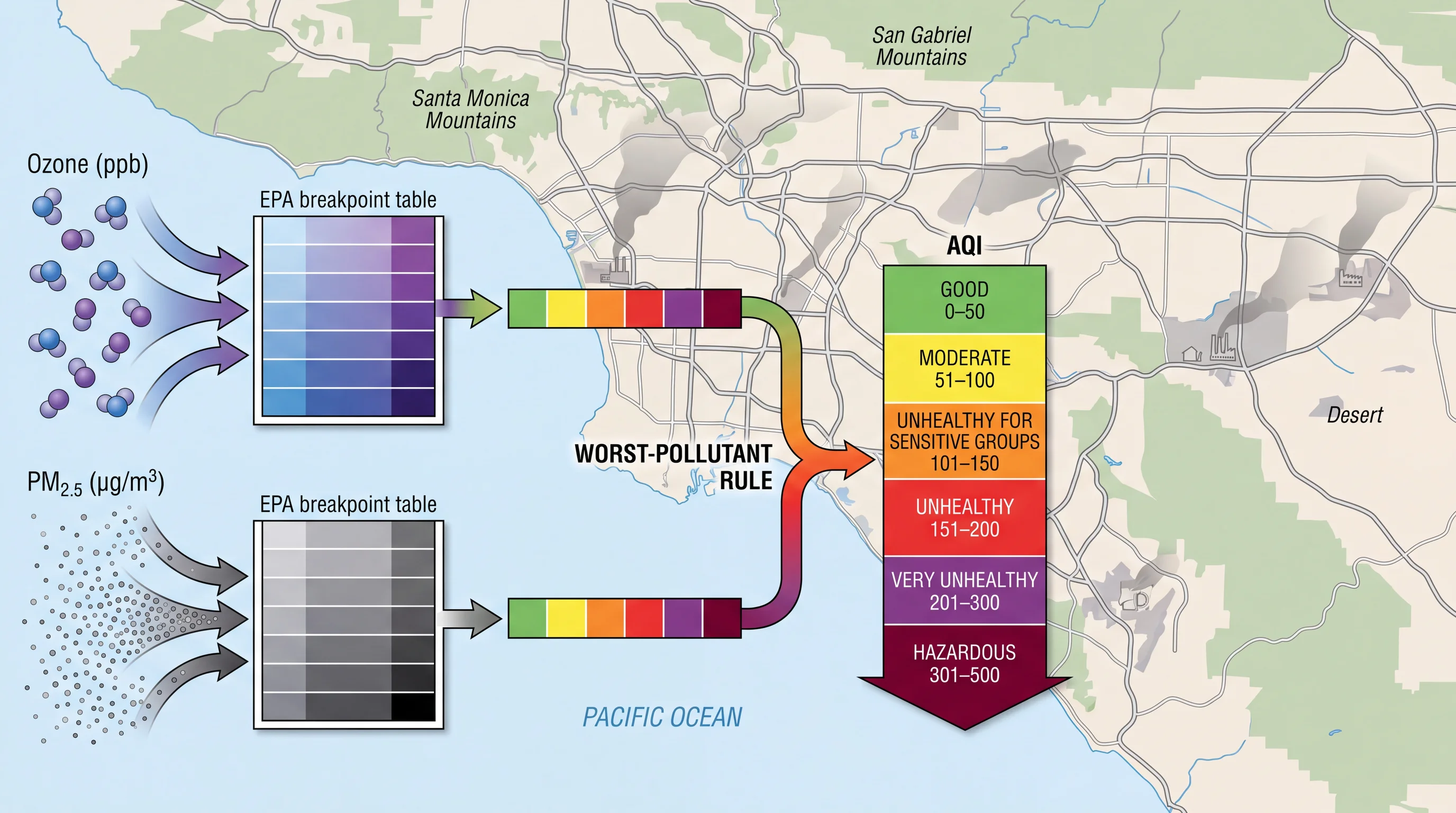
A diagram showing ozone concentration in parts per billion and PM2.5 concentration in micrograms per cubic meter each entering a separate EPA breakpoint table and both emerging as the same six color-coded AQI categories from Good to Hazardous
Ozone and PM2.5 are measured in different units on different schedules, but the EPA's breakpoint tables convert both into the same 0-to-500 AQI scale so a reading of 100 means a comparable health concern either way.

Which pollutants usually drive Southern California AQI?

Ground-level ozone dominates the South Coast Air Basin on sunny, hot afternoons, typically from late spring through early fall, because it forms when sunlight cooks vehicle and industrial emissions over several hours as they drift inland. That is why ozone readings tend to run higher in inland communities like Woodland Hills and the San Gabriel Valley in the mid-to-late afternoon, after pollution has had time to cook and accumulate downwind of the coast.

PM2.5 takes over as the dominant pollutant during two very different situations: active wildfire smoke, when a fire anywhere in the region or further north can push smoke plumes over the Los Angeles Basin, and winter stagnation, when a high-pressure system traps cool, stagnant air near the surface for days at a time and lets fine particles from traffic, wood burning, and other combustion sources build up close to the ground. South Coast AQMD issues No-Burn Day restrictions specifically to curb residential wood-burning PM2.5 during these winter stagnation episodes. The South Coast AQMD monitoring network spans the coastal basin, central Los Angeles, the San Gabriel and San Fernando Valleys, and the Inland Empire, and the dominant pollutant genuinely differs across that geography rather than following a single basin-wide number.

Why can nearby LA neighborhoods report different AQI values?

Two neighborhoods a few miles apart can show meaningfully different AQI values because of monitor placement, wind direction, terrain, proximity to traffic, and the exact averaging period being reported. Ozone concentrations generally increase moving inland and away from the immediate coast, since onshore wind pushes the pollution created near the coast further into the basin as the day warms, so a station in Pasadena can read meaningfully higher ozone AQI on a hot afternoon than a coastal station reads at the same hour. Wildfire smoke behaves even less uniformly, since it moves in plumes shaped by wind speed and direction, so one side of a valley can sit under thick smoke while a few miles away the sky looks clear.

It also matters what kind of device produced the number. A regulatory-grade monitor operated by South Coast AQMD or the California Air Resources Board (CARB) follows strict federal reference methods and is the standard used for official health advisories. A modeled map interpolates AQI between monitors using weather and satellite data, which fills coverage gaps but can miss hyper-local variation. A low-cost sensor, like those in citizen networks, can be useful for a general trend but is not certified to the same accuracy standard and can drift, especially in heavy smoke. Knowing which of the three you are looking at changes how much weight to put on a single number, particularly when planning outdoor time near a specific address rather than a general area.

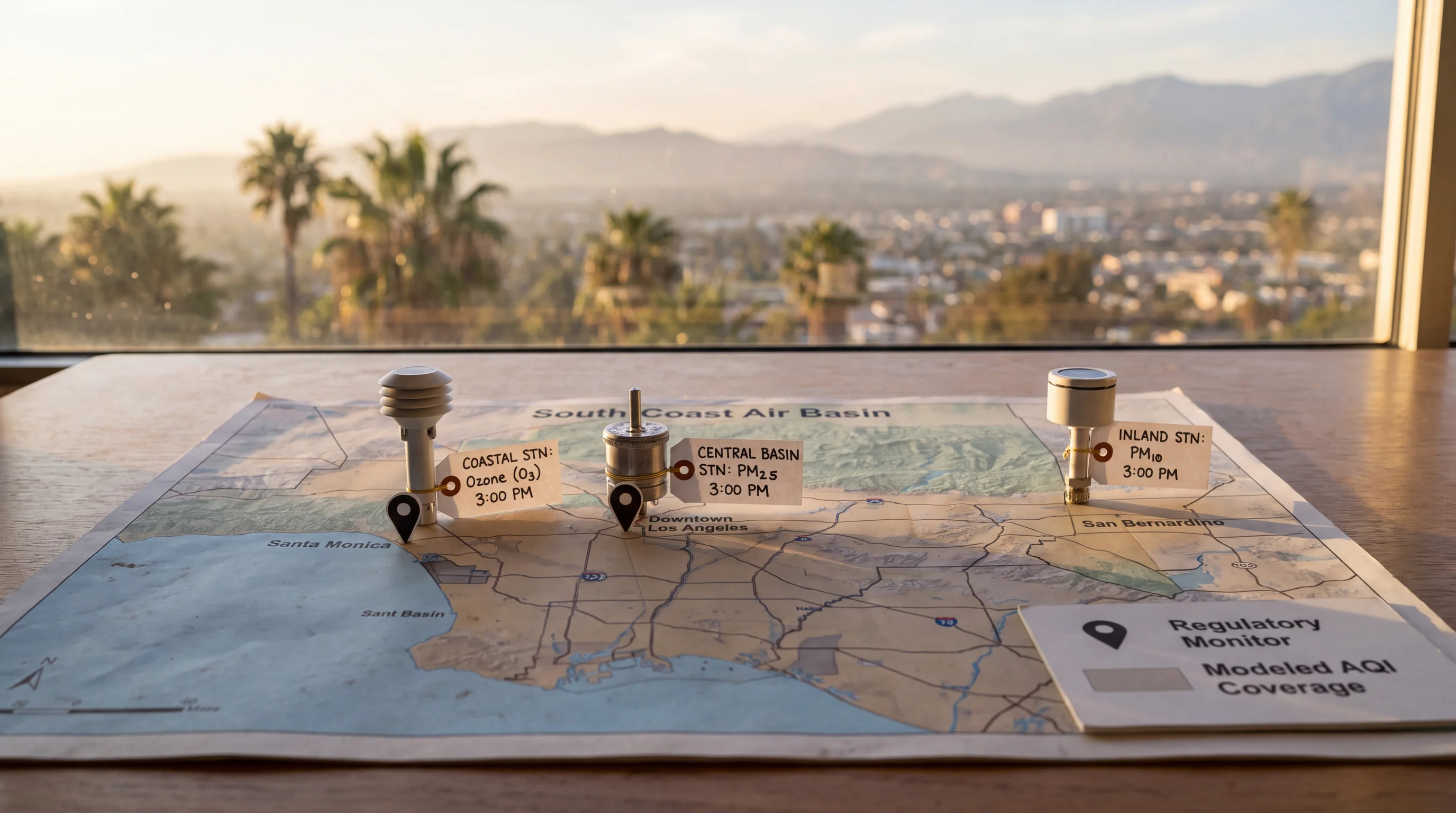
A South Coast Air Basin map marking coastal, central-basin, and inland monitoring stations, each labeled with its dominant pollutant and a timestamp, alongside a legend distinguishing regulatory monitors from modeled AQI coverage
South Coast AQMD's monitoring network spans coastal, basin, and inland stations that can report different dominant pollutants and different AQI values at the same hour, which is why one downtown reading should not stand in for the whole region.

What should you do at each AQI level?

AirNow's guidance splits into general-population advice and sensitive-group advice, and the two diverge starting at AQI 101. In the Good (0-50) and Moderate (51-100) categories, outdoor activity is fine for nearly everyone, though the Moderate category flags a small risk for people who are unusually sensitive to a specific pollutant. At Unhealthy for Sensitive Groups (101-150), the recommendation shifts specifically for children, older adults, people who are pregnant, and people with heart or lung conditions including asthma, who should reduce prolonged or heavy outdoor exertion, while the general public can typically continue as normal.

Once AQI crosses into Unhealthy (151-200), AirNow's guidance extends the caution to everyone, not just sensitive groups, recommending shorter and less intense outdoor activity for the general public. Very Unhealthy (201-300) and Hazardous (301-500) call for avoiding prolonged outdoor exertion altogether and, at the highest levels, avoiding outdoor activity entirely. This article does not diagnose personal symptoms or set a universal indoor-air rule, since the right response depends on individual health conditions, the specific pollutant involved, and how long you expect to be outside; AirNow's official category guidance and your own physician are the right references for anything beyond general planning.

At what AQI should you stay indoors?

AirNow's official guidance recommends that sensitive groups start limiting prolonged outdoor exertion once AQI passes 100, and that the general public do the same once AQI passes 150, with the strongest recommendation to stay indoors and limit outdoor air exchange applying at Very Unhealthy and Hazardous levels (AQI 201 and above). These are general population thresholds, not a fixed rule for every individual, since a healthy adult and someone with asthma can reasonably draw the line differently within the same numeric range.

What AQI level is considered good?

An AQI of 0 to 50 is officially classified as Good by the EPA, meaning air quality is considered satisfactory and poses little or no health risk to the general public. Moderate air quality, 51 to 100, is still acceptable for almost everyone but carries a small caution for people who are unusually sensitive to a particular pollutant, such as ozone for some people with respiratory conditions.

Should you run the AC when air quality is bad?

Running air conditioning on recirculate, rather than pulling in outside air, is one of the general steps public health agencies point to for reducing indoor exposure during smoke events, since it limits how much outdoor pollution enters the building compared with open windows or fresh-air ventilation modes. This article is not the source for a detailed indoor air quality protocol, filtration recommendation, or portable air cleaner guidance; for that level of detail, use AirNow's official smoke-ready guidance and any specific instructions issued by South Coast AQMD during an active episode, since recommendations can vary by the pollutant involved and the duration of the event.

Where should you check current Southern California air quality?

For a live, official reading, start with AirNow, the EPA's national air quality reporting site, and South Coast AQMD, the regional agency with the most granular monitoring network across the Los Angeles Basin. Both report the current AQI value, the dominant pollutant, the specific monitoring station or model behind the number, and the timestamp of the reading, all of which matter more than the bare number alone. The California Air Resources Board publishes statewide context and forecast guidance, while NWS Los Angeles/Oxnard and NWS San Diego issue red flag warnings and smoke advisories tied to the fire weather conditions that often precede a PM2.5 spike.

Because AQI can shift within hours as wind direction changes or a smoke plume moves, treat any single number as a snapshot for that station and that hour, not a forecast for your whole day.

The AQI system is simpler than it looks once you know the one rule that governs it: the worst pollutant sets the number, and the label attached to that number tells you which pollutant to actually worry about. Before planning extended time outdoors anywhere from Downtown Los Angeles to the foothills around Pasadena or the valley near Woodland Hills, check your destination's current AQI, dominant pollutant, monitor distance, and forecast period on WeatherEscape rather than relying on a single citywide impression.

Frequently Asked Questions

What does the Air Quality Index measure?

The AQI is an EPA scale from 0 to 500 that translates outdoor pollutant concentrations into six color-coded health categories. It calculates a separate sub-index for five regulated pollutants (ozone, PM2.5, PM10, carbon monoxide, and sulfur dioxide) and reports whichever sub-index is highest as the overall AQI.

How does a pollutant concentration become an AQI number?

The EPA uses published breakpoint tables that map specific concentration ranges for each pollutant onto the matching 0 to 500 category. A monitoring station measures the raw concentration, and a formula interpolates it within the correct breakpoint range to produce that pollutant's sub-index for the period.

Which pollutant usually drives AQI in Southern California?

Ground-level ozone typically dominates on hot, sunny afternoons from late spring through early fall, especially inland. PM2.5 takes over during active wildfire smoke and during winter stagnation events, when a high-pressure system traps particles from traffic and wood burning near the surface.

Why do nearby Los Angeles neighborhoods report different AQI values?

Monitor placement, wind direction, terrain, and proximity to traffic all affect local readings. Ozone tends to increase moving inland as onshore wind carries coastal pollution further into the basin through the day, while wildfire smoke moves in plumes that can leave one side of a valley clear while another sits under thick smoke.

What should you do at each AQI level?

At Good and Moderate (0-100), outdoor activity is fine for nearly everyone. At Unhealthy for Sensitive Groups (101-150), children, older adults, pregnant people, and those with heart or lung conditions should reduce prolonged exertion. At Unhealthy (151-200) and above, caution extends to the general public, with the strongest recommendations to limit or avoid outdoor activity at Very Unhealthy and Hazardous levels.

At what AQI should you stay indoors?

AirNow's guidance recommends sensitive groups start limiting prolonged outdoor exertion once AQI passes 100, and the general public do the same once AQI passes 150. The strongest recommendation to stay indoors and limit outdoor air exchange applies at Very Unhealthy and Hazardous levels, AQI 201 and above.

What AQI level is considered good?

An AQI of 0 to 50 is classified as Good by the EPA, meaning air quality poses little or no health risk to the general public. Moderate air quality, 51 to 100, is still acceptable for almost everyone but carries a small caution for people unusually sensitive to a specific pollutant.

Should you run the AC when air quality is bad?

Running air conditioning on recirculate rather than pulling in outside air is a general step public health agencies point to for reducing indoor exposure during smoke events. For detailed filtration or portable air cleaner guidance, use AirNow's official smoke-ready resources and any specific instructions from South Coast AQMD during an active episode.

Where should you check current Southern California air quality?

AirNow and South Coast AQMD both report the current AQI, dominant pollutant, monitoring station, and timestamp for a given location. The California Air Resources Board publishes statewide context, and NWS Los Angeles/Oxnard and NWS San Diego issue red flag warnings and smoke advisories tied to the fire weather that often precedes a PM2.5 spike.

Related Destinations

Live Los Angeles Conditions

Compare temperature, wind, clouds, and comfort across the map.

See which microclimates are clear, cool, windy, smoky, or warming up right now.

Open the Weather Map
Destinations☀️Smog Forecast🌫️Smog Heat Map🔒Privacy Policy📄Terms of Service