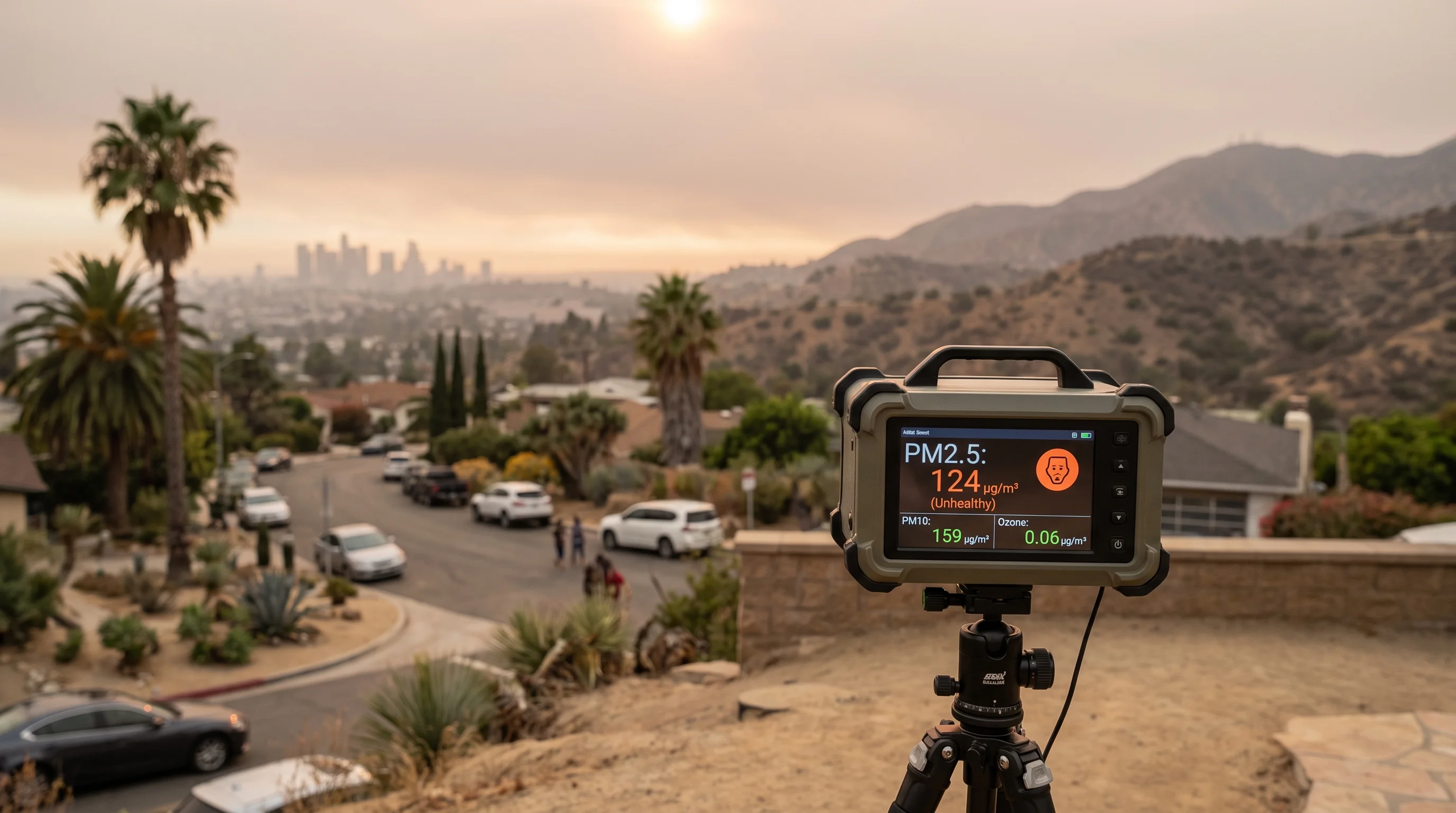
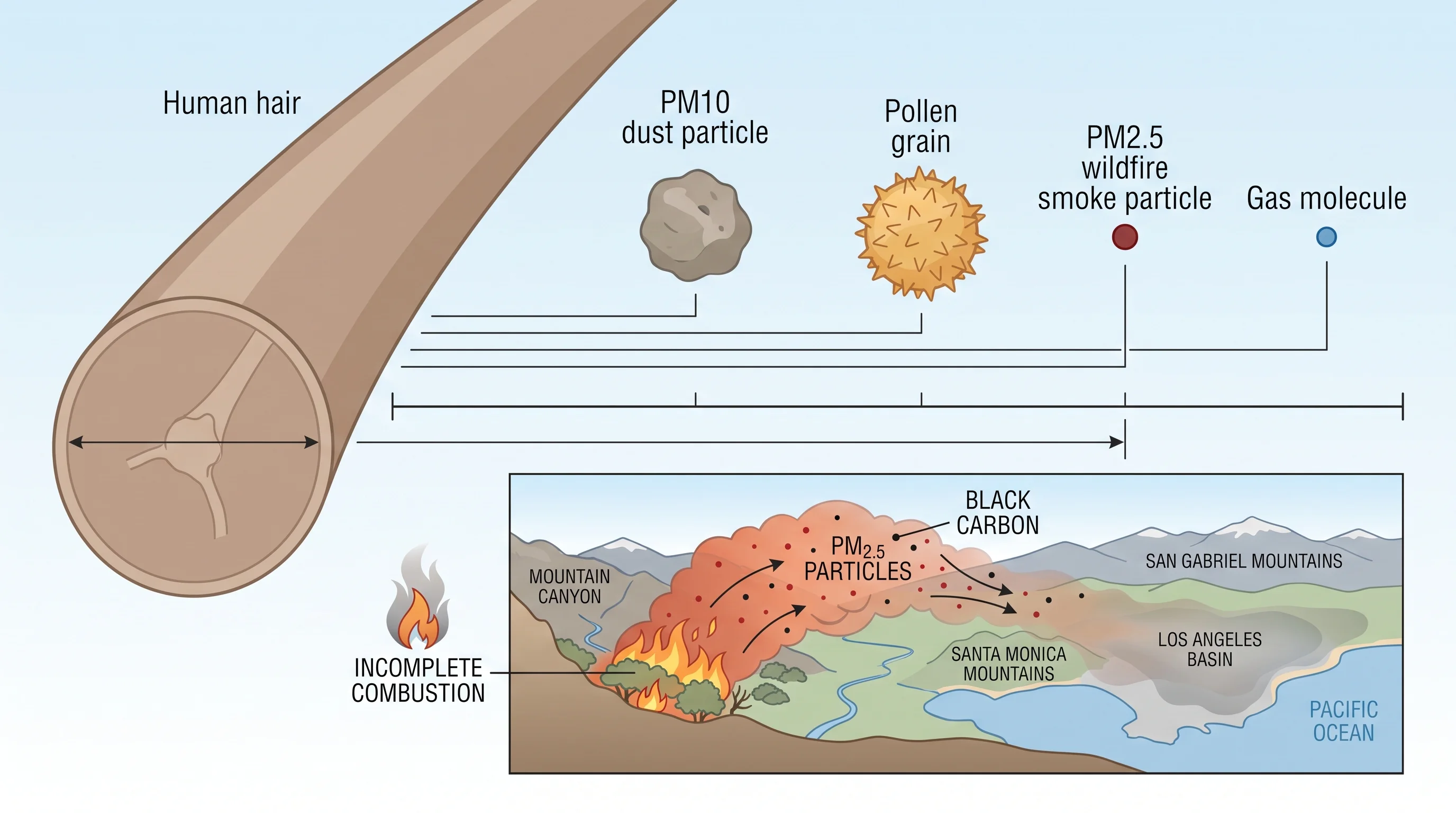
PM2.5 is airborne particulate matter 2.5 micrometers wide or smaller, about thirty times thinner than a human hair and small enough to get past the body's upper airway defenses and lodge deep in the lungs. PM2.5 is a size category, not one substance, and it can include soot, ash, organic compounds and dust.
In Los Angeles, PM2.5 usually drives the AQI during wildfire smoke. Unlike ozone, a gas formed by sunlight, PM2.5 is physical particles that the AirNow network and South Coast AQMD measure directly. PM2.5 can spike at any hour whenever smoke, dust or stagnant air concentrates fine particles near the ground.
What Is PM2.5?
PM2.5 is fine particulate matter 2.5 micrometers across or smaller, a size limit the EPA set because particles that small behave differently in the body than larger dust and pollen. PM2.5 is a size cutoff, not a brand or a chemical: anything smaller than 2.5 micrometers counts, whatever it is made of. Its makeup therefore varies with the source. Wildfire smoke, vehicle exhaust, industrial burning, sea spray and dust storms all add particles that qualify.
PM2.5 particles are so small and light that they stay in the air for hours to days and travel long distances on the wind, unlike heavier PM10 particles that settle near their source. Once inhaled, they get past the nose and throat's natural filters and reach the deepest parts of the lungs, the alveoli, where oxygen enters the blood. That is the main health concern: the particles making the haze are small enough to reach places larger particles cannot.
| AQI category | AQI value | PM2.5 (µg/m³, 24-hr avg) | General guidance |
|---|---|---|---|
| Good | 0-50 | 0.0-9.0 | Air quality is satisfactory for everyone |
| Moderate | 51-100 | 9.1-35.4 | Unusually sensitive individuals should consider reducing prolonged outdoor exertion |
| Unhealthy for Sensitive Groups | 101-150 | 35.5-55.4 | Children, older adults, pregnant people, and those with heart or lung disease should reduce prolonged exertion |
| Unhealthy | 151-200 | 55.5-125.4 | Everyone should reduce prolonged or heavy outdoor exertion |
| Very Unhealthy | 201-300 | 125.5-225.4 | Everyone should avoid prolonged or heavy outdoor exertion |
| Hazardous | 301-500 | 225.5-500.4 | Everyone should avoid all outdoor exertion; stay indoors with air filtration |
The table above lists the official EPA 24-hour PM2.5 breakpoints, which AirNow uses to convert a concentration in micrograms per cubic meter into the 0-500 AQI scale. During wildfires, South Coast AQMD and AirNow also publish NowCast readings that update faster than a full 24-hour average. That is one reason a posted AQI can change noticeably within one afternoon as smoke moves through a neighborhood. Thick smoke can also tint daylight orange; see why the sky turns orange.
Why Does Wildfire Smoke Contain So Much PM2.5?
Wildfire smoke contains so much PM2.5 because burning vegetation rarely burns completely, and incomplete burning releases exactly the small, light particles PM2.5 includes. Some fuel burns fully into carbon dioxide and water vapor. A large share burns only partly, releasing black carbon (soot), partly burned organic compounds and fine ash into the smoke. Smoke has no single chemical recipe.
The mix depends on what is burning, how hot the fire is and how much oxygen it gets. Smoke from a fast chaparral fire and smoke from a smoldering structure fire can carry different particles, though both raise PM2.5.
Wildfire smoke is a more serious PM2.5 source than everyday city pollution. The National Weather Service and the California Air Resources Board (CARB) note that wildfire smoke can push PM2.5 far higher, far faster than traffic or industry. It can also spread over a wide area as the plume drifts, instead of staying near one freeway or facility.
How Is PM2.5 Different From PM10 and Ozone?
PM2.5 and PM10 are both particle pollution, defined by different size limits. PM10 includes particles up to 10 micrometers across, adding coarser material such as road dust, pollen and mold spores; all PM2.5 also counts as PM10. Coarser particles settle faster and are filtered better by the nose and upper airway. Health guidance therefore treats PM2.5 as more penetrating and generally more concerning, though both have their own AQI categories.
Ozone is a different kind of pollutant: a gas, not a particle, formed when nitrogen oxides and volatile organic compounds react in sunlight over several hours, as ground-level ozone in Southern California explains. Ozone needs sunlight, so it usually peaks on hot, sunny afternoons and drops overnight. PM2.5 has no daily sunlight rhythm. Wildfire smoke, a winter inversion or a dust event can push PM2.5 to unhealthy levels at any hour, including overnight.
For the photochemical haze that combines ozone with other particles over the basin, see what is smog and how LA's photochemical haze forms. For how the AQI works across all pollutants, see AQI explained for Southern California.
PM2.5 and ozone are measured differently. Official PM2.5 monitors, run by South Coast AQMD and reported through AirNow, use federal reference methods and set official AQI values.
Ozone monitors measure a gas with different instruments. During smoke, PM2.5 almost always drives the Los Angeles AQI. Ozone matters more on clear, hot, stagnant afternoons without smoke.
Why Can Readings Vary Across Los Angeles?
PM2.5 readings can differ sharply between neighborhoods a few miles apart, because smoke depends on plume height, wind direction, terrain and distance from the fire. A San Gabriel Mountains fire can send smoke high over Downtown Los Angeles, keeping ground-level PM2.5 moderate there. The same plume can sink to the ground a few miles away in Pasadena or Woodland Hills and push readings to Unhealthy. Wind decides which communities sit downwind each hour, and that can shift within a day as a fire grows or winds change, including during Santa Ana events.
Terrain and air mixing add to the variation. The mountains around the Los Angeles Basin can trap smoke against the foothills, as they trap ozone ingredients.
A temperature inversion, warm air above cooler surface air, can hold smoke near the ground overnight and into the morning, concentrating PM2.5 until daytime heating breaks it up. Monitor location matters too. A station near a busy road or under a plume reads differently from one in an open area upwind, so South Coast AQMD runs stations across the basin.
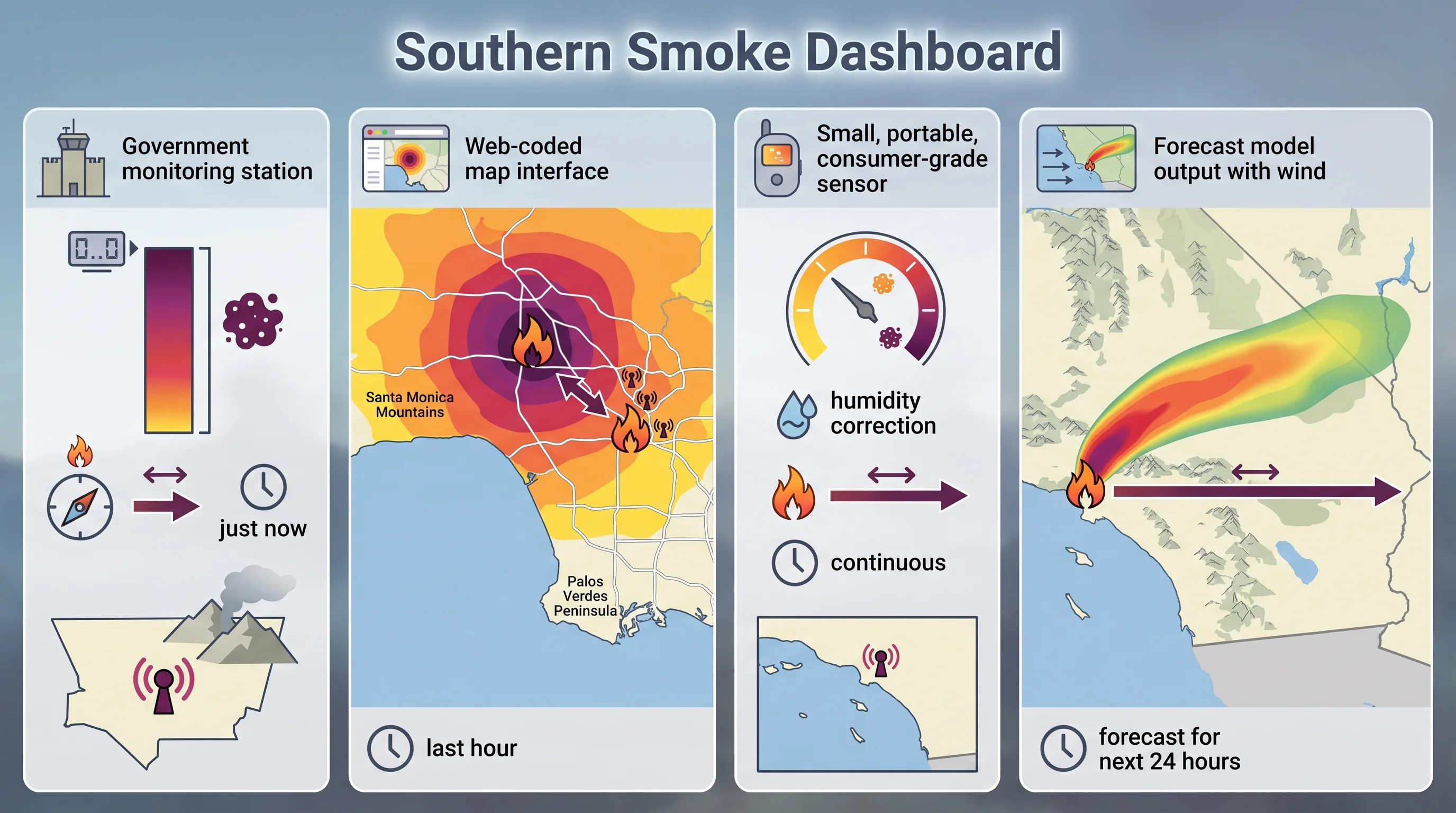
Humidity affects low-cost sensors. Some consumer optical particle counters overreport PM2.5 in high humidity or fog, because water droplets scatter light like fine particles. Official monitors correct for that; many consumer sensors do not.
What Do Concentration and AQI Mean?
PM2.5 concentration is measured in micrograms per cubic meter (µg/m³), the actual mass of particles in a volume of air. The AQI is a separate 0-500 health scale the EPA built to turn that number, and other pollutants, into one index with color-coded categories. A 24-hour PM2.5 average of 35.4 µg/m³ or less equals an AQI of 100 or less, the line between Moderate and Unhealthy for Sensitive Groups, under the EPA breakpoints in the table above.
The averaging period matters as much as the number. Standard AQI breakpoints use a 24-hour average. During fast-moving smoke, AirNow and South Coast AQMD also publish NowCast values, a shorter weighted average that reacts faster. A posted AQI can jump or drop within an hour as smoke arrives or clears, so check each reading's timestamp.
How Do Santa Ana Winds and Temperature Inversions Change Wildfire-Smoke PM2.5 in Los Angeles?
Santa Ana winds and temperature inversions push wildfire-smoke PM2.5 in opposite directions, and both occur in the same fire season. Santa Ana winds are strong, dry offshore winds that can spread a fire and its smoke toward the coast quickly, carrying PM2.5 across much of the basin within hours. The same strong winds can also scatter and dilute smoke already in the air, sometimes clearing a smoky sky faster than calm weather would.
A temperature inversion is warm air sitting above cooler surface air that stops vertical mixing. When an inversion forms after a Santa Ana event or during calm high pressure, it traps smoke near the ground overnight and into the morning, keeping PM2.5 high until it breaks. The National Weather Service Los Angeles/Oxnard office tracks both patterns, because wind-spread fire followed by inversion-trapped smoke recurs in the region's worst air quality episodes.
When Should Los Angeles Residents Use an N95 or Indoor Air Cleaner During Wildfire Smoke?
Use an N95 or indoor air cleaner when the AQI reaches unhealthy levels, not when the sky looks smoky. The National Weather Service and CARB tie protective steps to the AQI category.
At Unhealthy for Sensitive Groups, children, older adults, pregnant people and anyone with heart or lung disease should limit long outdoor exertion. At Unhealthy or worse, that applies to everyone. Outdoors, a properly fitted N95 or KN95 respirator, not a cloth or surgical mask, meaningfully reduces PM2.5 exposure, and it must seal against the face.
Indoors, run a HEPA air cleaner sized for the room, keep windows and doors closed and set the HVAC system to recirculate instead of drawing in outside air, as CARB and the EPA recommend during smoke. Indoor PM2.5 can climb close to outdoor levels fairly quickly in a home left open to smoky air.
What PM2.5 Level Is Safe?
No PM2.5 level is completely risk-free, but an AQI of 50 or below, 9.0 µg/m³ or less on a 24-hour average, is the Good category, where air quality is satisfactory for the general public. The EPA sets annual and 24-hour national standards for PM2.5 based on long-term health research. Those standards are reviewed and can change, so check the EPA's PM2.5 page for the current numbers.
For daily decisions, the most useful question is which AQI category the current reading falls in and what that category recommends for sensitive groups and everyone else.
Can PM2.5 Pass Through a Mask?
PM2.5 passes easily through or around a loose cloth or surgical mask, which offers little protection. An N95 or KN95 respirator is rated to filter at least 95% of airborne particles at 0.3 micrometers, a size that includes PM2.5, but only when it seals tightly against the face.
A respirator with gaps at the nose or cheeks loses much of its protection, whatever its rating. Adult-sized masks on children and facial hair under the seal are common causes of gaps. NWS and CARB guidance treats an N95 as one part of a smoke response, along with limiting time outdoors and cleaning indoor air.
Which Monitors and Forecasts Show LA's PM2.5?
AirNow and South Coast AQMD are the main official sources for current PM2.5 across the Los Angeles area, using the same official monitors and the EPA breakpoints in the table above. AirNow shows national data on an interactive map with readings and timestamps for each station. South Coast AQMD publishes forecasts and health advisories for the South Coast Air Basin, including smoke guidance during wildfires.
Low-cost sensors, usually PurpleAir units, fill gaps between official stations and give a neighborhood-level snapshot. They are optical particle counters that can read high in humid or foggy air unless corrected, so treat an uncorrected reading as a rough guide, not an official AQI.
For live smoke conditions, check the current official readings above. South Coast AQMD also declares No-Burn Days that ban residential wood burning when particle pollution is forecast to build; see what no-burn days in Southern California mean. For how the AQI works across every pollutant, see AQI explained for Southern California.
PM2.5 turns a smoky sky into a health decision, and it is a particle size category, not a single substance. Before spending long hours outdoors in Downtown Los Angeles, Pasadena or Woodland Hills during wildfire season, check the dominant pollutant, the nearest official monitor reading and its timestamp on AirNow or South Coast AQMD. Then decide whether that run or practice belongs outdoors or inside.