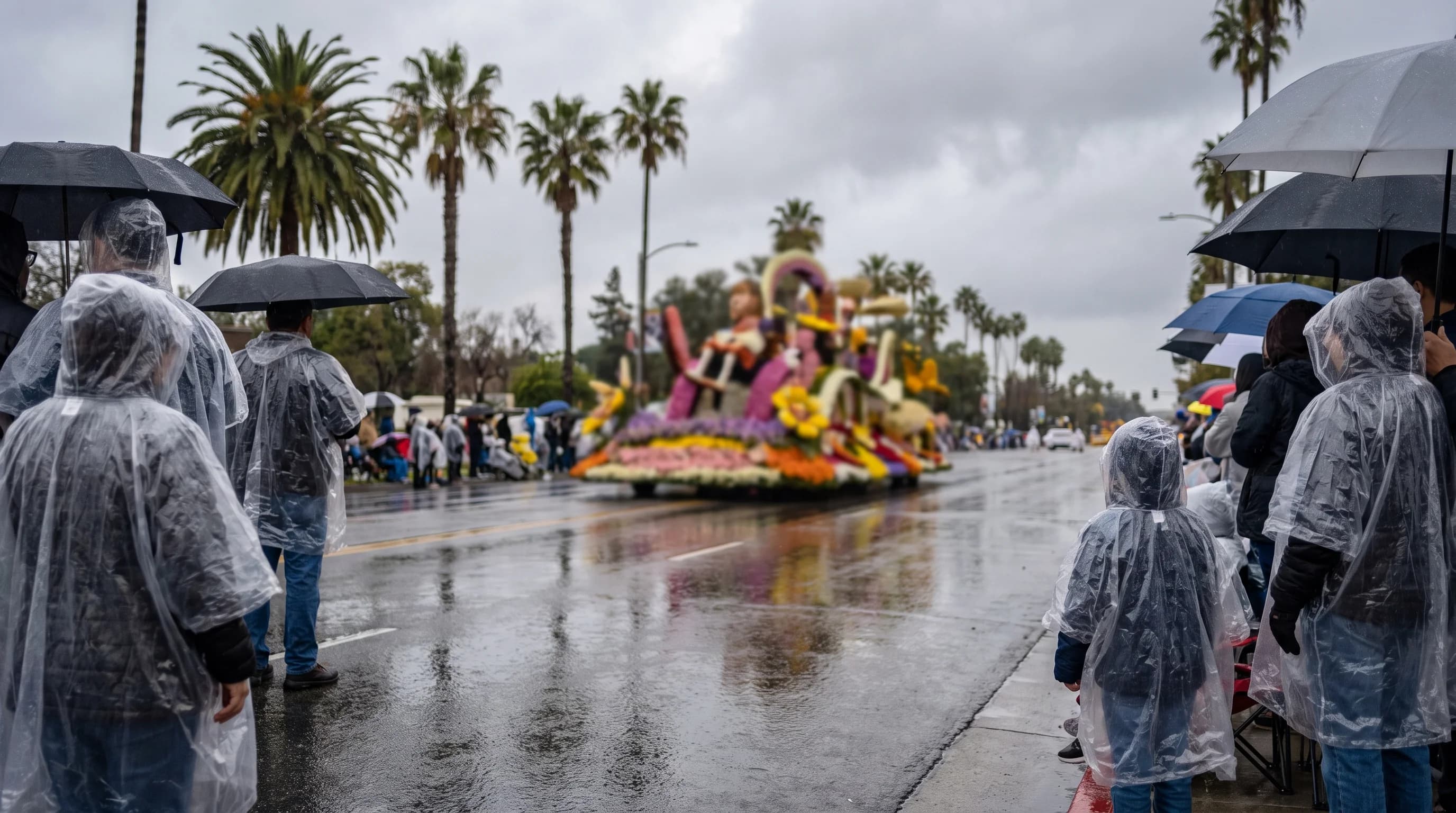
Rain on the Rose Parade is rare, but it happens. The Tournament of Roses counted about 10 rain-affected parades before 2026, and on January 1, 2026, the 137th parade marched through a steady downpour, the first wet parade in 20 years. Measurable rain falls on New Year's Day about one year in nine in Downtown Los Angeles. Cold is more certain than rain: Pasadena averages about 45°F on New Year's morning.
For two decades the parade stayed dry, and many people came to believe it never rains on the Rose Parade. Then Downtown's gauge recorded 1.31 inches on New Year's Day 2026, tied for the second-wettest January 1 in records back to 1878. Three years earlier, a stormy New Year's weekend had missed the parade entirely, thanks to a rule from 1893 about horses and churches.
| Question | Answer |
|---|---|
| Next parade | Friday, January 1, 2027, 8 a.m. (per the Tournament of Roses) |
| Rainy parades | About 10 before 2026, including 1955 and 2006; 2026 was wet too |
| Chance of rain on New Year’s Day | About 1 year in 9 at Downtown LA’s midnight-to-midnight gauge |
| Typical morning low | About 45°F in Pasadena; it has dipped to 35°F since 1996 |
| Typical afternoon high | About 66°F |
| Sunrise | About 6:59 a.m., an hour before the parade steps off |
Does It Ever Rain on the Rose Parade?
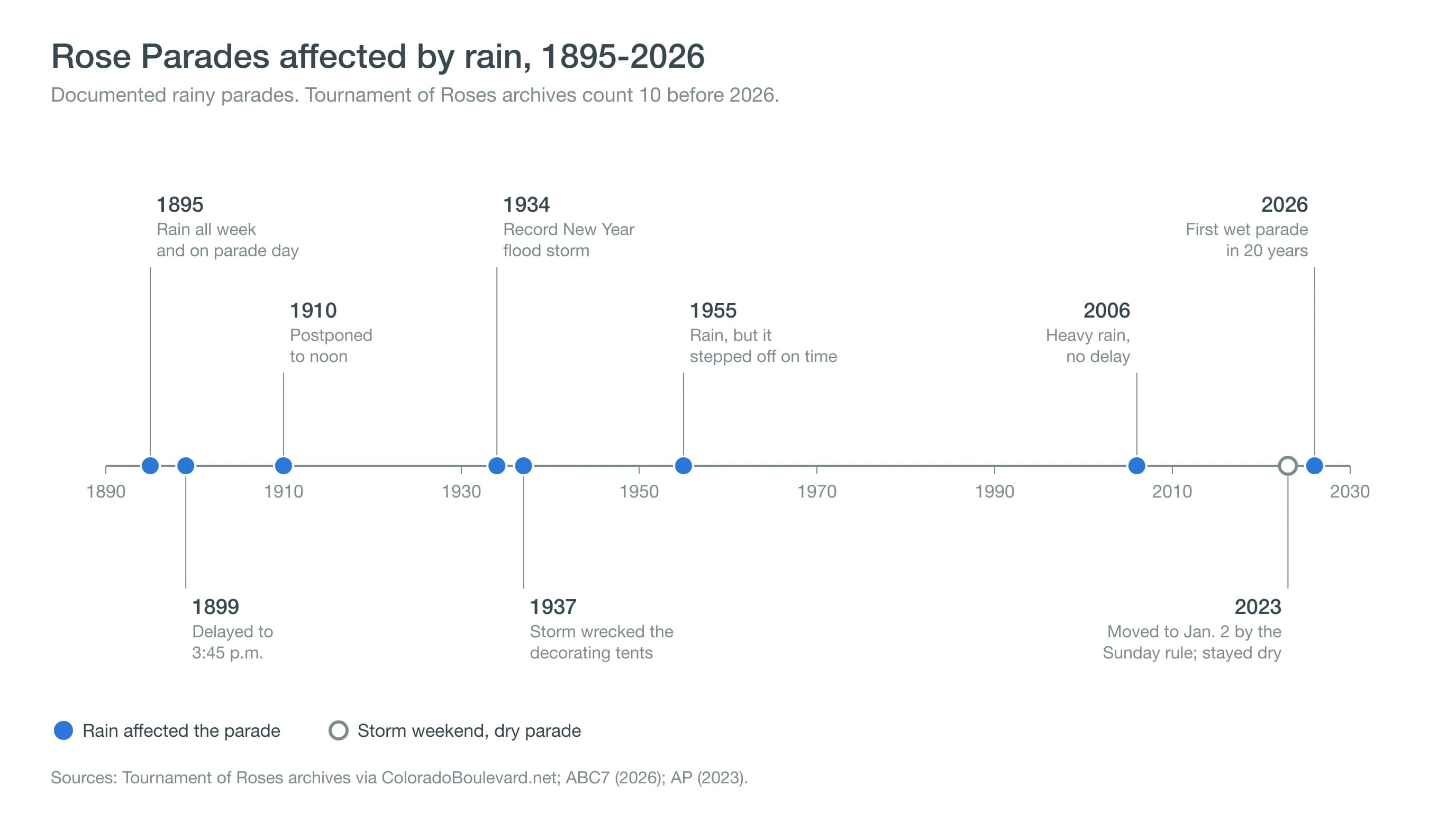
Rain has fallen on the Rose Parade about a dozen times in 137 parades. The Tournament's archives count 10 rain-affected parades before 2026, and the documented cases span the parade's whole history. In 1895, rain fell all week.
In 1899 rain pushed the start to 3:45 p.m., and in 1910 the parade was postponed to noon. The 1934 parade followed the record New Year's flood storm, and in 1937 a storm the night before wrecked the tents where floats were being decorated. In 1955 and 2006 the parade stepped off on time in the rain.
Counts differ because "rain on the parade" can mean a drizzle during the march, a storm that delayed it, or one that hit the night before. News coverage in 2026 used "about a dozen"; the Tournament's archive figure is 10 before that year. Either way, more than nine parades out of ten have stayed dry.
How Often Does It Rain in Pasadena on New Year's Day?
Rain falls on New Year's Day in the Pasadena area about one year in nine. Downtown Los Angeles, which measures from midnight to midnight, recorded measurable rain on 16 of 148 New Year's Days.
Pasadena's volunteer gauge shows rain on 20 of 122, about one in six, but it is read once each morning, so its "January 1" number often includes rain from New Year's Eve. The wettest New Year's Day on record is 1934, with 3.12 inches Downtown. The 2026 parade day ranks next, tied with 1922 at 1.31 inches.
The odds are low even though January is one of LA's wettest months, because Southern California rain comes in a few storms rather than frequent showers. Downtown averages about 6 rainy days in January, which leaves roughly 25 dry ones. That pattern is explained in what a wet LA winter looks like.
The 2027 parade comes during an unusually strong El Niño. On September 10, 2026, NOAA's Climate Prediction Center gave a very strong event better than 90% odds for this winter and a historic one 75%. That makes a wet season more likely, but it does not forecast any single day.
In the two strongest El Niño winters on record, 1997-98 and 1982-83, New Year's Day was dry Downtown. The heaviest El Niño storms usually arrive later, in January and February.
What Was the "Never on Sunday" Rain Dodge of 2023?
The "Never on Sunday" rule moves the Rose Parade to Monday, January 2, when New Year's Day falls on a Sunday, and in 2023 it helped the parade dodge a storm. The rule dates to 1893, when organizers worried the commotion would spook horses tied up outside churches during services. A storm soaked Southern California over the New Year's weekend, with 1.11 inches Downtown on December 31 and 1.76 inches on Pasadena's New Year's morning reading. The 134th parade on January 2 fell in a dry break between storms, and the rain returned that evening during the Rose Bowl Game.
The rule applies again in 2034, the next time January 1 falls on a Sunday. The next parades, on Friday, January 1, 2027, and Saturday, January 1, 2028, are on New Year's Day.
How Cold Is It at the Rose Parade?
The Rose Parade is cold enough to surprise visitors. From 1996 to 2025, Pasadena averaged a low of about 45°F on New Year's morning, and the coldest was 35°F. Burbank, across the hills in the San Fernando Valley, averaged 41°F and dropped as low as 31°F.
Pasadena's lowest temperatures come around sunrise, which is about 6:59 a.m. on January 1, an hour before the parade steps off at 8 a.m. from Green Street and Orange Grove Boulevard. Clear, calm nights are the coldest; cloudy or rainy ones, like 2026, stay in the 50s.
By the time the last floats pass, around 10 a.m., the day is warming toward an average high of about 66°F. Colorado Boulevard runs east to west, so the north side of the street faces the low winter sun and warms first, with the glare in your eyes. The south side stays in building shadow longer.
Pasadena's cold mornings come from its position at the foot of the San Gabriel Mountains, where cool air drains downhill overnight; the microclimates explainer covers why. Snow falls on the mountains above town but not on the parade route, as what winter brings to Pasadena explains.
What Should You Bring to the Rose Parade Curb?
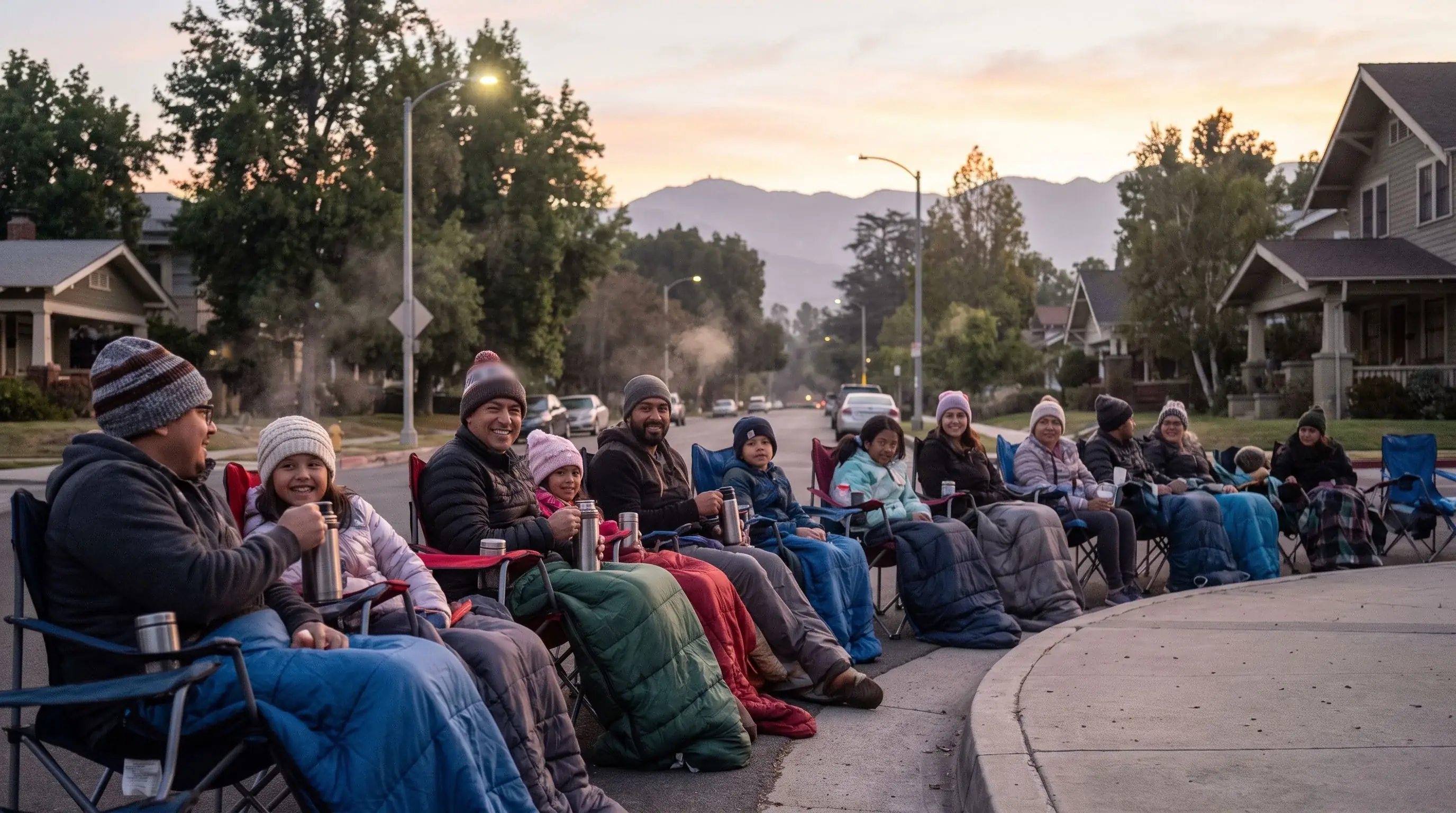
Bring winter-night clothing to the Rose Parade curb, not Southern California afternoon clothing. For overnight or pre-dawn arrival, bring layers, a warm hat, gloves, a sleeping bag or blankets, and a ground tarp or pad to put on cold, damp concrete. Add a poncho or rain jacket if any rain is forecast; on a packed curb, a poncho keeps you dry without blocking anyone's view. By mid-morning you will want sunglasses and a lighter layer.
Know the curb rules too. The Tournament's parade-day guide allows curbside camping from noon the day before, and at 11 p.m. campers may move up to the blue Honor Line but not past it. Items that block views or create safety risks are not allowed, and past city rules have banned tents, sofas, boxes used as seats, bonfires and unoccupied chairs. Check the current list before you go, and see the forecast on our Pasadena page.
When Can You Trust a Forecast for Parade Day?
A parade-day forecast becomes useful about five to seven days out, when forecasts can show whether a storm is likely to be near Southern California around New Year's. Rain timing, which decides whether the parade gets wet, usually becomes reliable only one or two days ahead. In 2023 the storm was clearly forecast, but the gap that kept the parade dry was a matter of hours.
In the last few days, watch the hourly forecast for 6 a.m. to 10 a.m., overnight lows if you plan to camp, and any alerts from the National Weather Service in Los Angeles. A flood watch or wind advisory changes the plan more than a chance of showers does; the difference is explained in what LA's weather alerts mean. Occasionally the risk is dry wind instead of rain: early-January Santa Ana winds can bring gusty, chilly mornings to the foothills.
Most years, the Rose Parade gets a cold, clear dawn and a bright, mild morning. Plan for the cold every time, pack for rain when the forecast calls for it, and let the Tournament's announcements guide any changes.