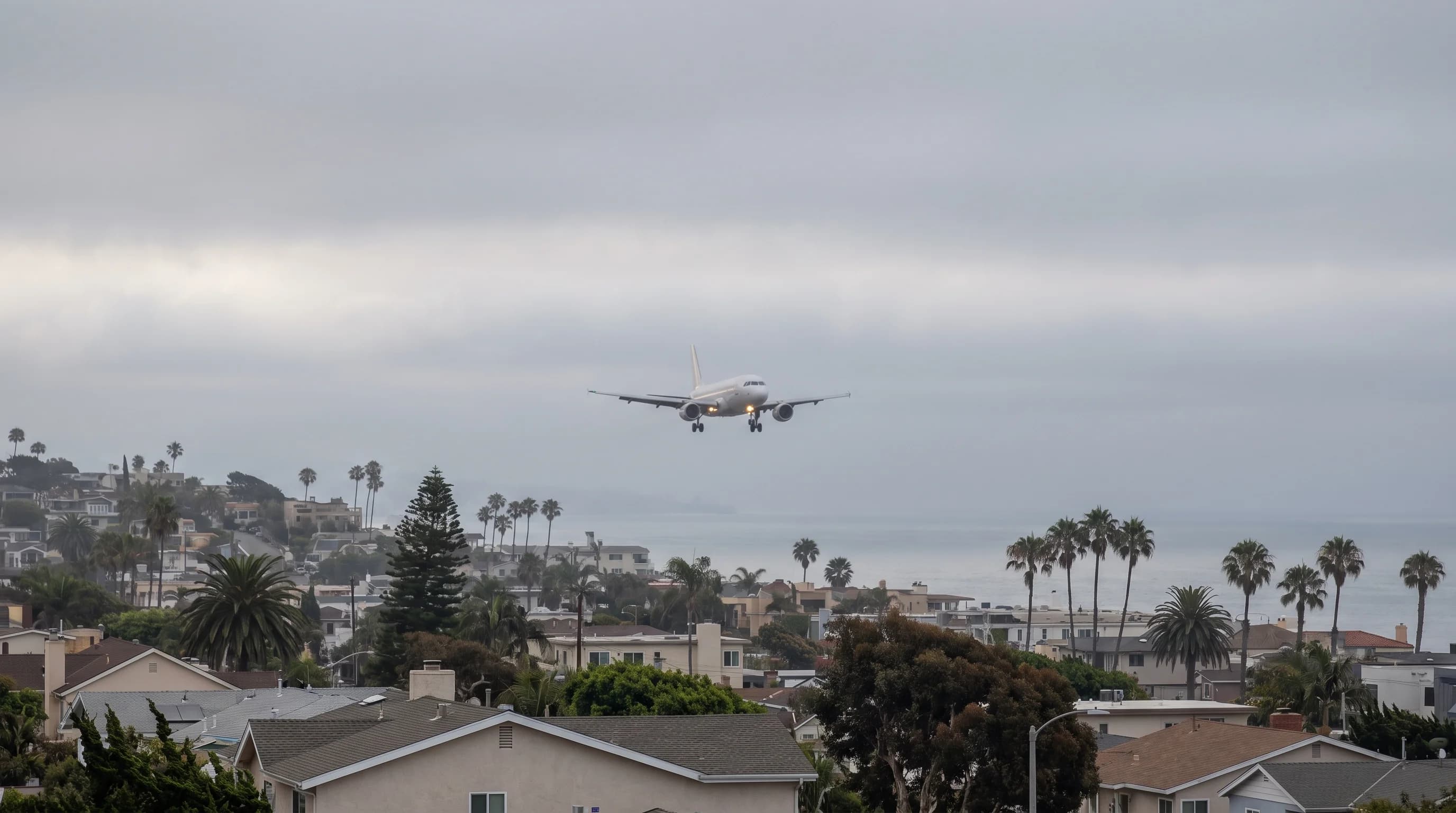
Most weather delays at LAX start with low clouds and fog from the marine layer, not storms. When the cloud ceiling drops below about 1,000 feet or visibility falls under 3 miles, fewer planes can land each hour. At LAX that happens most often in June, July and October, and worst between 3 and 7 a.m. Strong east winds occasionally reverse the runways, and winter storms add rain and gusty crosswinds.
Five years of hourly observations at LAX show a clear pattern. Around 6 a.m., the airport sits under low clouds or poor visibility about 18% of the time, nearly one hour in five. By 2 p.m., it is about 3%, one hour in thirty. If you can choose your flight time at LAX, early afternoon has the best weather odds.
| Question | Answer |
|---|---|
| Most common weather delay | Low clouds and fog from the marine layer |
| Worst time of day | 3 to 7 a.m., when 15% to 18% of hours have low ceilings or poor visibility |
| Best time of day | 1 to 4 p.m., about 3% of hours |
| Most low clouds | June and July, about 16% to 18% of hours |
| Densest fog | October, then December and November |
| Runway reversals (east winds) | Less than 5% of the time, mostly January to March |
Source: NCEI hourly observations at LAX, 2021-2025; Los Angeles World Airports.
What Weather Causes Flight Delays at LAX?
Flight delays at LAX come mainly from low ceilings and fog. LAX's runways end within about a mile of the ocean, directly under the marine layer, the cool, moist air that spreads gray stratus over the coast most nights from late spring into fall. In clear weather, pilots can fly visual approaches with tighter spacing.
In low clouds, planes fly instrument approaches with wider spacing, so the airport handles fewer arrivals per hour. When demand exceeds that reduced rate, the FAA can issue a ground delay program that holds LAX-bound flights at their departure airports.
Other weather causes delays less often: strong east winds, often Santa Anas, that force the runways to reverse, and winter storms that bring heavy rain, gusty crosswinds and the occasional thunderstorm.
What Time of Day Is LAX Most Likely to Be Fogged In?
LAX is most likely to be fogged in during the early morning. From 2021 to 2025, low ceilings or visibility showed up in 15% to 18% of hours between 3 and 7 a.m., and about 3% of hours between 1 and 4 p.m. The marine layer builds overnight as the air cools, peaks around sunrise, and usually burns back to the coast by late morning. It often returns in the evening, which is why the late-night hours climb back above 10%.
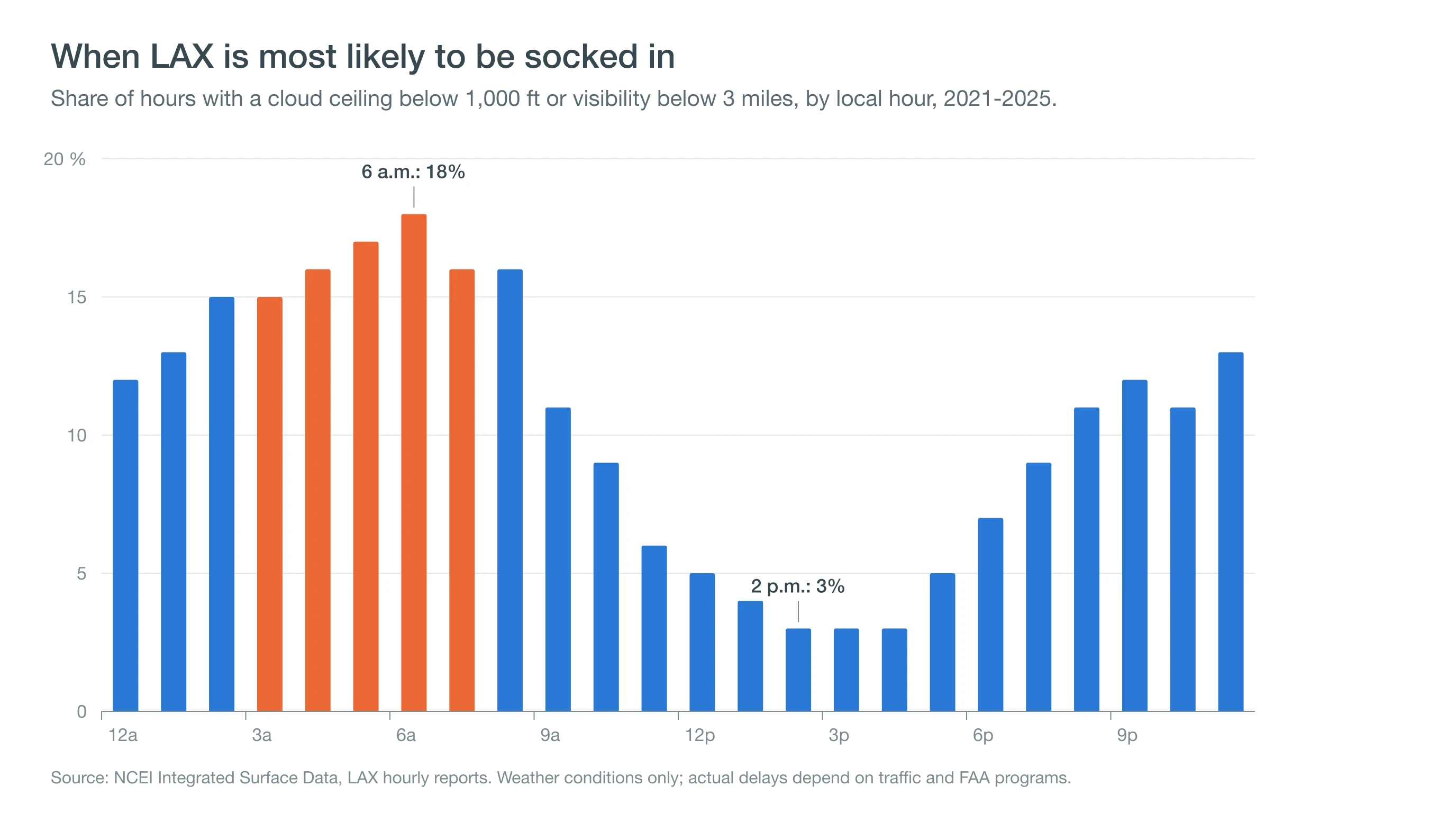
For travelers, that means the first departures and arrivals of the day are the flights most likely to slow down for low clouds, especially in June and July. Some summer mornings the gray thickens and lingers under a Catalina eddy, a spin in the coastal winds that deepens the marine layer.
Which Months Have the Most Low Clouds and Fog at LAX?
LAX has the most low clouds in June and July, and the most dense fog in October. In July, about 17.6% of hours had a ceiling below 1,000 feet or visibility below 3 miles. Dense conditions, with ceilings under 200 feet or visibility under half a mile, follow a different pattern. They peak in October at 2.7% of hours, followed by December and November, when long, calm nights let fog form right at runway level. January through May are the clearest months, apart from storm days.
| Month | Ceiling under 1,000 ft or visibility under 3 mi | Ceiling under 200 ft or visibility under 1/2 mi |
|---|---|---|
| January | 6.5% | 0.8% |
| February | 8.5% | 1.2% |
| March | 7.5% | 0.7% |
| April | 8.5% | 0.6% |
| May | 7.3% | 0.1% |
| June | 16.0% | 0.2% |
| July | 17.6% | 1.1% |
| August | 9.6% | 0.4% |
| September | 8.7% | 0.6% |
| October | 14.2% | 2.7% |
| November | 9.9% | 1.4% |
| December | 11.2% | 1.8% |
What Happens at LAX During Santa Ana Winds?
During strong Santa Ana winds, planes at LAX take off and land in the opposite direction from normal. Planes take off and land into the wind, and at LAX the wind almost always comes off the ocean, so aircraft normally land toward the west and depart over the Pacific. When strong east winds blow, the FAA switches to easterly operations: arrivals come in from the ocean and departures climb out over the city.
Airport officials say that happens less than 5% of the time. In the 2021-2025 data, east winds of 10 knots or more showed up in about 2% to 3% of hours from January through March and almost never from May to November.
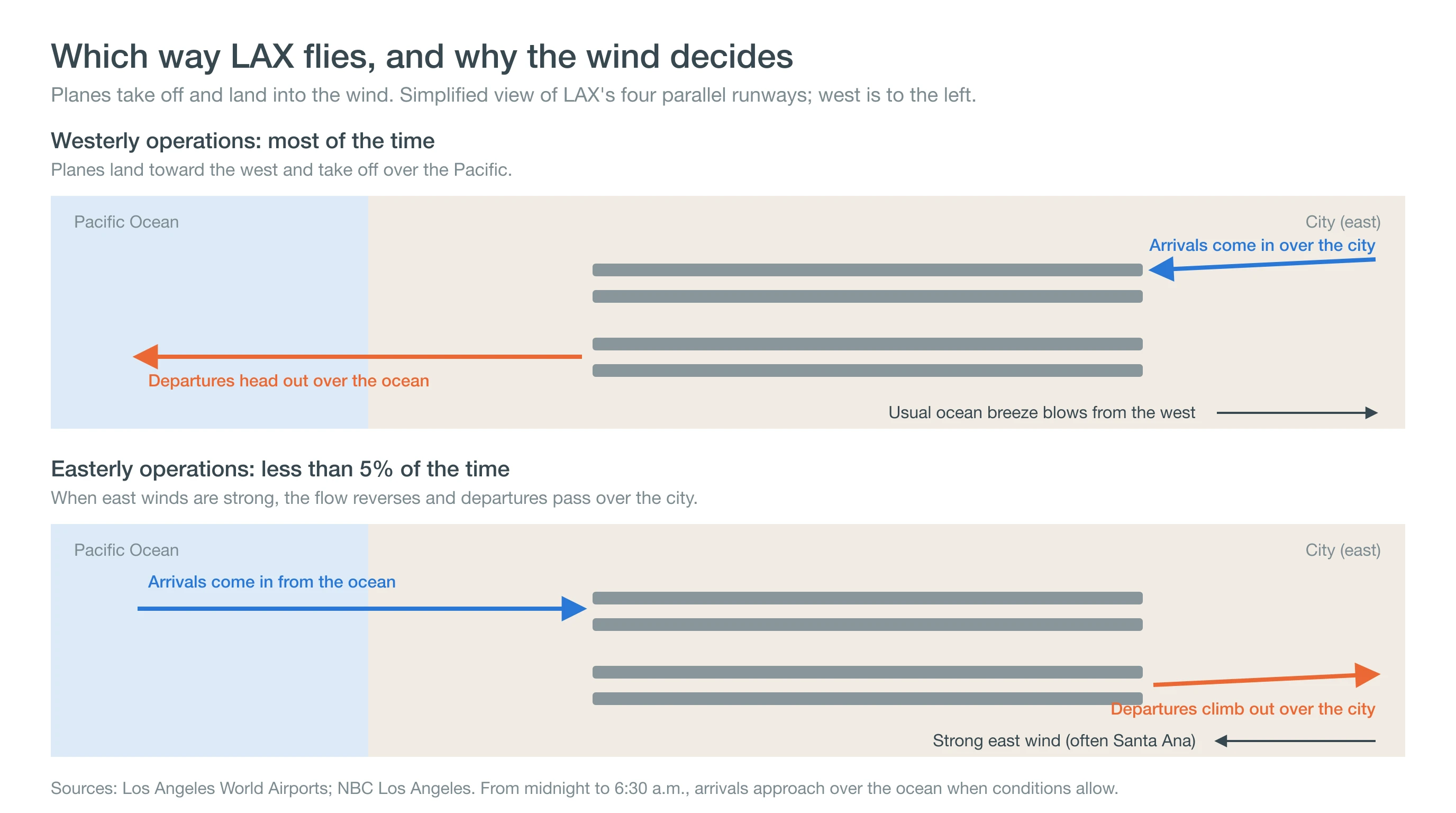
Switching directions slows traffic while the airport changes over, and east wind days are often gusty and turbulent on climb-out. Separately, from midnight to 6:30 a.m. LAX brings arrivals in over the ocean for noise relief, a procedure in place since 1973, whenever weather and traffic allow. For what gusty winds do to aircraft near the ground, see wind shear over LA airports and the wind hazards guide.
Can Weather Somewhere Else Delay Your LAX Flight?
Weather somewhere else often delays LAX flights. If San Francisco is fogged in or a storm is moving through Denver or Chicago, the FAA may hold flights bound there, including yours at LAX, and your inbound plane may be late from its previous stop. The Bureau of Transportation Statistics tracks this in two categories: "extreme weather," and National Aviation System delays, which include ordinary weather along with traffic volume and air traffic control. A sunny afternoon in Los Angeles is no guarantee of an on-time departure.
In Los Angeles itself, rain matters mainly in winter. LAX averages about 12.2 inches a year, most of it from November to March, and the storms that bring it are covered in what a wet LA winter looks like.
How Do You Check LAX Delays Before Leaving for the Airport?
To check LAX delays before leaving for the airport, start with the FAA's National Airspace System Status page, which shows airport-wide ground delay programs and ground stops at LAX and the airports you are flying to. Your airline's app shows your specific flight, including the status of the inbound aircraft. Then look at the weather: if the hourly forecast shows low clouds lingering past mid-morning, or a wind shift to the east, expect delays.
LAX's weather follows a predictable daily pattern: gray at dawn, clear by lunch, with a handful of wind and storm days each winter. Book early-afternoon flights when you can, allow extra time on gray summer mornings, and check the conditions for El Segundo, just south of the runways, and Inglewood, just east, before you head out.